- Netherlands Investment Law 2026: What the Dutch Box 3 Tax Reform Means for Your Money
- Introduction: A Tax Change That Is Shaking Dutch Investors to Their Core
- What Is the Dutch Box 3 Tax System?
- A Quick Background on How Dutch Taxation Works
- What the Reform Actually Changes
- Taxing Unrealized Gains: Fair Reform or Financial Overreach?
- What Are Unrealised Gains?
- Feature Old System (Pre-2026) New System (2026 Reform)
- The Liquidity Problem
- Capital Flight: Are Wealthy Dutch Investors Already Leaving?
- The Early Warning Signs
- Mini Case Study: What Sweden’s Wealth Tax Taught Europe
- What the IMF and World Bank Say About Wealth Taxes in 2026
- Practical Impact: What Does This Mean for Different Types of Investors?
- For Savers
- For Stock Market Investors
- For Property Investors
- For Expats and International Investors
Netherlands Investment Law 2026: What the Dutch Box 3 Tax Reform Means for Your Money
Key Takeaways
- The Dutch Box 3 tax reform now taxes actual returns rather than a fictional assumed return — a major shift for investors.
- Unrealized gains in the Netherlands may soon be taxed, raising serious concerns about fairness and capital flight.
- Wealthy Dutch investors are already exploring moves to Belgium, Portugal, and the UAE to avoid the new rules.
- The IMF has flagged wealth tax designs like Box 3 as potentially distorting investment behaviour across Europe.
- Whether you invest in stocks, property, or funds, understanding this law change could save you thousands.
Introduction: A Tax Change That Is Shaking Dutch Investors to Their Core
Imagine you bought shares in a company. The shares have gone up in value — but you have not sold them. You have not seen a single euro of profit land in your bank account. And yet, the Dutch tax authority sends you a bill. You owe tax on money you have never actually received.
That is not a hypothetical nightmare. For many investors in the Netherlands, that is becoming the reality of 2026.
The Netherlands Investment Law 2026, built around the reformed Dutch Box 3 tax system, represents one of the most significant shifts in European personal finance taxation in decades. And the ripple effects are already being felt — not just in Amsterdam and Rotterdam, but across the entire European investment landscape.
For years, the Dutch Box 3 system worked on a simple — some would say lazy — assumption. The tax authority did not bother calculating what you actually earned on your savings and investments. Instead, they assumed you earned a fixed, fictional return and taxed you on that. If the assumed return was 4% but you actually earned 1%, you were overtaxed. If you earned 10%, you got a relative bargain.
The Dutch Supreme Court put a stop to all that in 2021, ruling that the old system was unlawful. The government scrambled. They patched it temporarily. And now, in 2026, the new permanent system is here — and it is making investors very, very nervous.
This article breaks down exactly what has changed, what it means for your investments, what the data says, and what you should be thinking about right now. Whether you are a Dutch resident, an expat investing in the Netherlands, or simply someone watching how Europe handles wealth taxation, this is essential reading.
The stakes are high. Capital is already moving. Decisions made in 2026 could define your financial position for the next decade.
Let us get into it.
What Is the Dutch Box 3 Tax System?
A Quick Background on How Dutch Taxation Works
The Netherlands divides personal income into three categories, called “boxes.”
Box 1 covers income from work and your primary home — your salary, freelance income, pension, and the deemed rental value of your own house. Tax rates here are progressive, going up to around 49.5%.
Box 2 covers income from a substantial shareholding — typically when you own 5% or more of a company. Dividends and capital gains from those shares are taxed here.
Box 3 is where things get interesting — and where the 2026 reform bites hardest. Box 3 covers savings, investments, and second properties. This is the box that taxes your wealth rather than your earned income.
Under the old system, the Dutch government assumed everyone earned a theoretical return on their Box 3 assets — regardless of what they actually earned. This assumed return was then taxed at a flat rate. It was simple. It was also, as the courts decided, fundamentally unjust.
What the Reform Actually Changes
The new Box 3 system, phased in and now taking full effect from 2026, moves toward taxing actual returns. That means:
- Actual interest earned on savings accounts is taxable.
- Actual dividends received from shares are taxable.
- Actual rental income from second properties is taxable.
- And here is the controversial part: unrealized capital gains — the increase in value of assets you still hold — are also included in the calculation for some asset categories.
This last point is where the real debate is happening.
Taxing Unrealized Gains: Fair Reform or Financial Overreach?
What Are Unrealised Gains?
An unrealized gain is simply the paper profit on an asset you still own. If you bought shares for €10,000 and they are now worth €15,000, you have an unrealized gain of €5,000. You have not sold. You have not received any cash. But on paper, you are €5,000 richer.
Most countries — including the UK, the US, and Germany — do not tax unrealized gains. You only pay capital gains tax when you sell the asset and actually receive the profit. This approach is widely regarded as fair because you are only taxed when you actually have the money to pay the tax.
The Netherlands, under certain interpretations of the new Box 3 rules, moves closer to taxing these paper gains. This is legally and philosophically controversial, and it is one of the core reasons wealthy Dutch investors are paying attention.
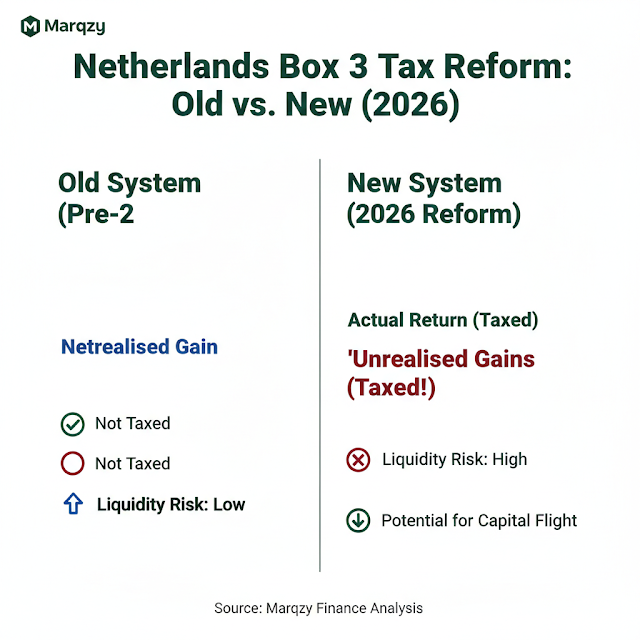
Feature Old System (Pre-2026) New System (2026 Reform)
The Liquidity Problem
Here is a real and practical problem with taxing unrealized gains: you might not have the cash to pay the tax.
Suppose you own a second property in Amsterdam that has risen sharply in value, as Dutch property has done for many years. You are being taxed on that rise in value. But your rental income might not cover the tax bill. You would need to sell assets, take out a loan, or use savings from elsewhere.
This is not theoretical. It is already a conversation happening in Dutch financial planning circles right now.
Capital Flight: Are Wealthy Dutch Investors Already Leaving?
The Early Warning Signs
Capital flight — when wealthy individuals or businesses move their money (or themselves) to lower-tax jurisdictions — is not new. It happened in France after François Hollande introduced a 75% supertax in 2012. It happened in Sweden when its wealth tax pushed high earners out. And analysts at Marqzy Finance are now flagging similar early warning signs in the Netherlands.
Reports from Dutch financial advisers in early 2026 suggest a notable increase in enquiries about residency in:
- Belgium, which has no capital gains tax for individual investors
- Portugal — popular with expats due to its Non-Habitual Resident (NHR) tax regime
- The UAE, which has zero personal income tax
These are not fringe cases. These are mainstream conversations being had by doctors, entrepreneurs, and long-term investors who have built up substantial wealth over decades and are now questioning whether the Netherlands remains the right place to hold it.
Mini Case Study: What Sweden’s Wealth Tax Taught Europe
Sweden offers a powerful cautionary tale. For decades, Sweden operated a wealth tax. By the early 2000s, economists at the Swedish government’s own research institutes were documenting serious capital outflows. IKEA founder Ingvar Kamprad famously relocated to Switzerland. The Swedish football manager Sven-Göran Eriksson and dozens of other high-profile Swedes moved abroad.
In 2007, Sweden abolished its wealth tax entirely. The decision was based not on ideology but on evidence: the tax was raising relatively little revenue while driving significant talent and capital out of the country.
The World Bank, in its 2019 review of wealth taxation in OECD countries, noted that poorly designed wealth taxes frequently collect less revenue than projected while generating substantial economic distortions. The Dutch government is aware of this research. The question is whether the Box 3 reform has been designed carefully enough to avoid the same outcome.
What the IMF and World Bank Say About Wealth Taxes in 2026
The IMF’s Fiscal Monitor report has repeatedly highlighted the tension between equity (fairness) and efficiency (economic impact) in wealth taxation. The Fund acknowledges that taxing wealth can reduce inequality — but warns that execution matters enormously. Systems that tax unrealized gains without adequate liquidity provisions or instalment payment options risk forcing asset sales, destabilizing markets, and ultimately collecting less than planned.
In the context of global trade policy in 2026 — with tariff uncertainty, higher interest rates, and sluggish European growth — the IMF has specifically warned that European governments should be cautious about layering additional investment disincentives onto an already fragile investment climate.
The Netherlands, historically one of Europe’s most investment-friendly economies, is navigating this tension in real time.
Practical Impact: What Does This Mean for Different Types of Investors?
For Savers
If your money sits in a savings account earning interest, the reform actually simplifies things. You pay tax on the interest you actually receive. This is likely fairer than the old system for many ordinary savers who were previously overtaxed on assumed returns that exceeded their actual earnings.
For Stock Market Investors
This is where it gets more complicated. If you hold a diversified portfolio of shares, any dividends you receive will be taxable as actual income. The treatment of unrealized capital gains on shares is still being clarified through court cases and legislative guidance. Stay close to Dutch tax news throughout 2026.
For Property Investors
Rental income from second properties is now taxed on actual amounts received. For property that has risen sharply in value, the deemed return calculation still applies in certain scenarios, meaning your tax bill could be higher than your actual cash income from the property.
For Expats and International Investors
If you are a foreign national investing in Dutch assets, or a Dutch national with assets abroad, the interaction of the new Box 3 rules with international tax treaties is a specialist area. Get advice from a cross-border tax adviser before making any decisions.
What Should Investors Do Right Now?
Here are practical steps worth considering in light of the Netherlands Investment Law 2026:
Review your asset allocation. Understand what sits in your Box 3 and how each asset category is treated under the new rules.
Speak to a Dutch tax specialist. The rules are still being refined. A qualified belastingadviseur (Dutch tax adviser) can give you scenario-specific guidance.
Consider the timing of realizations. If you are planning to sell assets, the timing of that sale relative to the tax year matters more now than it did before.
Do not panic-move. Relocating to avoid taxes is a significant life decision. The costs — financial, personal, and administrative — are real. Model it properly before acting.
Watch the court cases. Several legal challenges to elements of the new Box 3 system are working their way through Dutch courts. Rulings could change the picture meaningfully.
Frequently Asked Questions
What is the Dutch Box 3 tax reform in simple terms?
Box 3 is the part of Dutch tax law that covers savings and investments. It used to tax a fictional assumed return. Now it taxes what you actually earn — which sounds fair, but the detail of how unrealized gains are treated has caused significant concern among investors.
Will I be taxed on investments I have not sold yet?
For some asset categories, yes. The treatment of unrealized gains is one of the most contested aspects of the reform and is still subject to legal challenge. You should seek advice from a qualified tax professional tailored to your individual situation.
Is the Netherlands still a good place to invest in 2026?
The Netherlands remains a stable, transparent, and well-regulated market. The tax reform introduces uncertainty, but the country’s fundamentals — rule of law, strong financial infrastructure, EU membership — remain excellent.
Are Dutch investors really leaving the country?
Some high-net-worth individuals are exploring relocation. But the numbers so far are modest. Whether this becomes a meaningful trend depends on how the government refines the rules over the next 12–18 months.
How does the Netherlands compare to Belgium for investors?
Belgium has no capital gains tax on individual share investments, which makes it attractive. However, Belgium has its own complexities — including a financial transactions tax and different treatment of rental income. A direct comparison requires specialist advice.
What did the Dutch Supreme Court say about the old Box 3 system?
In December 2021, the Dutch Supreme Court ruled that the old Box 3 system violated European human rights law because it taxed fictional returns rather than actual returns, meaning some taxpayers paid more tax than their actual investment income.
Is this related to global trade policy in 2026?
Indirectly, yes. Global uncertainty — including tariff changes, inflation, and slower European growth — makes investment decisions more sensitive to tax changes. The Box 3 reform lands at a moment when investors are already reassessing their European exposure.
What is Marqzy Finance’s view on the reform?
Analysis from Marqzy Finance suggests the reform introduces meaningful uncertainty for medium-to-long-term Dutch investors, particularly those with illiquid assets like property. The recommendation is to model scenarios carefully rather than react impulsively.
Conclusion: Stay Informed, Stay Calm, Stay Invested — Wisely
The Netherlands Investment Law 2026 and the Dutch Box 3 tax reform are not reasons to panic. But there are absolutely reasons to pay attention.
The shift from fictional to actual returns is, in principle, a more just system. The controversy lies in the details — particularly around unrealized gains and liquidity. These details are still being shaped by courts, advisers, and the Dutch legislature itself.
What the broader picture tells us — from Sweden’s experience, from IMF warnings, from the early capital flight signals — is that how a wealth tax is designed matters enormously. Get it right, and it is fair and functional. Get it wrong, and capital leaves, revenues disappoint, and you end up worse off than before.
If you invest in the Netherlands, or are thinking about it, the single most important thing you can do right now is get informed. Talk to a specialist. Model your specific situation. And watch how the legal challenges develop over the coming months.
Your money deserves that attention.
Disclaimer: All content published on Marqzy is for educational and informational purposes only and should not be construed as financial advice. We are not SEBI-registered financial advisors. Investments in the stock market, mutual funds, or other financial instruments carry inherent risks. Please seek advice from a qualified financial professional and perform independent due diligence before investing. Marqzy shall not be held liable for any financial loss incurred.