- In Less Than 20 Hours, Walmart CEO Doug McMillon Matches the Average U.S. Annual Salary—Making $1,563 in Just 30 Minutes.
- A Shocking Commute to Wealth
- Who Is Doug McMillon and How Did He Get Here?
- The Bigger Picture: CEO Pay Trends in the US
- Impacts of Income Inequality on Society
- Conclusion: Time for Change?
In Less Than 20 Hours, Walmart CEO Doug McMillon Matches the Average U.S. Annual Salary—Making $1,563 in Just 30 Minutes.
- Research suggests that Walmart CEO Doug McMillon’s high pay highlights growing income gaps, where top executives earn hundreds of times more than average workers, though some argue it rewards company success.
- It seems likely that such disparities contribute to wider economic inequality in the US, with the top 10% holding most wealth, but views differ on whether this motivates innovation or harms society.
- The evidence leans toward the need for balanced policies, as global trends show that within-country inequality is rising, affecting everything from wage growth to social stability.
A Shocking Commute to Wealth
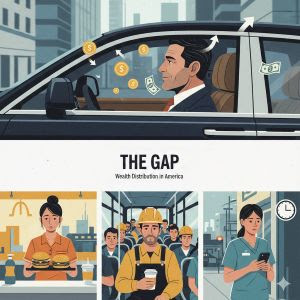
Imagine starting your day with a simple 30-minute drive to work. For most people, that’s just time to listen to the radio or think about the day ahead. But for Walmart’s outgoing CEO Doug McMillon, that short commute means earning $1,563—more than many Americans make in a full day. This fact alone shows the huge difference between top executives and everyday workers. In less than 20 hours, McMillon earns what the average American takes home in a whole year, around $62,088. It’s a story that makes us stop and think about fairness in pay.
Doug McMillon has led Walmart since 2014, turning it into a giant retail company with shops everywhere. His total pay for 2025 was about $27.5 million, including a base salary of $1.5 million, stock awards worth $20.4 million, and bonuses of $4.4 million. That’s $75,000 a day, $3,127 an hour, or $52 a minute. Every second, he makes nearly $1. These numbers come from recent reports as he gets ready to retire at the end of January 2026.
This isn’t just about one person—it’s part of a bigger picture. In the US, CEO pay has grown much faster than worker wages. In 2024, CEOs earned 281 times what a typical worker did, up from just 21 times in 1965. For low-wage companies like Walmart, the gap is even wider, at 930 times the median employee pay. Walmart’s median worker earns about $29,469 a year, while McMillon takes home
millions.
Why does this matter? Income inequality can make life harder for many people. Lower-income workers saw their wages grow only 1.3% in July 2025, compared to 3.2% for higher earners. This divide is the widest in four years. Globally, inequality between countries has fallen, but inside countries like the US, it’s rising. The IMF says this happens mostly in advanced economies, where the rich get richer faster.
But not everyone sees it as a problem. Some say high CEO pay is fair because leaders like McMillon create value for the company, helping it grow and create jobs. Walmart employs millions, and under McMillon, it has expanded online and improved worker benefits. Still, the question remains: is this level of pay needed, or is it too much?
In this post, we’ll look at the facts, trends, and what it means for all of us. We’ll use data from trusted sources like the IMF, World Bank, and Federal Reserve to give a balanced view. Let’s dive in.
Who Is Doug McMillon and How Did He Get Here?
Doug McMillon started at Walmart as a teenager, unloading trucks for $6.50 an hour. That’s a far cry from his current earnings of $3,127 per hour—a 481 times increase. Born in 1966, he joined the company in 1984 while studying. Over the years, he climbed the ladder, becoming CEO in 2014. Under his leadership, Walmart’s sales grew to over $600 billion, and it became a leader in e-commerce.
McMillon’s story is inspiring, showing how hard work can lead to success. But it also highlights opportunity gaps. Not everyone begins on equal footing, and many workers remain stuck in low-paying jobs. According to the World Bank, economic inequality affects growth and stability, with poorer countries struggling more. In the US, the Federal Reserve notes that the top 10% of households hold 67.2% of wealth, averaging $8.1 million each.
Breaking Down McMillon’s Pay Package
Let’s look at the numbers. McMillon’s 2025 compensation included:
- Base salary: $1.5 million
- Stock awards: $20.4 million
- Incentives: $4.4 million
Total: $27.5 million
Compared to the average American’s $62,088 annual salary (from BLS 2025 data), he earns that in about 19.86 hours. In a 30-minute commute, that’s $1,563. He could buy a median US home ($439,000) in just 5.85 days.
|
|---|
This table shows how most CEO pay comes from stocks, linking it to company performance. But critics say this encourages short-term gains over long-term fairness.
The Bigger Picture: CEO Pay Trends in the US
CEO pay has skyrocketed. In 2024, average S&P 500 CEO pay was $18.9 million, up 7% from the year before. For low-wage firms, the ratio is 632:1. Walmart’s is higher at 930:1.
The IMF reports that within-country inequality has risen in advanced economies over three decades. The World Bank notes global inequality increased from 1820 to 1990 but has stabilised, yet gaps persist. The Federal Reserve highlights moderate rises in consumption inequality compared to income.
Between 2019 and 2024, CEO compensation at low-wage firms climbed 34.7%, while worker wages rose just 16.3%. Billionaire wealth grew to $33 trillion from 2015 to 2025.
Why Do CEOs Earn So Much? Arguments For and Against
On one side, high pay attracts top talent and rewards value creation. For example, McMillon’s leadership boosted Walmart’s stock. Companies are larger today, so CEOs manage more, justifying their pay.
On the other hand, it fuels inequality. EPI says CEOs set their own pay through power, not just performance. High gaps can hurt teamwork.
Practical tips: Companies can adopt pay ratios, like limiting CEO pay to 100 times the median worker. Workers can join unions for better wages.
Impacts of Income Inequality on Society
Inequality affects growth, health, and politics. The World Bank says it hinders poverty reduction. In the US, lower wages mean less spending and a slowing economy.
Examples: In Brazil, high inequality leads to social unrest. US workers in low groups see slow wage growth.
Mini Case Study: Tesla and Elon Musk’s Pay
Tesla’s Elon Musk had a $1 trillion pay package in 2025, but it was tied to performance goals. This made Tesla’s value soar, creating jobs and innovation in electric cars. However, workers at Tesla earn a median of $50,000, leading to a huge gap. Critics say it widens inequality, while defenders note Musk’s risk-taking grew the company from startup to giant. This case shows how high CEO pay can drive success but spark debates on fairness, per Oxfam studies.
Conclusion: Time for Change?
Doug McMillon’s pay shows the stark reality of income gaps in America. While it rewards success, it also points to unfairness that affects millions. As inequality rises, we need balanced approaches. What do you think? Share in the comments or subscribe for more insights.
FAQs
Why is CEO pay so high compared to that of workers?
CEO pay often includes stocks and bonuses tied to company performance. It attracts talent, but power imbalances let boards approve high packages. In 2024, it was 281 times a worker’s pay. Trending now: With inflation, people ask if this worsens the cost-of-living crisis.
Does high CEO pay affect the economy?
Yes, it can increase inequality, reducing consumer spending. But some say it drives growth. IMF notes rising within-country gaps slow progress. Current trend: Debates on tax reforms to redistribute.
Is the pay gap widening?
Absolutely, from 2019-2024, CEO pay rose faster than workers’. Trending question: How does AI affect this, with tech CEOs earning more?
What can workers do about inequality?
Join unions, learn skills, or vote for fair policies. Examples: Walmart workers pushed for higher wages.
Are there companies with fairer pay?
Yes, like employee-owned firms. Apis & Heritage funds help reduce gaps. Trending: Interest in co-ops amid 2026 elections.