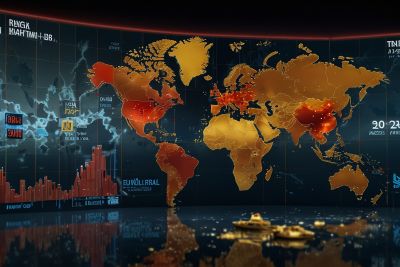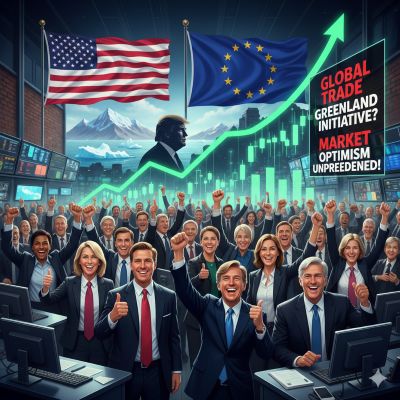
- Markets reversed course, with the S&P 500 and Dow Jones jumping more than 1% as Trump’s comments soothed tariff-driven anxiety.
- Geopolitical Easing: The pause on tariffs reduces immediate risks in international trade relations, particularly with the EU, fostering positive global market news.
- Economic Implications: This move highlights shifts in US economic news, with potential benefits for stock market trends and reduced volatility in 2026 under Trump’s trade policy.
- Broader Outlook: Investors should watch Davos Summit developments for ongoing market sentiment and geopolitical risk assessments.
Introduction
Global markets reacted swiftly after Donald Trump paused planned tariffs linked to U.S. ambitions in Greenland. The announcement came after discussions at Davos with NATO chief Mark Rutte, during which a framework for continued dialogue on Greenland and the Arctic was outlined. By explicitly rejecting military action, Trump helped calm geopolitical tensions, reversing an earlier market downturn and lifting Wall Street.
A tariff threat from Donald Trump sparked a market shock, with proposed 10% duties—set to climb to 25%—on imports from eight European countries. The targets had resisted U.S. efforts related to Greenland, citing sovereignty concerns. Unveiled days before Davos, the move rekindled memories of earlier U.S.–EU trade battles. Renewed trade fears drove a sharp sell-off, sending the S&P 500 down 2.1%.
Momentum turned after Trump wrote on Truth Social that a “very productive meeting” had yielded a framework for a future Greenland deal, explicitly stating that tariffs would not be imposed. The pivot removed near-term trade pressure and highlighted the stop-start nature of U.S. trade policy in 2026. With geopolitical risk fading, investors re-entered risk assets, lifting the Dow more than 700 points and sending the S&P 500 and Nasdaq up 1.5% and 1.6%, respectively.
The episode underscores the deep interconnection between U.S. policy decisions and global markets. Against the backdrop of Davos, leaders weighed Arctic security, trade flows, and financial stability. For investors and businesses, the pause offers short-term relief for equities, even as policy uncertainty persists. Next, we examine the key takeaways and what they mean for portfolios and strategy.
Understanding the Greenland Tariffs and Trump’s Policy Shift
Background on Trump’s Greenland Ambitions
Greenland, an autonomous territory of Denmark, has long caught Trump’s eye due to its strategic Arctic location and resources like rare earth minerals. In 2026, amid rising tensions with Russia and China in the region, Trump renewed his call for US acquisition, framing it as a national security imperative. However, European allies viewed this as overreach, leading to the tariff threats as leverage.
The proposed tariffs targeted key exports, potentially affecting $100 billion in US goods if retaliated against, according to estimates from the Wall Street Journal. This escalated geopolitical risk, with EU leaders like French President Emmanuel Macron calling it “blackmail.” At the Davos Summit, Trump’s speech ruled out force but emphasized negotiations, setting the stage for the pause.
How the Tariff Pause Happened
Following a Davos meeting with NATO Secretary-General Mark Rutte, Trump announced on Truth Social that he would not proceed with the February 1 tariffs. Denmark welcomed the de-escalation, with its foreign minister saying the day “ended better than it started.
The move aligns with Trump’s broader 2026 trade policy, which uses tariffs as bargaining tools. As he stated in past posts, “Mister Tariff” drives market highs, with the S&P 500 hitting records despite volatility.
Immediate Market Reaction and Stock Market Trends
After a 2% tariff-driven drop, Wall Street rebounded strongly—Dow +722 points, S&P 500 +1.47%, Nasdaq +1.6%—as volatility eased and sentiment improved.
Gold hit record highs amid uncertainty but eased post-announcement, while US bonds and stocks recovered. Global market news echoed this: European stocks steadied, and Asian markets watched closely.
Geopolitical Risk and International Trade Relations
EU Trade Ties Under Strain
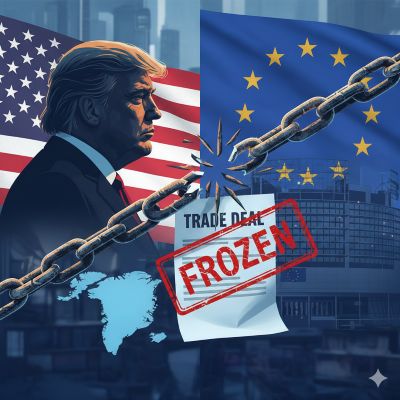
The EU suspended ratification of a July 2025 US trade deal—agreed at Trump’s Turnberry golf club—over the Greenland threats. This deal aimed for zero tariffs on industrial goods, but Bernd Lange, the EU Parliament trade chair, halted progress until threats cease. The European Parliament has formally suspended the ratification of the July 2025 ‘Turnberry’ trade deal as a retaliatory measure.
The CBOE Volatility Index (VIX) retreated from its 24-hour peak as safe-haven demand for Gold eased.
Such actions highlight fragile European Union trade ties. According to the IMF, intensifying tariff tensions risk cutting global GDP by around 0.5%, echoing 2025 patterns of growing trade restrictions. World Bank reports similarly note that US-EU trade, worth $1.2 trillion annually, faces risks from protectionism.
Davos Summit’s Role in De-escalation
At Davos, Trump blasted European leaders but later softened, ruling out force. The summit, themed around global cooperation, became a pivotal arena for resolving tensions. Discussions on Arctic securityare tied into broader international trade relations, with NATO’s involvement signaling alliance strains.
Federal Reserve minutes from late 2025 indicate that such geopolitical risks could influence US interest rates, potentially delaying cuts if volatility persists.
US Economic News and Broader Implications
Impact on Stock Market Trends
This event fits into 2026 Trump trade policy patterns, where threats followed by pauses drive market swings. Hedge funds gained $628 billion in 2025, shifting from private equity amid bubble fears. Diversification remains key, with tech and energy offering relative resilience.
Staying on top of U.S. market moves is easier with Yahoo Finance, while S&P 500–tracking ETFs offer a simple way to gain diversified market exposure.
Mini Case Study: Novo Nordisk and Tariff Impacts
Take Novo Nordisk, Denmark’s pharma giant behind insulin drugs like Ozempic. Tariffs threatened a 10% hit on its $12 billion US exports, potentially raising prices for American patients. Shares dropped 5% on initial news but rebounded 3% post-pause.
This mirrors broader effects: John Deere, a US firm with European exposure, saw similar volatility in past trade spats. Company disclosures show that tariffs drove a 15% rise in Deere’s costs in 2018, prompting the company to raise prices. Today, with Greenland resolved temporarily, Deere-like firms benefit from stable supply chains.
Stats from the Federal Reserve show US manufacturing PMI improved to 50.3 in early 2026, signaling expansion amid eased risks.
Practical Tips for Investors Amid Geopolitical Risk
- Diversify Portfolios: Balance US stocks with international bonds to hedge against Trump trade policy shifts.
- Stay Informed: Follow global market news via sources like Reuters or CNBC.
- According to the IMF, global growth could reach roughly 2.8% in 2026 as major disputes are resolved.
Conclusion
Trump’s pause on Greenland tariffs marks a win for market sentiment, easing geopolitical risk and strengthening European Union trade ties for now. While Wall Street rises, it reminds us of the delicate balance in international trade relations andthe 2026 Trump trade policy. As Davos Summit talks continue, expect more twists in global market news.
Stay ahead—subscribe to our newsletter for updates on stock market trends and US economic news. What are your thoughts on this development? Comment below!
FAQs
What are the Greenland tariffs, and why did Trump pause them?
The tariffs were 10% levies on European goods, which threatened to pressure nations opposing the US control of Greenland. Trump paused them after Davos talks yielded a framework deal, reducing immediate geopolitical risk.
How did this affect stock market trends?
Markets dropped sharply on threats but rebounded with gains of over 1%, reflecting positive market sentiment. Trending question: Will tariffs return if talks fail? Analysts say yes, per Reuters.
What’s the impact on European Union trade ties?
The EU froze a trade deal ratification, straining relations. Trending: How might this evolve? World Bank notes potential 0.3% EU GDP hit if escalated.
Is geopolitical risk still high in 2026, under Trump’s trade policy?
Yes, with Arctic ambitions ongoing. Trending: Could force be used? Trump ruled it out, but White House says “all options on the table.
What should investors do amid US economic news like this?
Diversify and monitor Davos Summit outcomes. Trending: Gold as a safe haven? It hit records during uncertainty.
Disclaimer: All content on Marqzy is for educational purposes only and is not financial advice. We are not SEBI-registered advisors. Investments carry risks; please consult a professional and perform your own due diligence before investing. Marqzy is not liable for any financial losses.