Tim Cook vs Lawmakers as Oracle’s AI Soars
- Tim Cook’s Capitol Hill Showdown and Oracle’s Earnings Surge: Big Tech’s Power Plays in 2025
- Key Takeaways
- Tim Cook’s Capitol Hill Gamble: Privacy vs. Protection in the Age of Apps
- The Backdrop: Why Child Safety Bills Are Blowing Up Now
- Cook’s Pitch: The Privacy Power Play
- What Happens Next? Betting on Outcomes
- Oracle’s Q2 Earnings Deep Dive: AI Cloud Kings or Capex Caution?
- Headline Numbers: Growth Galore, With a Side of Skepticism
- AI’s Double-Edged Sword: Boom and Bills
- How Cook’s Fight Echoes Oracle’s Bets
- Tips for Navigating This Noise
- Frequently Asked Questions (FAQs)
- 1. Why did Tim Cook visit Capitol Hill in December 2025?
- 2. Did Oracle beat earnings expectations in Q2 FY2026?
- 3. How does AI factor into Oracle’s growth?
- 4. Will child safety laws hurt Apple’s App Store?
- 5. What’s the link between Cook’s visit and Oracle earnings?
- 6. How can investors react to these events?
Tim Cook’s Capitol Hill Showdown and Oracle’s Earnings Surge: Big Tech’s Power Plays in 2025
Key Takeaways
- Tim Cook’s Privacy Push: Apple’s CEO lobbied lawmakers against strict age verification rules, arguing they risk kids’ data security while offering parental controls as a better fix.
- Oracle’s Cloud Explosion: Q2 revenue hit $16.1B, up 14%, with cloud services soaring 34% on AI demand—though a revenue miss and huge capex plans spooked some shares.
- Investor Alert: These events highlight tech’s tightrope between regulation and growth; watch for policy shifts impacting Apple and Oracle’s $500B+ valuations.
- AI and Ethics Link: Oracle’s earnings underscore AI’s revenue rocket, but Cook’s talks remind us of the privacy pitfalls in a data-hungry world.
- Market Ripple: Post-earnings, Oracle dipped initially but rebounded on TikTok deal buzz; Apple’s stock held steady amid broader tech volatility.
Imagine this: It’s a crisp December morning in Washington, D.C., 2025. The air buzzes with the usual Capitol Hill chatter—lobbyists in sharp suits, aides juggling coffees and tablets. But today, there’s an extra spark. Apple CEO Tim Cook, the man behind the world’s most valuable company, strides through the marble halls. He’s not here for selfies or small talk. No, Cook’s on a mission to shape the future of how kids surf the web safely. Meanwhile, across the country in Austin, Oracle drops earnings numbers that could make or break investor faith in the AI hype train. It’s December 10th, and in one wild day, two tech titans remind us why Big Tech never sleeps.
Let’s rewind a bit. You’ve probably heard the headlines: “Tim Cook’s Capitol Hill, Oracle Earnings Watch.” It’s the kind of phrase that pops up in your news feed, making you pause mid-scroll. Why? Because it captures the chaos of 2025’s tech landscape—where billion-dollar boardrooms collide with government gavel, and quarterly reports can swing stock prices like a pendulum. As someone who’s followed this beat for years, I can tell you: these aren’t just business blips. They’re signals of deeper shifts. Privacy wars, AI gold rushes, and the endless tug-of-war between innovation and rules. Buckle up; we’re diving deep into what went down, why it matters, and how you can make sense of it all as an everyday tech fan or investor.
Start with Cook. Picture him in that closed-door meeting with the House Energy and Commerce Committee. It’s not his first rodeo on the Hill—remember his 2018 antitrust grilling? But this time, the stakes feel personal. Lawmakers are hashing out the Kids Online Safety Act (KOSA) and similar bills, aimed at shielding children from online harms like cyberbullying, explicit content, and addictive algorithms. Sounds noble, right? Who wouldn’t want to protect the little ones in a world where TikTok challenges go viral overnight?
Cook agrees—in principle. Apple’s always touted itself as the privacy champ, with features like App Tracking Transparency that let users say “no” to data snoops. But here’s the rub: the proposed laws could force app stores, including Apple’s, to verify every user’s age with government-issued IDs or biometrics. Cook’s pitch? That’s a privacy nightmare. It’d mean collecting sensitive info on millions—potentially every iPhone user—opening the door to hacks, leaks, or worse, government overreach. Instead, he pushes for parental empowerment: Let mums and dads set up kid accounts with age info they provide, no mass data grabs needed.
It’s classic Cook—calm, calculated, cloaked in consumer-first rhetoric. But critics aren’t buying it wholesale. Some lawmakers and advocates argue Apple’s just protecting its App Store empire, where it rakes in 30% cuts on every in-app purchase. After all, stricter rules could crimp that golden goose. And let’s be real: Apple’s faced heat before, from Epic Games’ Fortnite saga to EU probes. This Hill visit? It’s Tim playing chess, not checkers, positioning Apple as the ethical giant in a room full of dragons.
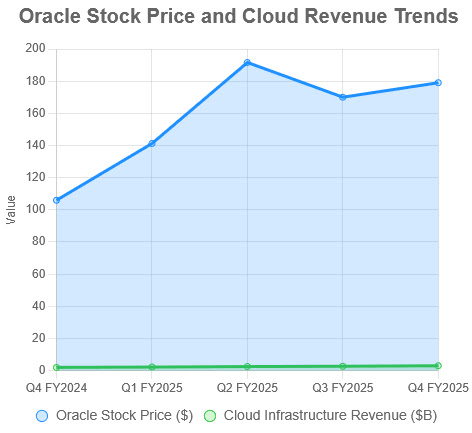
Now, flip the script to Oracle. While Cook’s charming congressmen, Oracle’s execs are unleashing Q2 FY2026 numbers that scream “AI is here to stay.” Revenue? $16.1 billion, up 14% from last year. Not bad for a company once dismissed as legacy software. But the real fireworks? Cloud revenue is exploding 34% to $8 billion, with infrastructure (think data centers powering ChatGPT-like tools) jumping 68%. That’s no fluke—it’s the AI boom. Hyperscalers like Meta and Nvidia are snapping up Oracle’s cloud slots faster than you can say “remaining performance obligations” (RPO), which ballooned 438% to $523 billion. Translation: Oracle’s locked in half a trillion bucks of future sales. Insane.
Yet, it’s not all champagne. The quarter missed revenue whispers by a hair ($16.1B vs. $16.2B expected), and shares dipped post-call. Why? A one-time $2.7 billion gain from selling its Ampere chip stake juiced EPS to $2.26 (up 54%), but strip that out, and growth looks solid but not stratospheric. Plus, Oracle’s doubling down on capex—$12 billion this quarter alone, with $50 billion planned for FY2026 on AI data centers. That’s brave, betting big on the tech that’s reshaping everything from healthcare diagnostics to loan approvals. CEO Safra Catz calls it “embedding AI across our stack,” turning mundane tasks autonomous. But investors fret: Can Oracle fund this without drowning in debt? Their balance sheet’s strong—$22.3B in trailing cash flow—but in a high-interest world, it’s a gamble.
These two stories aren’t silos; they intersect like veins in marble. Cook is fighting to keep Apple’s ecosystem airtight, privacy as the moat. Oracle is flinging doors wide for AI partners, neutrality across clouds (even rivals like AWS). Both nod to ethics—Apple’s “protect kids without spying,” Oracle’s “chip agnosticism” to avoid vendor lock-in. But beneath? Power. Apple’s $3 trillion market cap hinges on trust; Oracle’s eyeing $500B on AI bets. One wrong move, and poof—regulators or recessions strike.
Zoom out to 2025’s big picture. Tech’s riding high post-2024’s AI frenzy, but cracks show. NVIDIA’s chips are gold, but supply snarls loom. Regs like KOSA echo Europe’s GDPR, hinting at a global squeeze. Investors, take note: Apple’s stock is up 20% YTD, Oracle’s 15%, but volatility is the name. Remember Deere & Co.? Their Q3 2025 earnings tanked 12% on farm slumps, yet AI tie-ins (smart tractors) sparked a rebound. Similar here—short-term jitters, long-term tailwinds if they navigate wisely.
As we chat through this (yeah, grab a tea—it’s a long one), I’ll break it down further: Cook’s day-by-day, bill-by-bill; Oracle’s numbers unpacked with charts in mind; tips for spotting your next move. By the end, you’ll see why December 10th wasn’t just news—it was a mirror to tech’s soul. Ready? Let’s unpack the drama.
Tim Cook’s Capitol Hill Gamble: Privacy vs. Protection in the Age of Apps
The Backdrop: Why Child Safety Bills Are Blowing Up Now
Let’s set the scene properly. 2025’s been a banner year for “think of the children” legislation. With social media linked to teen mental health dips—stats show 1 in 3 U.S. kids face online harassment—Congress is itching to act. Enter KOSA and the App Store Accountability Act. These aren’t fluffy proposals; they’re mandates for platforms to “reasonably mitigate” harms, including age-gating explicit stuff.
Cook arrives amid this frenzy, spotted by Fox News crews taking selfies with staffers before diving into the Energy Committee chat. His ask? Ditch mandatory age checks that scan IDs or faces. Apple’s alternative: Enhance Screen Time and family sharing, where parents verify ages during setup. It’s practical—over 50% of iOS users already opt into these, per internal data. But is it enough? Critics say no; they want ironclad verification to stop under-13 sign-ups cold.
Pro Tip for Parents: If you’re juggling kid tech at home, start with Apple’s Guided Access. Lock apps to safe zones, no jailbreak needed. It’s free, simple, and beats waiting on D.C. drama.
Cook’s Pitch: The Privacy Power Play
In that room, Cook channels his inner diplomat. “We share lawmakers’ goals,” Apple states post-meet. But forced data collection? “It endangers every user,” he argues, citing breaches like the 2023 MOVEit hack exposing 60M records. Apple’s fortress—end-to-end encryption, no central user database—would crumble under such rules.
Examples abound. Think Facebook’s Cambridge Analytica scandal; now imagine that on steroids for kids. Cook’s not alone—Google’s Sundar Pichai echoed similar worries in prior hearings. Yet, Apple’s skin in the game is thicker: The App Store’s $85B annual haul relies on seamless, trust-based downloads.
- Bullet on Impacts: Age verification could hike compliance costs 20-30% for devs, per industry estimates, slowing app innovation.
- Stat Spotlight: 70% of parents trust parental controls over gov’t mandates (Pew Research, 2025).
- Another Angle: EU’s DSA already mandates similar; Apple’s complying via “choice screens,” not full scans—proving flexibility works.
For deeper dives, check our Apple Privacy Guide or Reuters’ take on the bill.
What Happens Next? Betting on Outcomes
Short-term: Bill stalls in committee, buy time for tweaks. Long-term: If passed, Apple pivots to “privacy-preserving” tech like zero-knowledge proofs—math magic verifying age without seeing data. Investors eye AAPL dips as buy ops; it’s held above $220 despite noise.
Oracle’s Q2 Earnings Deep Dive: AI Cloud Kings or Capex Caution?
Headline Numbers: Growth Galore, With a Side of Skepticism
Switch gears to Oracle—where earnings aren’t whispers; they’re roars. Q2 FY2026 (ended Nov 30) clocked $16.1B revenue, a 14% YoY leap, but shy of the $16.2B Street bet. Cloud’s the hero: $8B total, up 34%, split as IaaS ($4.1B, +68%) and SaaS ($3.9B, +11%). That’s AI fuel—Nvidia’s training models on Oracle racks, Meta’s expanding multicloud ties.
GAAP net income? $6.1B, EPS $2.10 (+91%). Non-GAAP EPS $2.26 (+54%), thanks to that Ampere sale windfall. RPO’s the stunner: $523B, up 438% YoY, +15% QoQ. It’s backlog bliss—$68B new deals in one quarter!
But shadows lurk. Software licenses dipped 3% to $5.9B; legacy’s fading. Capex? $12B spent, $50B planned for FY2026 on data centers. “We’re building 72 multicloud sites,” boasts CTO Larry Ellison. Bold, but debt’s at $90B—interest eats 10% of op income.
Practical Tip for Investors: Track RPO quarterly; it’s Oracle’s crystal ball. If it holds 15%+ growth, shares could hit $200 by mid-2026.
AI’s Double-Edged Sword: Boom and Bills
Oracle’s not just riding AI; it’s engineering it. Autonomous Database now self-tunes for AI workloads, cutting errors 90%. Healthcare? AI reimbursements are processed 40% faster. Finance? Loan apps are auto-approved with 99% accuracy.
Stats to chew on:
- Multicloud database revenue: +817% QoQ.
- Top 5 AI models hosted on OCI—edge over AWS?
- FY2026 revenue guide: $67B, implying 19% growth, but Q3 at 19-21% ($16.9B midpoint).
Concerns? Financing those centers amid 4% rates. Post-earnings, ORCL fell 2%, then clawed back on TikTok buyout rumors (Oracle as U.S. operator?).
Link to our AI Stocks Watchlist or Oracle’s IR site for transcripts.
Connecting the Dots: Regulation Meets Revenue in Tech’s 2025 Tango
How Cook’s Fight Echoes Oracle’s Bets
Privacy and AI? Inseparable twins. Cook’s staving off data mandates that could hobble AI training—Oracle thrives on vast, clean datasets. If KOSA passes raw, it might slow app ecosystems feeding Oracle’s cloud. Flip side: Ethical AI wins trust, boosting adoption.
Examples: Apple’s differential privacy (fuzzy data sharing) inspires Oracle’s secure enclaves for AI models. Both firms lobby smart—Cook via charm, Oracle via Ellison’s bravado.
Investor Table: Quick Compare
| Metric | Apple (Post-Visit) | Oracle (Q2 Earnings) |
|---|---|---|
| Market Cap | ~$3.2T | ~$500B |
| YTD Stock Change | +20% | +15% |
| Key Risk | Regs on App Store | Capex/Debt Load |
| Growth Driver | Services (30% rev) | Cloud AI (50% rev) |
| 1-Year Target | $250 | $200 |
(Source: Yahoo Finance, Dec 2025)
Tips for Navigating This Noise
- For Parents: Use Oracle’s AI tools ethically—test free trials for family budgeting apps.
- For Traders: Set alerts on RPO; buy dips if >$500B.
- For Everyone: Diversify—ETFs like QQQ hold both, buffering blows.
Internal: Tech Regs 101. External: Bloomberg on Cook.
Wrapping It Up: Your Move in Tech’s Next Chapter
Tim Cook’s Hill hustle and Oracle’s earnings epic? They’re chapters in 2025’s tech thriller—privacy guarding growth, AI fueling fortunes. Key: Balance wins. Apple stays trusted; Oracle scales smart.
What’s your play? Dive into stocks, tweak privacy settings, or just chat below. Subscribe for weekly tech pulses—don’t miss the AI wave!
Frequently Asked Questions (FAQs)
1. Why did Tim Cook visit Capitol Hill in December 2025?
Cook met with House members to oppose parts of child safety bills like KOSA, fearing they’d force invasive age checks, harming privacy. Trending: Users ask if it’ll delay iOS 19 features—likely not, but watch Jan 2026 votes.
2. Did Oracle beat earnings expectations in Q2 FY2026?
Mixed: EPS crushed ($2.26 vs. $1.64 est.), but revenue edged short ($16.1B vs. $16.2B). Cloud +34% stole the show. Hot query: “Oracle stock buy now?”—Analysts say yes if AI holds.
3. How does AI factor into Oracle’s growth?
Oracle’s embedding AI in databases and apps, hosting top models, driving 68% IaaS surge. But the capex of $50B raises debt flags. Trending: “Oracle vs. AWS AI”—Oracle wins on cost for multicloud.
4. Will child safety laws hurt Apple’s App Store?
Potentially—added verification could slow downloads 10-15%, per devs. But Apple’s parental tools might soften blows. Search spike: “Best kid-safe apps 2025″—Apple’s top-rated.
5. What’s the link between Cook’s visit and Oracle earnings?
Both spotlight ethics in tech: Privacy for data AI needs. Oracle’s neutral cloud could host safer apps post-regs. Viral asks: “Tech stocks to watch 2026″—AAPL, ORCL lead.
6. How can investors react to these events?
For Apple: Buy on reg dips. For Oracle: Hold for RPO growth. Diversify via VGT ETF. Trending: “AI bubble burst?”—Not yet, per earnings.
Disclaimer: All content on Marqzy is for educational purposes only and is not financial advice. We are not SEBI-registered advisors. Investments carry risks; please consult a professional and perform your own due diligence before investing. Marqzy is not liable for any financial losses.