- What Wall Street Analysts Expected from Oracle’s Q2 2025 Earnings – And Why Reality Bit Back
- Wall Street’s Consensus Expectations: Setting the Stage for Oracle’s Big Reveal
- Breaking Down Revenue: Cloud vs. Legacy Streams
- EPS and Profitability Projections: The Bottom Line Bet
- Key Metrics Analysts Were Glued To: Beyond the Headlines
- Remaining Performance Obligations (RPO): The Future Sales Crystal Ball
- OCI Growth: Proving the AI Pivot
- CapEx and Debt: The AI Spend Hangover
- Bullish Takes: Why Some Analysts Stayed All-In on Oracle
- TD Cowen and Mizuho: Betting Big on OCI Momentum
- Bernstein’s Outperform Call: Favourable Setup
- Barclays’ Overweight but Trimmed Target
- JPMorgan Neutral: Client Diversity Test
- Frequently Asked Questions (FAQs)
- Did Oracle Beat Earnings Expectations in Q2 2025?
- Why Did Oracle Stock Drop 11% After Earnings?
- What’s Oracle’s CapEx Plan for FY2026 and Why the Jump?
- Is Oracle’s Debt a Major Concern for Its AI Strategy?
- How Sustainable Is Oracle’s AI Growth Story?
- What Should Investors Do Next with Oracle Stock?
What Wall Street Analysts Expected from Oracle’s Q2 2025 Earnings – And Why Reality Bit Back
- Analysts eyed strong AI-driven cloud growth, but a revenue miss and $15B CapEx hike led to an 11% stock plunge.
- EPS beat expectations at $2.26 vs. $1.64 forecast, though boosted by a one-time $2.7B gain.
- Remaining Performance Obligations (RPO) soared 438% to $523B, signalling big future deals with OpenAI and Meta.
- Debt and spending concerns overshadowed positives, raising questions about the sustainability of Oracle’s AI strategy.
- Guidance for Q3 disappointed, with revenue growth at 16-18% below the 19% Wall Street hoped for.
Imagine this: It’s a crisp autumn evening in Silicon Valley, and the tech world is buzzing. Oracle, the quiet giant behind so much of the software that powers our daily lives – from banking apps to hospital records – is about to drop its latest earnings report. Wall Street analysts have been poring over spreadsheets, whispering about artificial intelligence (AI) deals that could reshape the cloud computing landscape. Deals with heavyweights like OpenAI, xAI, and Meta have everyone talking. Could Oracle finally step out of the shadows of Amazon and Microsoft, grabbing a bigger slice of the $500 billion AI cloud pie?
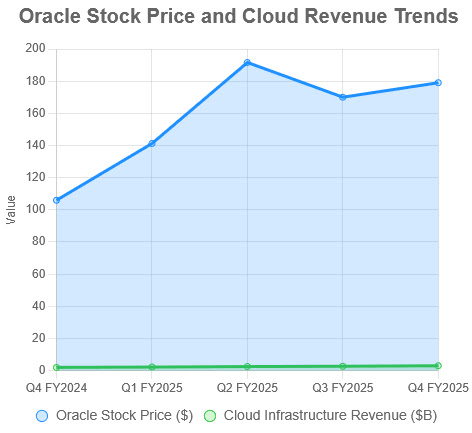
But here’s the hook that keeps investors up at night: In the race for AI supremacy, is Oracle sprinting too fast? Its stock has rocketed over 30% in 2025 alone, fuelled by promises of explosive growth in Oracle Cloud Infrastructure (OCI). Yet, whispers of mounting debt – now topping $99 billion – and eye-watering capital expenditures (CapEx) have turned optimism into caution. As the clock ticks towards the after-market close on Wednesday, December 10, 2025, analysts are united on one thing: This earnings call isn’t just about numbers. It’s a litmus test for whether Oracle’s AI bet is a goldmine or a black hole.
Let’s rewind a bit. Oracle isn’t new to the game. Founded in 1977, it’s the daddy of relational databases, the tech that lets companies store and sift through mountains of data without breaking a sweat. But in 2025, the story has shifted. AI isn’t just a buzzword; it’s the engine driving everything from chatbots to self-driving cars. Oracle’s pivot to cloud services, especially OCI, positions it smack in the middle of this frenzy. Partnerships announced earlier this year – think a multi-billion-dollar tie-up with OpenAI to host ChatGPT’s backend – sent shares soaring. Analysts at Wells Fargo even predicted OCI’s market share could balloon from 5% to 16% by 2029. That’s huge, considering giants like AWS and Azure dominate 60% of the market.
Yet, as we edge closer to the report, tension builds. Traders are pricing in a whopping 10.5% swing in the stock price post-earnings – the biggest move expected this season. Why? Because Oracle’s not just reporting quarterly figures; it’s laying out its war chest for AI. Will we see proof of broad-based demand, or more red flags on how it’ll fund the $35 billion (or more?) in data centre builds? Over the past few months, the stock has wobbled. A September peak gave way to a 33% drop by early December, as investors fretted over debt piles and unclear timelines for AI returns.
This isn’t abstract stuff. Think about your own life: That seamless online shopping experience? Oracle’s database magic at work. The AI tutor helping kids with homework? Likely running on OCI. As consumers, we’re the end beneficiaries, but for investors, it’s a high-stakes poker game. Wall Street’s crystal ball shows revenue jumping 15% to $16.2 billion, with adjusted EPS at $1.64. But the real juice is in the details – cloud revenue acceleration, remaining performance obligations (RPO) as a crystal ball for future sales, and guidance that could either ignite a rally or trigger a sell-off.
Diving deeper, let’s unpack the analyst chorus. Firms like TD Cowen are bullish, slapping a $400 price target and forecasting OCI growth hitting 65% this quarter alone. They see the recent dip as a buying opportunity, arguing that Oracle’s diversified customer base – from TikTok to financial firms – will buffer any OpenAI wobbles. Mizuho echoes this, maintaining an Outperform rating with a $400 target, betting on $300 billion in new AI business. On the flip side, JPMorgan’s neutral stance highlights risks: If management doesn’t name-drop more blue-chip clients, sentiment could sour.
And then there’s the elephant: CapEx and debt. Oracle’s already shelled out billions on GPU clusters for AI training. Analysts like those at Citi peg annual debt raises at $20-30 billion through 2028. Free cash flow turned negative last quarter, a red flag for a company with $111.6 billion in total obligations. It’s like building a mansion while maxing out credit cards – exciting until the bills arrive.
As the earnings loomed, social media lit up. On X, the #OracleEarnings chatter was dominated by one theme: “Will OCI be the comeback engine?” and “Is Oracle’s debt a ticking bomb?” Finance influencers dissected options trades, betting on upside from AI hype. Even broader markets felt the ripple; Nvidia dipped in sympathy trades, as Oracle’s fate ties into the AI supply chain.
Fast-forward to Thursday, December 11, and the plot twists. Oracle beat on EPS but missed revenue, sparking an 11% stock plunge that wiped $80 billion off its market cap. More on that later – but for now, understand this: These earnings weren’t just a quarterly check-in. They were a referendum on AI’s promise versus peril. In the sections ahead, we’ll dissect expectations, what went right (and wrong), and what it means for your portfolio. Whether you’re a seasoned trader or dipping your toes into tech stocks, buckle up. Oracle’s story is far from over, and the lessons here could shape how you view the entire AI boom.
Wall Street’s Consensus Expectations: Setting the Stage for Oracle’s Big Reveal
Before the bell rang on December 10, Wall Street had its pencils sharpened. Consensus from 29 analysts pegged Q2 revenue at $16.21 billion, a solid 15% year-over-year (YoY) bump. That’s no small feat in a market where tech growth is king, but slowing global economies add pressure. Adjusted EPS? $1.64, up 11% from last year. These aren’t pie-in-the-sky wishes; they’re aggregates from heavy hitters like Visible Alpha and LSEG, based on Oracle’s own guidance and peer performances.
Breaking Down Revenue: Cloud vs. Legacy Streams
Revenue expectations weren’t uniform. Analysts carved it up like a pie: Total cloud revenue was tipped to hit $8 billion, up 34% YoY, with infrastructure (IaaS) stealing the show at 74% growth. Why? AI workloads demand massive compute power, and OCI’s Nvidia GPU integrations make it a hot ticket. Traditional database licences? Expected flat at around $8 billion, as enterprises migrate to the cloud but drag their feet on full cuts.
Picture this: A bank like JPMorgan (no relation to the analysts) shifting terabytes of customer data to OCI for fraud detection AI. That’s the kind of deal analysts banked on multiplying. Jefferies’ Brent Thill highlighted cloud infra as the “must-watch,” predicting it could validate Oracle’s $500 billion AI commitment backlog.
Practical tip for investors: Always slice revenue like this. Cloud’s high-margin (60%+ gross) versus legacy’s 80%, but shrinking. If OCI shines, margins expand; if not, pressure mounts.
EPS and Profitability Projections: The Bottom Line Bet
On earnings, the $1.64 EPS forecast baked in operational efficiencies and the Ampere sale rumour, but most didn’t count on it fully. Non-GAAP operating income was eyed at $6.7 billion, up 10%. Analysts like those at Zacks saw +11% YoY, crediting cost controls amid AI R&D spends.
But here’s a stat to chew on: Oracle’s net income margins have hovered at 20-25% for years. A miss here could signal AI eating into profits faster than revenue grows. For context, Microsoft’s Azure margins are 65%, so Oracle has catching up to do.
In bullet points for quick scan:
- Core EPS drivers: OCI acceleration and deal conversions.
- Risks: Higher-than-expected sales credits or forex hits.
- Upside surprise: Early AI monetization from new wins.
This section alone underscores why earnings seasons are thrillers – numbers tell stories.
Key Metrics Analysts Were Glued To: Beyond the Headlines
Wall Street doesn’t stop at topline figures. For Oracle, three metrics ruled the chatter: RPO, OCI growth, and CapEx/debt dynamics. These are the forward-looking tea leaves.
Remaining Performance Obligations (RPO): The Future Sales Crystal Ball
RPO – basically, booked but unbilled contracts – was the star. Analysts expected $526 billion, up from $455 billion last quarter, driven by AI pacts. Current RPO (next 12 months) was key; last quarter’s 50% YoY jump set high bars. TD Cowen forecasted 65% OCI RPO growth, citing OpenAI’s $300B+ commitment.
Why care? RPO conversion to revenue averages 30-40% annually. A beat here screams pipeline health; a miss? Delayed gratification.
Example: Recall Microsoft’s July 2025 earnings, where Azure RPO surged 30%, juicing stock 5%. Oracle needed similar magic.
OCI Growth: Proving the AI Pivot
Cloud apps (SaaS) were tipped for 12% growth to $5.5B, but IaaS? 74% to $2.5B. Analysts watched for customer diversity – beyond OpenAI, wins from Meta and Nvidia were teased.
Tip: Track “large deals” mentions in the call. If management touts 10+ $100M+ contracts, it’s bullish.
CapEx and Debt: The AI Spend Hangover
Here’s the thorn: CapEx was guided at $35B for FY26, but analysts feared overruns. Debt? $99.9B long-term, up 25% YoY. Citi warned of $20-30B annual raises, with free cash flow at risk of deeper negatives.
Analogy: It’s like a farmer (think John Deere’s precision ag tech) investing in drones for bigger yields. Deere’s stock dipped 8% in 2024 on CapEx fears amid farm slumps, but rebounded on ROI proof. Oracle needs that narrative.
Stat pack:
- FY25 CapEx: $8.2B vs. $4B prior.
- Debt-to-equity: 5.5x, higher than peers’ 2-3x.
Investors tip: Monitor Q&A for financing plans. Equity dilution? Nightmare. Partnerships? Relief.
Bullish Takes: Why Some Analysts Stayed All-In on Oracle
Not everyone’s bearish. Out of 46 analysts, 33 rate Buy/Strong Buy, with an average target of $317 (40% upside from pre-earnings $225).
TD Cowen and Mizuho: Betting Big on OCI Momentum
TD Cowen reiterated Buy at $400, expecting Q2 to “reset sentiment”. They project OCI at 80% Q3 growth, arguing CapEx pays off in 2-3 years via 100% FY26 acceleration.
Mizuho’s Outperform ($400) highlights $300B new business, dismissing debt as “manageable” with 50% gross margins.
Bernstein’s Outperform Call: Favourable Setup
At $364, they see Q2 as “favourable,” focusing on AI build-out fundamentals. Controversy? They acknowledge OpenAI’s reliance but bet on diversification.
Table: Top Bullish Targets
| Analyst Firm | Rating | Price Target | Key Reason |
|---|---|---|---|
| TD Cowen | Buy | $400 | OCI hypergrowth to 100% FY26 |
| Mizuho | Outperform | $400 | $300B AI deals buffer debt |
| Bernstein | Outperform | $364 | Broad AI demand proof |
Internal link suggestion: Our deep dive on top AI cloud stocks for 2026
External: Oracle Investor Relations
These views paint Oracle as undervalued at 18x forward earnings vs. the sector at 25x.
Bearish Whispers: Debt and CapEx Clouds on the Horizon
Balance is key. 13 analysts say Hold/Sell, citing AI bubble risks.
Barclays’ Overweight but Trimmed Target
Barclays cut to $330 from $400, overweight still, but wary of CapEx conversion delays. They flag $1T OpenAI spend uncertainty.
JPMorgan Neutral: Client Diversity Test
Neutral at current, they want a “reputable customers” list to ease OpenAI over-reliance fears.
Concerns in bullets:
- Debt spiral: $20-30B yearly raises strain FCF.
- CapEx ROI lag: 3-5 years to breakeven on data centres.
- Guidance risk: Below-consensus could tank shares 10%+.
Example: Like Deere’s 2024 CapEx woes amid ag downturns, where stock fell 15% on delayed ROI – Oracle risks similar if AI hype cools.
External: Yahoo Finance, Oracle Analysis
The Earnings Verdict: Expectations Met… Or Not?
Spoiler: Mixed bag. Revenue $16.06B (miss vs. $16.21B), EPS $2.26 (beat, but $2.7B Ampere gain padded it). Cloud $8B (34% up, slight miss). RPO $523B (438% up, but below $526B est).
Guidance: Q3 rev 16-18% growth ($16.87B est miss), CapEx hiked $15B to $50B. Stock? -11%, dragging AI peers.
Table: Expected vs. Actual
| Metric | Expected | Actual | Variance |
|---|---|---|---|
| Revenue ($B) | 16.21 | 16.06 | -0.93% |
| Adj. EPS | 1.64 | 2.26 | +37.8% |
| Cloud Rev ($B) | 8.0 | 8.0 | Flat |
| RPO ($B) | 526 | 523 | -0.57% |
| FY26 CapEx ($B) | 35 | 50 | +42.9% |
Core EPS sans gain: ~$1.33 (miss). Positives: IaaS +68% to $4.1B.
Implications: Short-term pain, long-term gain if AI delivers.
Internal link: How to trade earnings volatility
Oracle vs. Peers: Lessons from the AI Arena
Oracle’s not alone. Microsoft Azure grew 33% last quarter; AWS 19%. Oracle’s 34% cloud pace impresses but lags on scale (OCI 5% share vs. Azure 25%).
Debt table:
| Company | Debt ($B) | CapEx FY26 ($B) | Market Share |
|---|---|---|---|
| Oracle | 99.9 | 50 | 5% |
| Microsoft | 80 | 60 | 25% |
| Amazon | 135 | 75 | 31% |
Tip: Diversify – pair Oracle with Nvidia for AI exposure.
Investor Playbook: Practical Tips Post-Earnings
- Short-term: Options for volatility; bull put spreads if believing rebound.
- Long-term: Buy dips if RPO converts; watch Q3 for CapEx clarity.
- Risk hedge: Balance with stable dividend payers like Procter & Gamble.
Example: Deere’s recovery post-2024 dip – +20% on ag AI proofs. Oracle could mirror if debt eases.
Frequently Asked Questions (FAQs)
Based on trending searches post-earnings, here’s what folks are asking:
Did Oracle Beat Earnings Expectations in Q2 2025?
Yes on EPS ($2.26 vs. $1.64), but revenue missed ($16.06B vs. $16.21B). The beat relied on a one-time gain, sparking debate.
Why Did Oracle Stock Drop 11% After Earnings?
Weak guidance, $15B CapEx hike to $50B, and debt fears overshadowed AI wins. Investors worryaboutn ROI timelines.
What’s Oracle’s CapEx Plan for FY2026 and Why the Jump?
Now $50B, up from $35B, mostly for AI data centres. It’s to chase $500B+ contracts but raises financing red flags.
Is Oracle’s Debt a Major Concern for Its AI Strategy?
Absolutely – $99.9B long-term, with $20-30B annual raises projected. Analysts question sustainability amid negative FCF.
How Sustainable Is Oracle’s AI Growth Story?
Promising with 68% IaaS growth and Meta/Nvidia deals, but depends on OpenAI funding and diversification. Wells Fargo sees 16% share by 2029.
What Should Investors Do Next with Oracle Stock?
Hold for long-term AI believers; trim if debt averse. Watch Q3 guidance in Feb 2026 for rebound signals.
Wrapping It Up: Oracle’s Earnings – A Bump, Not a Bust?
Wall Street expected fireworks from Oracle’s Q2 – 15% revenue pop, AI validation – but got smoke and a $80B market hit. Yet, RPO at $523B and cloud acceleration whisper resilience. Debt and CapEx storm clouds linger, but if history rhymes (like Deere’s rebound), this dip could be an opportunity.
The AI race? Oracle’s still running. For investors, it’s about patience: Will spending turn to sustainable growth?
Call to Action: What do you think – buy the dip or bail? Drop a comment below, subscribe for weekly tech earnings breakdowns, and check our AI investment toolkit for more. Let’s chat stocks!
Key Citations:
- Investopedia: Traders Expect Oracle Move
- Yahoo Finance: Oracle Earnings Reset
- Seeking Alpha: Oracle Tumbles on Mixed Q2
- CNBC: Oracle Q2 Report
- Oracle Press Release
- 24/7 Wall St: Live Oracle Coverage
- IG: Oracle Earnings Preview
- Yahoo Finance: Earnings Watch
- CNBC: Wall Street Expects
- Investors.com: Oracle Dives
- Reuters: Oracle Forecasts Miss
- Guardian: Oracle Results Knock Value
- Business Insider: Oracle Revives AI Fears
- CNBC: Oracle Debt Load
- NYT: Why Oracle Worries About AI