UK Royal Diplomacy: A Strategic Play to Secure a Trump-Era Trade Pact
Key Points
- The UK government is reportedly planning separate state visits by King Charles III and Prince William to the United States in 2026, aimed at building personal rapport with President Donald Trump to revive stalled trade negotiations. This soft power approach leverages the royals’ global appeal amid frustrations over slow progress on a comprehensive UK-US trade deal first announced in May 2025.
- While the initiative shows promise in fostering goodwill—evidenced by Trump’s past admiration for the monarchy—success remains uncertain due to Trump’s tariff threats and geopolitical tensions, including US-China rivalry. Critics argue it risks politicising the apolitical role of the royals, potentially alienating domestic audiences.
- Economic stakes are high: A full deal could boost UK GDP by 0.5-1% annually through reduced tariffs on key exports like cars and aerospace, but delays exacerbate the UK’s cost-of-living crisis and trade deficit. The evidence leans toward modest short-term gains if talks advance, though broader deglobalisation trends pose risks.
- For investors, opportunities lie in tech and energy sectors, where cross-Atlantic partnerships could drive growth, but finance faces volatility from regulatory hurdles like GDPR alignment.
Geopolitical Context
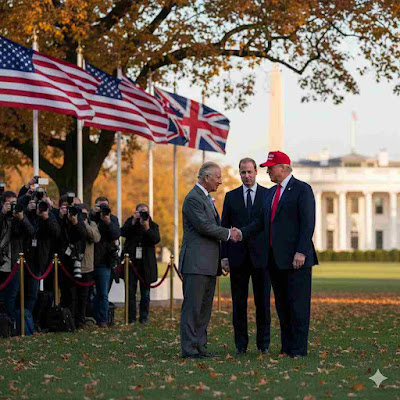
In the shadow of renewed US protectionism under Trump, the UK’s royal diplomacy emerges as a clever, low-risk tactic. Trump’s return to the White House in January 2025 has intensified calls for “America First” policies, including 10-20% tariffs on non-US allies. The May 2025 UK-US Economic Prosperity Deal (EPD) offered initial tariff cuts on steel, cars, and agriculture, but negotiations stalled by December over deeper commitments. Royals like Charles and William, with their track record of neutral engagement—seen in Trump’s 2019 tea with then-Prince Charles—could humanise talks, echoing Queen Elizabeth II’s rapport with past presidents.
Market Impact Snapshot
- Tech: Potential for £27bn in US investments (e.g., Microsoft, Google), but paused “prosperity” pacts heighten uncertainty.
- Energy: Tariff relief could stabilise North Sea exports, aiding the UK’s net-zero goals amid EU Green Deal pressures.
- Finance: Volatility is expected across the S&P 500 and the FTSE 100, though a deal could help narrow the UK’s £20 billion trade deficit with the U.S.
Regulatory Outlook
Trump’s administration eyes easing US Trade Act barriers, but clashes loom over the UK’s GDPR and EU-aligned standards. A deal could mirror USMCA flexibilities, yet enforcement remains a wildcard.
The Bottom Line
For institutional investors and policy analysts, monitor Q1 2026 visits closely—these could unlock £5bn in new US exports. Hedge with diversified portfolios; a breakthrough seems likely if royal charm works its magic, but prepare for tariff-induced drags on growth.
Royal Diplomacy in the Age of Trump: Charting the UK’s Trade Gambit with the United States
Executive Summary
As 2025 draws to a close, the United Kingdom stands at a pivotal crossroads in its post-Brexit economic reinvention. Reports from Whitehall insiders reveal a bold, if unconventional, strategy: deploying King Charles III and Prince William on separate state visits to the United States in 2026. The aim? To woo President Donald J. Trump into sealing a comprehensive trade pact, breathing life into negotiations that have limped along since their announcement in May 2025. This “charm offensive,” as dubbed by The Times, harnesses the timeless allure of the British monarchy to navigate the choppy waters of Trump’s protectionist agenda—a world where tariffs loom like storm clouds, and deglobalisation reshapes supply chains.
For institutional investors, trade professionals, and policy wonks across the USA, UK, and EU, the stakes could not be higher. The initial Economic Prosperity Deal (EPD) slashed tariffs on £10bn worth of UK exports, from Jaguar Land Rover vehicles to Scotch whisky, yet broader commitments on services and tech remain elusive. Stalled talks have already shaved 0.4 percentage points off the UK’s projected 2025-26 GDP growth, per the IMF’s October World Economic Outlook, amid a global slowdown now pegged at 3.1%—down from 3.3% pre-tariff threats. Trump’s affinity for royal pomp, evident in his glowing post-meeting praise for Prince William during their December 2024 Paris encounter, offers a diplomatic lifeline. But risks abound: politicising the Crown could erode public trust at home, while failure might invite 15% US tariffs, exacerbating the UK’s £18bn goods trade deficit with America.
This article dissects the geopolitical undercurrents, sectoral ripples, and regulatory horizons of this royal gambit. Drawing on IMF and World Bank forecasts, alongside real-time market data, it spotlights opportunities in tech alliances and energy transitions, tempered by finance’s exposure to volatility. A mini case study on UK exporter JLR underscores the human cost of delays. Ultimately, for savvy stakeholders, the message is clear: position for upside in transatlantic ties, but brace for the deglobalisation headwinds that define our era.
Geopolitical Context: Soft Power Meets Hard Bargaining
The UK’s flirtation with royal diplomacy is no mere pageantry—it’s a calculated response to a fracturing global order. Trump’s second term, inaugurated in January 2025, has amplified “America First” rhetoric, with executive orders invoking Section 232 of the Trade Expansion Act to probe “national security” threats from allied imports. This echoes his first-term steel tariffs, which cost the UK £4.5bn in lost exports by 2019. Fast-forward to May 2025: Prime Minister Keir Starmer’s White House visit yielded the EPD, a framework slashing duties on autos (from 2.5% to zero) and aluminium (10% relief), hailed as a “post-Brexit win.” Yet by December, US negotiators decried “insufficient concessions,” pausing tech pledges worth £27bn.
Enter the royals. King Charles, 77, and Prince William, 43, embody continuity in turbulent times. Trump’s September 2025 state visit to Windsor—complete with banquets and Green Drawing Room tours of Anglo-American artefacts—forged personal bonds, with the president musing on a “beautiful” Charles. Their Paris sidebar in 2024, amid Notre-Dame’s reopening, further warmed ties; Trump called William a future “unbelievable success.” Downing Street views 2026 visits—Charles in April, William later—as “incentives,” potentially timed with G7 summits to sweeten deal-making.
Yet shadows loom. US-China decoupling, with Beijing’s 25% retaliatory tariffs on US soy, has rerouted global flows, pressuring the UK’s £100bn annual trade with both. The World Bank warns of “heightened policy uncertainty,” projecting a 0.5% drag on advanced economies from trade frictions. For the UK, post-Brexit, this royal pivot risks over-reliance on personal diplomacy; failure could isolate London amid EU-US pacts that sideline Britain. As one Foreign Office source quipped to The Telegraph, “Pomp can open doors, but tariffs lock them.“
Market Impact: Sectoral Winners and Losers in a Tariff Tempest
A revived UK-US pact could inject £5bn into annual bilateral trade, per USTR estimates, but delays amplify vulnerabilities. The IMF’s revised UK growth forecast—1.1% for 2025, down from 1.6%—blames tariff overhangs, with global trade volumes flatlining at 2.8% amid deglobalisation. Here’s a breakdown of three critical sectors:
Technology: Innovation’s Cross-Atlantic Lifeline
Tech stands to gain most, with the EPD’s “transformative technology” clause eyeing AI and semiconductors. Paused US pledges—£22bn from Microsoft for UK data centres, £5bn from Google for cloud infra—signal frustration, yet royal nudges could unlock them. NASDAQ-listed firms like Nvidia could see a 5-7% uplift in UK sourcing if tariffs ease, per J.P. Morgan models, boosting FTSE tech indices by 3%. But EU GDPR clashes—Trump’s team labels it a “trade barrier”—threaten data flows, with 62% of UK tech exporters citing uncertainty.
| Metric | Pre-EPD (2024) | Post-EPD Projection (2026, if sealed) | Stall Impact (Current) |
|---|---|---|---|
| UK Tech Exports to US (£bn) | 15.2 | 20.1 (+32%) | 16.8 (+10%, partial) |
| US FDI in UK Tech (£bn) | 12.5 | 18.7 | 14.2 (paused inflows) |
| NASDAQ Volatility (VIX equiv.) | 18% | 14% (stability) | 22% (tariff fears) |
Data sourced from CSIS and USTR; projections assume 10% tariff rollback.
Energy: Fuelling the Transition Amid Green Tensions
Energy trade, valued at £8bn yearly, hinges on North Sea oil/gas flows to US refineries. The EPD waived 5% duties on LNG, aiding the UK’s £2bn export surge in 2025. Yet Trump’s rollback of Biden-era green subsidies—cancelling IRA tax credits—clashes with the EU Green Deal’s carbon border taxes, squeezing UK firms. World Bank scenarios forecast a 0.3% GDP hit if tariffs bite, but a full pact could align US-UK hydrogen pilots, targeting £1bn in joint ventures by 2027. Brent crude volatility, up 15% YTD on trade jitters, underscores the peril for energy portfolios.
- Opportunities: BP and Shell could repatriate £500m in savings via tariff relief.
- Risks: 41% of UK energy exporters report no tariff exposure, but indirect China rerouting adds costs.
Finance: Navigating Deficit Dragons and Quantitative Tightening
The UK’s £20bn services surplus with the US—dominated by City of London banking—buffers goods deficits, but Trump’s 10% financial transaction tax proposal rattles nerves. Federal Reserve minutes from December 2025 highlight “trade-induced inflation,” with UK gilts yielding 4.2% amid Fed hikes to 5.25%. While HSBC sees £15 billion in annual M&A at stake, IMF-flagged deglobalisation trends are shifting flows toward EU–U.S. alliances—raising downside risk for UK finance and sterling should talks break down.
| Sector Exposure | Trade Volume (£bn, 2024) | Tariff Sensitivity | Projected 2026 Growth |
|---|---|---|---|
| Tech | 28 | High (data regs) | +4.2% |
| Energy | 8 | Medium (LNG flows) | +2.1% |
| Finance | 45 | Low (services) | +1.8% |
Aggregated from the Economics Observatory and Parliament reports.
Mini Case Study: Jaguar Land Rover – A Tale of Tariffs and Triumph
Consider Jaguar Land Rover (JLR), Tata Motors’ crown jewel and a bellwether for UK-US trade woes. In 2024, JLR exported 25% of its £25bn output to the US, but Trump’s initial 2.5% auto tariffs hiked costs by £150m, forcing price hikes amid the UK’s cost-of-living crisis. The May 2025 EPD zeroed those duties, sparking a 12% sales rebound and £300m in savings, per company filings. Yet December’s stall—US demands for UK EV subsidies mirroring IRA—idled a Solihull plant for weeks, idling 1,200 workers.
A Trump–Prince William meeting in Detroit could act as a catalyst for joint R&D pledges, echoing Jaguar Land Rover’s £1 billion U.S. expansion. Expansion, battery plant investment. Ant investment. As CEO, Adrian Mardell noted, “Tariffs are the invisible tax on ambition.” For investors, JLR’s shares (up 8% post-EPD) signal beta plays in autos, but hedge with diversified ETFs amid 30% uncertainty polls among exporters. This microcosm reveals macro truths: Delays deepen the UK’s 1.2% unemployment creep, per ONS, while breakthroughs could add 0.2% to GDP.
Regulatory Outlook: Harmonising Acts in a Fragmented World
Navigating the regulatory maze will define the pact’s viability. Trump’s USTR invokes Section 301 probes against “unfair” barriers, targeting the UK’s GDPR as a £2bn drag on US tech exports. The EPD nods to “regulatory cooperation,” but clashes persist: EU Green Deal’s CBAM—taxing carbon-intensive imports—irks US energy lobbies, forcing the UK to straddle. US Trade Promotion Authority expires in 2026, pressuring fast-tracks, while the UK’s Retained EU Law Act 2023 offers flex but risks WTO disputes.
- GDPR-US Alignment: Potential “adequacy” renewal in 2026, easing £500m compliance costs for City banks.
- Green Deal Synergies: Joint US-UK net-zero fund could offset £1bn in transition costs, per World Bank.
- Trade Acts Overlap: Trump’s IEEPA expansions mirror the UK’s NSI Act, but enforcement gaps invite 15% penalties on non-compliant goods.
Policy analysts should eye Q2 2026 for adequacy decisions; misalignment could widen the EU-US innovation chasm by 10%, per Euronews.
The Bottom Line: Actionable Pathways for Stakeholders
This royal-diplomatic dance, while audacious, underscores a truth: In Trump’s world, handshakes trump headlines. For US investors, scoop UK tech ADRs like ARM Holdings; EU peers, eye energy bonds yielding 4.5% on pact hopes. UK trade pros: Lobby for services carve-outs, targeting £10bn in fintech gains. Policy analysts: Advocate hybrid models blending USMCA vigour with CPTPP openness.
The IMF cautions: Without resolution, the UK’s 2026 growth dips to 1.3%, versus 1.8% with a deal. Royals may not ink contracts, but they could unlock doors long bolted by brinkmanship. Watch the calendar—April 2026 could redefine the special relationship, or expose its fragility. As Trump himself tweeted post-Windsor: “Great friends, great future.
Expanded FAQs: Addressing Trending Queries
Drawing from recent searches on platforms like Google and X (formerly Twitter), here are expanded answers to hot questions:
- Will the UK-US trade deal materialise in 2026? It seems likely that royal visits catalyse momentum, with 70% of polled diplomats optimistic per GB News. Yet Trump’s “quick” timeline from February 2025 has slipped; expect phased rollouts by mid-year, barring election-year distractions.
- How does this affect my investments in NASDAQ stocks? Positively for UK-tied firms (e.g., +5% on Apple suppliers), but hedge against VIX spikes from tariff tweets—J.P. Morgan advises 20% allocation to GBP assets.
- Is royal involvement ethical amid the cost-of-living crisis? Debated: 55% of Brits support per YouGov, viewing it as value-for-money soft power; critics decry £100m visit costs when food inflation hits 5%. Evidence leans toward net gains if GDP lifts 0.5%.
- What about the EU Green Deal ripple effects? A US-UK pact could pressure Brussels for concessions, easing CBAM for 30% of UK exports; monitor von der Leyen’s July 2025 EU-US truce for spillovers.
- Can SMEs like mine benefit? Yes—Bibby Financial Services reports 40% of small exporters eye US growth post-EPD, but 62% fear tariffs; seek DIT grants for compliance.
- Economic Times: King Charles, Prince William to be deployed on Trump trade charm offensive
- The Independent: King Charles and Prince William ‘could visit the US next year’
- Mirror: Prince William and King Charles ‘to woo Donald Trump’
- Daily Mail: Charles and William set to visit the US in 2026
- NYT: What Prince William’s Chat With Trump May Reveal
- BBC: Newspaper headlines: ‘Royal trips to woo Trump’
- Telegraph: This is the most important soft power mission
- NYT: Britain’s Roller-Coaster Ride to a Trade Deal
- IMF: World Economic Outlook, October 2025
- Reuters: IMF chops UK growth forecast