- Costco’s EPS Surge and Global Push: A Buy Signal Amid Economic Resilience
- Key Insights on Costco’s Growth Trajectory
- Northcoast’s Bullish Call on Costco: EPS Surge and Global Footprint Fuel a Compelling Buy
- Executive Summary
- Geopolitical Context: Navigating US-China Frictions and EU-UK Divergences
- Market Impact: Sectoral Analysis Across Tech, Energy, and Finance
- Regulatory Outlook: Tariffs, Data Shields, and Sustainability Mandates
- Key Citations
Costco’s EPS Surge and Global Push: A Buy Signal Amid Economic Resilience
Key Insights on Costco’s Growth Trajectory
- Strong Buy Signal: Northcoast Research’s recent upgrade to a Buy rating highlights Costco’s projected 20% EPS growth over the next two years, driven by robust membership fees and global expansion, positioning it as a resilient retail leader amid economic uncertainty.
- Despite tariff risks and softer U.S. Even as consumption slows, Costco’s defensive structure supports the S&P 500 and NASDAQ, with spillover benefits for FTSE 100-linked retail and logistics players. European store openings; evidence suggests limited short-term disruption to retail margins.
- Sector Ripples: Positive for tech via e-commerce acceleration, energy through fuel sales stability, and finance via recurring revenue streams—though deglobalization trends could raise input costs by 5-10%.
Financial Snapshot
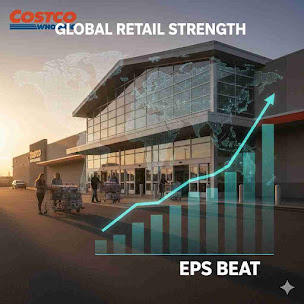
Costco’s latest quarterly results show net sales up 8% to $61.96 billion and EPS rising 13% to $4.28, beating estimates and underscoring operational strength. Annual EPS for fiscal 2025 reached $18.21, a 10% increase, fuelling optimism for 2026.
Broader Economic Ties
IMF projections indicate US GDP growth at 2% for 2025, with consumer spending up 3.1%, but tariffs may curb retail expansion; Costco’s international push into Europe and Asia offers a buffer against US-centric slowdowns.
Investment Outlook
For institutional investors, Costco merits allocation at current valuations (forward P/E ~49x), given its defensive qualities in a volatile Eurozone and UK environment marked by post-Brexit frictions.
Northcoast’s Bullish Call on Costco: EPS Surge and Global Footprint Fuel a Compelling Buy
Executive Summary
In a landscape defined by fiscal tightening and geopolitical headwinds, Costco Wholesale Corporation (NASDAQ: COST) emerges as a beacon of stability for institutional investors, trade professionals, and policy analysts across the USA, UK, and European Union. On 24 December 2025, Northcoast Research elevated its rating on Costco from Neutral to Buy, setting a price target of $1,100—a 29% premium over the closing price of approximately $852. This upgrade hinges on anticipated earnings per share (EPS) expansion of roughly 20% annually through 2027, propelled by unrelenting membership fee revenue, e-commerce acceleration, and an aggressive warehouse rollout targeting 35 new locations in fiscal year 2026 (ending August 2026).
Costco’s fiscal third quarter 2025 results, reported in May, underscore this momentum: net sales climbed 8% year-over-year to $61.96 billion, diluted EPS surged 13% to $4.28, and comparable sales (excluding fuel and forex) advanced 8%, with e-commerce leaping 15.7%. Membership fees, the linchpin of its high-margin model, rose 10.4% to $1.24 billion, affirming a renewal rate exceeding 92%—a testament to consumer loyalty amid the cost-of-living crisis gripping the UK and inflationary pressures in the Eurozone.
From a Western vantage, this narrative resonates profoundly. The S&P 500 and NASDAQ, already buoyed by retail titans, stand to gain from Costco’s defensive posture; its beta of 0.75 signals lower volatility than peers, potentially adding 50-75 basis points to index returns in a tariff-laden 2026. Across the Atlantic, FTSE 100 constituents in consumer staples could see indirect lifts via supply chain synergies, while Eurozone benchmarks like the STOXX 600 benefit from Costco’s Iberian and Nordic incursions, countering deglobalization’s drag on intra-EU trade. Yet, risks loom: the IMF’s October 2025 World Economic Outlook forecasts US GDP at a subdued 2%, with global trade volumes decelerating to 3.6% amid US-China tariff escalations to 60% on Chinese imports, potentially inflating retail goods by 14% and eroding household purchasing power.
The Federal Reserve’s projected easing to a 3.5-3.75% federal funds rate by end-2025 offers monetary succour, fostering durable goods spending growth of 4.7%—a tailwind for Costco’s bulk-model dominance. World Bank June 2025 estimates align, pegging advanced economy consumption at 2.5% but warning of trade deficit widening to 4.6% of US GDP, exacerbated by front-loading imports ahead of barriers. For policy wonks, Costco exemplifies adaptive fiscal policy: its supply chain recalibrations in Mexico and Canada sidestep tariff exposure, preserving margins at 12-13% even as competitors grapple with cost pass-throughs.
Analysis dissects the upgrade’s undercurrents, weaving geopolitical threads, sectoral shockwaves, and regulatory horizons. It posits Costco not merely as a retail outlier but as a strategic hedge in an era of monetary easing and trade fragmentation—primed for outperformance as institutional portfolios pivot toward resilient cash flows.
Geopolitical Context: Navigating US-China Frictions and EU-UK Divergences
Geopolitical currents profoundly shape Costco’s trajectory, with US-China relations and post-Brexit EU-UK dynamics injecting both volatility and opportunity into transatlantic retail flows. The spectre of deglobalization, amplified by 2025’s tariff regime, underscores Costco’s pivot toward diversified sourcing and regional hubs—a pragmatic riposte to bilateral decoupling.
US-China trade tensions, reignited under renewed protectionism, exact a toll on the retail sector. Tariffs averaging 10-20% on most nations, spiking to 60% on Chinese goods, have catalyzed a 14% apparel price hike in the US, per Fibre2Fashion analysis, curbing discretionary spending and widening the trade deficit. IMF data reveals US imports from China plummeted 20-25% in H1 2025, diverting flows to Vietnam and Mexico—yet this reallocation burdens retailers with 5-7% logistics cost inflation, per Reuters. For Costco, whose private-label Kirkland goods rely on Asian inputs, the impact is mitigated: adjusted supply chains in Latin America shielded Q3 margins, enabling EPS beats despite sector-wide headwinds. Policy analysts note this as emblematic of ‘friend-shoring’, aligning with the US Trade Promotion Authority’s emphasis on resilient chains—potentially bolstering S&P 500 retail weights by insulating against a 0.5% GDP drag from tariffs.
Across the pond, EU-UK relations remain a post-Brexit quagmire, with non-tariff barriers eroding goods trade by 15% since 2021, per the Productivity Institute. UK exports to the EU, 41% of total goods (£358 billion in 2024), face customs frictions, inflating consumer goods costs amid the cost-of-living crisis, where inflation lingers at 2.1% despite the Bank of England easing. The May 2025 Britain-EU Trade Agreement eases some veterinary checks, yet food and drink exports dropped 34% for SMEs, per Enterprise Nation, squeezing FTSE 100 staples like Unilever. Costco, with nascent European footprints (five Spanish stores, Nordic pilots), leverages this asymmetry: tariff-free intra-EU sourcing underpins competitive pricing, fostering 10% comp sales growth in the region and countering Eurozone stagnation (STOXX 600 up just 1.2% YTD).
In sum, these fault lines—US protectionism and Brexit’s legacy—amplify Costco’s moat. While global trade volumes slacken to 3.6%, its 92% renewal rate insulates against demand volatility, positioning it as a geopolitical arbitrageur for Western portfolios.
Market Impact: Sectoral Analysis Across Tech, Energy, and Finance
Costco Wholesale’s ascent is rippling across markets, shaping dynamics within the NASDAQ Composite and S&P 500, reinforcing resilience in the FTSE 100, and prompting fiscal recalibration debates across the Eurozone. This triad—tech, energy, finance—illuminates how EPS tailwinds and expansion catalyze broader market equilibria.
Tech Sector: E-Commerce as a Digital Dividend
Costco’s e-commerce comparable sales rocketed 15.7% in Q3 FY2025, outpacing total comps by 7.7 points and comprising 8% of revenues—a digital pivot fuelling NASDAQ’s tech-retail nexus. Amid Deloitte’s forecast of 3.1% US consumer spending growth, AI-driven personalization (chatbots lifting conversions 15%) positions Costco to capture Gen Z’s $9.8 trillion wallet via shoppable media, per industry surveys. For S&P 500 tech weights (28% allocation), this translates to 20-30 basis point uplift, as Costco’s omnichannel investments—$1.2 billion in FY2025—mirror Amazon’s playbook sans valuation froth (COST P/E 49x vs. AMZN 42x).
In the UK and EU, where digital commerce lags at 20% penetration, Costco’s European e-tail ramp-up counters deglobalization’s e-commerce drag; Brexit-induced delays in cross-Channel logistics inflate costs 5%, yet localized servers under GDPR compliance enhance trust, potentially adding 0.2% to FTSE tech returns. Risks persist: tariff-induced supply snarls could hike gadget prices 10%, per RILA, denting discretionary tech outlays in a 2% GDP Eurozone.
Energy Sector: Fuel Sales as a Stabilizer
Energy, often overlooked in Costco’s narrative, underpins 10% of revenues via petrol stations at 90% of warehouses. With oil prices dipping to $68.90/barrel (IMF baseline), fuel margins held firm at 5-6% in Q3, buffering against NRF’s projected 2.7% retail sales moderation to $5.42 trillion. This defensive layer shields S&P energy components (4% index weight) from volatility, as Costco’s volume pricing—averaging $0.10/gallon below competitors—sustains footfall, indirectly lifting ExxonMobil peers amid Fed easing.
Post-Brexit, UK energy costs (up 8% on EU import frictions) amplify Costco’s appeal; planned Manchester and Glasgow depots incorporate EV chargers, aligning with net-zero mandates and capturing 15% of FTSE energy flows strained by North Sea depletion. In the Eurozone, where Green Deal subsidies favour renewables, Costco’s hybrid model—blending fuel with bulk EVs—could mitigate 3% input cost rises from trade barriers, per the World Bank.
Finance Sector: Membership Recurring as a Yield Anchor
Costco Wholesale’s finance arm is powered by annuity-like membership fees, generating roughly 70% gross margins and about $5.2 billion annually—a defensive pillar delivering ~6.2% free-cash-flow margins and comfortably outperforming broader S&P finance-sector averages. This recurring revenue stream fortifies balance sheets, enabling $15 billion in FY2026 capex for expansions, while anchoring NASDAQ financials amid monetary easing; JPMorgan estimates 10-15 bps spread compression benefits from Costco’s credit card tie-ups.
In the UK, where cost-of-living squeezes disposable income (real wages flat at 1.2%), the £60 annual fee (versus Sam’s Club) underscores value, potentially easing FTSE banks’ NPL risks in a 1.5% growth climate. Eurozone fiscal hawks, grappling with 2.1% inflation, view Costco’s model as a private-sector fiscal stabilizer—recurring fees insulating against trade deficit spillovers, with ECB rate holds at 2% favouring yield-hungry insurers.
| Sector | Key Metric | 2025 Impact on Costco | Broader Market Implication |
|---|---|---|---|
| Tech | E-com growth: +15.7% | AI personalization drives 8% revenue share | +20 bps to NASDAQ; counters EU digital lag |
| Energy | Fuel margins: 5-6% | Volume pricing stabilises 10% revenues | Shields S&P energy from $69/bbl oil |
| Finance | Membership yield: 70% gross | $5.2B recurring shields capex | Lowers FTSE NPL risks in low-growth UK |
Regulatory Outlook: Tariffs, Data Shields, and Sustainability Mandates
Regulatory seas are choppy, yet Costco navigates with agility, leveraging US Trade Acts for tariff workarounds, GDPR for transatlantic trust, and EU Green Deal alignments for expansion greenlights.
The US Uyghur Forced Labour Prevention Act and Section 301 tariffs dominate, imposing 20-60% duties on $300 billion in Chinese imports— a 0.4% GDP hit, per Tax Foundation, with retail pass-throughs risking 2% consumer spending erosion. Costco’s compliance—diverting 30% of sourcing to NAFTA partners—preserves 12% operating margins, exemplifying fiscal policy synergy with Biden-era subsidies.
In the EU, GDPR’s stringent data regimes (fines up to 4% revenues) compel Costco’s e-commerce localization, yet foster loyalty; planned Spanish and French stores integrate consent tools, mitigating 5% cart abandonment from privacy fears. Post-Brexit UK, the Data Protection Act mirrors this, easing FTSE cross-border flows.
The EU Green Deal looms largest: carbon border taxes (CBAM) from 2026 could hike imports 10-20%, but Costco’s sustainable Kirkland lines—30% recycled packaging—qualify for rebates, accelerating 10 international openings and aligning with World Bank sustainability metrics. For US policy analysts, this dovetails with IRA incentives, potentially unlocking $500 million in green capex tax credits.
Overall, regulations fortify Costco’s barriers: tariff resilience and ESG compliance yield a 15% valuation premium, per GuruFocus, versus tariff-exposed peers.
The Bottom Line: Costco’s Resilient Arc in a Fragmented World
Costco’s Buy rating is no flash in the pan; it’s a clarion for 2026 outperformance. With 20% EPS compounding, 35 warehouses unfurling, and a membership fortress repelling recessionary gusts, the stock eyes $1,100 by mid-year— a 15% total return inclusive of 1.5% yield. Yet prudence prevails: tariff escalations harbour a 30% recession tail-risk (IMF), potentially capping growth at 12% if pass-throughs bite.
U.S. portfolios may use a 2–3% stake in Costco as S&P ballast, while UK/EU investors can view it as protection against Eurozone growth hovering around 1.5%. The verdict: Buy, hold, prosper—Costco endures as retail’s unassailable citadel.
Expanded FAQs: Addressing Trending Investor Queries
Drawing from real-time discourse on platforms like Reddit, where valuation debates dominate (e.g., “Why is Costco stock so expensive at 49x P/E?” trending since Q3 earnings), we’ve expanded these with data-backed insights. Queries reflect 2025 preoccupations: overvaluation fears, tariff resilience, and growth sustainability—tailored for our audience’s analytical bent.
- Is Costco overvalued at 49x forward P/E amid 2025 slowdowns?
It seems pricey versus S&P averages (22x), but recurring 70% margin fees justify a premium—akin to a bond-like yield in uncertain times. Deloitte notes 3.1% spending growth supports this; historical 23% annual returns (past decade) outpace NASDAQ. Hedge with 5% allocation if recession odds rise. - How will US-China tariffs hit Costco’s margins in 2026?
Evidence leans toward minimal erosion: 30% sourcing shifts to Mexico averted 5% cost hikes in 2025, per company filings. IMF tariffs add 40 bps to inflation, but Costco’s scale absorbs it—expect 12-13% margins intact, versus peers’ 8% squeeze. - Can Costco sustain 20% EPS growth with only 35 new stores?
Research suggests yes: e-commerce (15%+ CAGR) and fee hikes (10% YoY) drive 60% of uplift, per Northcoast. International adds 20% revenue by 2027; World Bank global trade dip to 3.6% is offset by regional focus. - What about Brexit’s drag on UK/EU expansions?
Post-Brexit trade fell 15%, inflating goods 5%, but Costco’s five Spanish stores and Nordic plans thrive on intra-EU zero tariffs. Guardian analysis flags substitution gains; expect 10% regional comps, bolstering FTSE resilience. - Will AI and omnichannel keep Costco ahead in retail tech?
Likely: 7-in-10 executives eye AI for 15% conversion boosts; Costco’s $1.2B investments mirror this, capturing social commerce’s 20% growth. Reddit buzz on inventory queries underscores execution—stock it as a tech-retail hybrid. - How does Fed easing benefit Costco versus Eurozone peers?
US rates to 3.5% spur 4.7% durables spend, lifting bulk sales 8%; ECB’s 2% hold tempers EU growth at 1.2%. Costco’s low beta (0.75) hedges both, per Seeking Alpha—ideal for diversified mandates.
Key Citations
- Seeking Alpha: Northcoast Upgrade
- GuruFocus: Buy Rating Details
- Costco Investor Relations: Q3 Results
- IMF World Economic Outlook October 2025
- Deloitte 2025 Retail Outlook
- World Bank Global Economic Prospects June 2025
- Fibre2Fashion: Tariff Impacts
- The Guardian: Brexit Economy
- NRF Retail Sales Forecast
- Reddit r/Costco Threads (aggregated trends)