- Superman to the Rescue: Can the Man of Steel Save a $9 Billion Media Giant?
- The Numbers: Superman’s Flight vs. Cable’s Fall
- The “John Deere” Parallel: Precision Marketing
- Digging into the Budget: Why $615M Isn’t Enough
- Linear TV: The Lead Weight Sinking the Ship
- The Split: Is a Divorce Finally Necessary?
- Streaming: Steady but Under Pressure
- Practical Tips for WBD Investors & Fans
-
- Final Thoughts
- FAQ
Superman to the Rescue: Can the Man of Steel Save a $9 Billion Media Giant?
I was at the cinema last July, surrounded by kids in red capes and adults geeking out like crazy. It hit me right then—Superman isn’t just a hero for the fans anymore; he’s a massive financial lifeline for a company in serious trouble. On the big screen, David Corenswet was soaring through Metropolis, and the box office was absolutely buzzing. By the time the dust settled, James Gunn’s Superman had raked in a cool $615.9 million worldwide. It was a proper win for the people in the seats, but for the suits at Warner Bros. Discovery (WBD), the story is a lot more complicated than just a big opening weekend.
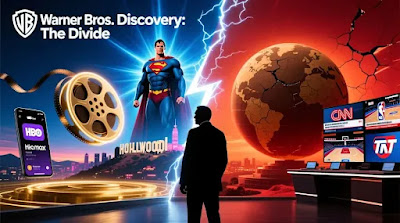
Fast forward to the Q3 2025 earnings report that dropped on November 7. Suddenly, the glow of that superhero success feels a bit overshadowed by the cold, hard numbers. While Superman was out there supercharging the studio earnings, the “old guard”—that traditional cable TV world—is dragging the whole company down into a $148 million net loss. It’s like a classic comic book battle, honestly. You’ve got the shiny new superhero fighting the crumbling villain of cord-cutting. Straight up, it’s a tale of two very different media worlds colliding in real-time.
The Numbers: Superman’s Flight vs. Cable’s Fall
Look, the studio side is flying high, no doubt about it. Thanks to Superman and some properly clever marketing, movie revenues jumped by a staggering 74%. That pushed the entire studio segment to $3.3 billion for the quarter. That is a massive figure, especially when you consider how tough the box office has been lately. But then you look at the other side of the house—the Linear TV stuff like CNN and the Discovery Channel.
Traditional TV revenues didn’t just dip; they plunged. We’re talking about a 23% drop, with ad sales down by 21%. It’s a perfect storm, really. People are ditching cable for TikTok scrolls and Netflix binges. Advertisers aren’t stupid either; they’re just following the eyeballs. As one analyst put it, linear TV isn’t just struggling; it’s basically in hospice care at this point. Fact.
The “John Deere” Parallel: Precision Marketing
I keep bringing up John Deere (DE) in my posts because its Q3 2025 story is strangely similar. While the broad construction market was flat as a pancake, Deere’s ag-equipment surge (up 12%) was driven by “precision tech.” They focused on what actually works and ignored the rest.
WBD is doing the same thing with Superman. They didn’t just release a movie; they released an “ecosystem.” From Nike apparel to McDonald’s Happy Meals, they squeezed every single cent out of that IP. Just like Deere’s AI tractors are more profitable than the old-school ones, Superman’s digital and merchandise sales are where the real profit hides. It’s a properly smart move in a market that’s fragmented into pieces. Straight up.
Digging into the Budget: Why $615M Isn’t Enough
Let’s talk money. Superman’s production budget was a whopping $350 million. When you add marketing and global prints, the total cost shot up to somewhere between $475 million and $525 million. Now, theaters usually keep about half the ticket sales. This means WBD only pocketed about $320 million from the box office.
On paper, that looks like a loss, right? But don’t hit the panic button. The real gold is in the ancillaries—digital sales, streaming rights, and toys. In Q3 alone, theatrical revenue surged 74% because of this “long tail” effect. This is how a studio can lead the industry with just 11 releases, crossing the $4 billion mark for the first time.
Linear TV: The Lead Weight Sinking the Ship
Ah, linear TV—the elephant in the room. Once WBD’s cash cow, networks like TNT, TBS, and CNN are now feeling like lead weights. In 2025, the ritual of flipping through cable channels feels as outdated as a flip phone. U.S. pay-TV households have dropped below 50 million for the first time.
CNN’s prime-time viewership is down 15%, as people switch to podcasts and YouTube. Ad dollars are following them, with linear networks losing $2 billion industry-wide this year alone. WBD responded with 1,000 job cuts in Q1, but it’s a painful, slow-motion decline. Without an Olympics boost this year, the drop was even more noticeable.
The Split: Is a Divorce Finally Necessary?
CEO David Zaslav has been dropping hints about a “strategic split” by mid-2026. Imagine WBD cutting its ties with the fading cable networks so the shiny new studios and streaming combo (Warner Bros. + Max) can fly solo.
It’s bold, it’s risky, but it makes total sense if you think about it. Studios trade at much higher valuations than cable networks. By splitting them, WBD could potentially unlock $20 billion in market value. It’s basically like Clark Kent taking off the glasses and suit to become Superman—it’s finally time to show the world what the core assets are really worth. Properly exciting for shareholders, if they can pull it off without breaking anything.
Streaming: Steady but Under Pressure
While the cable side is bleeding out, Max added 2.3 million subscribers, reaching a total of 128 million. That’s a good sign, sure, but the revenue stayed flat at $2.63 billion. Why? Because as they expand internationally, the average money they make per user (ARPU) is taking a hit, down to $6.64.
To be fair, the ad-supported tiers are growing by 15%. This shows that people are actually okay with a few commercials if it saves them a few bucks on the monthly bill. But for WBD to really compete with the big dogs like Netflix, they need more than just one superhero in the bank. They need a consistent stream of hits so people don’t hit that “cancel” button the moment the credits roll. Simple as.
Practical Tips for WBD Investors & Fans
If you’re watching this from the sidelines, here is my “friend-to-friend” advice:
- Watch the Debt Numbers: WBD paid off $1.2 billion this quarter. If they keep trimming the fat, they’ll be in a much stronger position for that 2026 split.
- Follow the DCU Slate: Superman’s success means the reboot is officially on. Look out for Supergirl: Woman of Tomorrow in 2026.
- Check the Bundles: That Max + Disney+ bundle is pulling in 1 million new subs a quarter. Bundling is the “new Cable,” and it’s actually working.
- Don’t ignore the Small Stuff: The real profit isn’t just in ticket sales; it’s in the sneakers, toys, and digital rentals. That’s what kept the studios afloat this quarter. Fact.
Final Thoughts
Look, Superman might have supercharged the earnings this quarter, but even the Man of Steel can’t fix a broken business model in one day. Warner Bros. Discovery is a company in transition—one foot is stuck in the profitable past of cable, and the other is in the expensive future of streaming.
The flight path is set, but it’s going to be a bumpy ride until that 2026 split happens. Stay sharp. Keep an eye on the box office numbers. Let’s see if James Gunn’s vision can truly save the day. Heroes rise from the ashes, and WBD is definitely feeling the heat right now. Straight up.
FAQ
Did Superman actually make money for Warner Bros. Discovery?
Look, theatrically it was a bit of a tight squeeze because of the massive $350 million budget. But when you add up the digital sales, merchandise, and streaming rights, it’s a proper win. It pushed the studio segment to $3.3 billion this quarter. Fact.
Why is WBD still reporting a net loss despite Superman’s success?
To be fair, the “old guard”—that traditional cable TV world—is dragging them down. Ad revenue for linear networks fell 21% as more people ditched cable for streaming. That legacy baggage is what led to the $148 million loss. Straight up.
What is this ‘Strategic Split’ everyone is talking about?
Properly speaking, WBD is thinking about dividing the company by mid-2026. One part would be the high-growth studios and streaming (Warner Bros. + Max), and the other would be the shrinking cable networks. It’s all about unlocking value for shareholders. Simple as.
How is Max performing compared to Netflix?
Max is doing okay—they hit 128 million subscribers this quarter. While it’s steady growth, they need a consistent stream of hits (like more Superman-level stuff) to keep up with Netflix’s massive lead. The ad-supported tiers are helping, though. Fact.