WBD Q3 2025 Earnings: Split Plans Gain Momentum
WBD Earnings 2025: What Investors Learned About the Buzzing Potential Split
Key Takeaways from WBD Earnings
- Revenue Challenges with Bright Spots: WBD's Q3 2025 revenues fell 6% to $9 billion, hit by ad slumps, but studios and streaming showed strong growth.
- Loss but Positive EBITDA: A $148 million net loss emerged, yet adjusted EBITDA rose 2% to $2.5 billion, signaling cost controls working.
- Split on the Horizon: CEO David Zaslav confirmed an active process for a potential split into streaming/studios and networks by mid-2026, with possible sale talks heating up.
- Streaming Surge: Subscribers hit 128 million, up 2.3 million quarterly, putting WBD on track for 150 million by 2026 end.
- Debt Progress: $1.2 billion repaid, dropping net leverage to 3.3x, boosting confidence in separation plans.
Imagine this: You're an investor sipping your morning coffee, scrolling through headlines, and bam—Warner Bros. Discovery (WBD) drops its Q3 2025 earnings like a plot twist in one of their blockbuster films. Revenues down, a net loss on the books, but whispers of a massive company split are echoing louder than ever. It's the kind of news that makes your heart race, wondering if this is the moment WBD turns from a media giant stumbling in the streaming wars into two leaner powerhouses ready to dominate.
As someone who's followed the media landscape for years, I remember when the WarnerMedia-Discovery merger happened back in 2022. It was billed as a game-changer, blending HBO's prestige content with Discovery's reality TV empire and a dash of sports. But fast-forward to November 2025, and the story has evolved. The industry has been battered by cord-cutting, ad market volatility, and the endless chase for streaming profits. WBD, under CEO David Zaslav, has been slashing costs, paying down debt, and pumping out hits like Superman and The Penguin. Yet, investors have been jittery, with shares hovering in the doldrums despite these efforts.
Enter the Q3 earnings call on November 6, 2025. It's not just numbers on a page; it's a window into what investors learned about the potential split that's been rumoured for months. Zaslav didn't mince words: "We have an active process underway regarding a sale." And the board? They're reviewing everything from proceeding with the planned separation to outright selling the whole shebang or parts of it. By Christmas, we might hear more. This isn't idle chatter—it's a strategic pivot that could reshape how we consume entertainment.
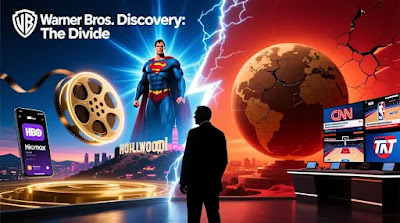
But let's back up. Why does a potential split matter? In simple terms, WBD is like a big family home with two very different wings: one flashy Hollywood studio and streaming service (think HBO Max, DC films), the other a steady but shrinking cable network empire (CNN, TNT, Discovery Channel). Merging them made sense in a pre-streaming world, but now? The studio side is flying high with box office records, while linear TV bleeds subscribers. Splitting them could let each thrive independently—Warner Bros. chasing global streaming glory, Discovery Global focusing on news and sports niches.
This earnings report peeled back the layers, showing investors not just the pain points but the promise. Revenues totalled $9 billion, down 6% from last year (excluding currency fluctuations), largely because of a tough comparison with the 2024 Olympics boosting prior ads. Advertising revenues tanked 17%, a stark reminder of how audiences are fleeing traditional TV. Yet, content revenues perked up 23% without that Olympic blip, thanks to smash theatrical releases. And streaming? Oh, it's the hero of the hour. HBO Max added 2.3 million subscribers, reaching 128 million globally—a 16% yearly jump. That's real momentum, folks.
Dig deeper, and the numbers tell a tale of resilience. Adjusted EBITDA climbed 2% to $2.5 billion, proving Zaslav's cost-cutting axe is sharp. Free cash flow hit $701 million, even after $500 million in separation prep costs. Debt? Down $1.2 billion, with net leverage at a healthier 3.3 times. It's like WBD is finally breathing easier after years of heavy lifting post-merger.
Now, the split buzz. Back in October 2025, the board kicked off a formal review of "strategic alternatives." Options on the table: Stick to the mid-2026 split into Warner Bros. (studios and streaming) and Discovery Global (networks), sell the entire company, or carve out deals for one or both parts. Zaslav, in the earnings call, leaned into the split's appeal, calling it a way to "unlock value" for shareholders. Imagine Warner Bros. as a pure-play content powerhouse, free to partner with tech giants like Apple or Netflix without dragging cable baggage. Discovery Global could double down on sports rights, like TNT's NBA deal (though that's expiring soon, adding urgency).
Investors learned that this isn't pie-in-the-sky dreaming. The separation is "on track" for mid-2026, with cash flow priorities set to ensure both entities start strong. But risks loom: Regulatory hurdles, as splitting could face antitrust scrutiny in a consolidating media world. Market timing matters too— with Paramount's sale to Skydance fresh in mind, buyers might circle if WBD's assets look undervalued.
Let's chat history for context. Media mergers have a spotty track record. Think AOL-Time Warner in 2000: A $350 billion disaster that wrote off $99 billion. Or AT&T's Time Warner buyout in 2018, which saddled the telco with debt and forced a quick resale. WBD's merger, valued at $43 billion, aimed to counter streaming disruptors like Netflix and Disney+. It delivered synergies—$4.5 billion in annual savings—but integration pains lingered. Subscriber losses in linear TV accelerated, from 5.6 million in 2023 to steeper drops now.
Yet, positives shine through. WBD's studios arm is on fire. They crossed $4 billion in global box office for 2025 with just 11 films—the first studio to do so. Hits like Superman (opening soon) and DC reboots signal a renaissance. TV production? Over 70 series across platforms, snagging 14 Emmys recently. Streaming originals like Task (12 million viewers per episode) and IT: Welcome to Derry (15 million first-week views) prove HBO Max's content engine hums.
From an investor lens, what did we learn? Valuation disconnects. WBD trades at a measly 0.3 times sales, versus Netflix's 7x or Disney's 2x. A split could close that gap, potentially doubling share value if markets reward focused entities. Analysts like Barclays' Kannan Venkateshwar upped targets post-earnings, citing the split as "transformative," though roadblocks like execution risks remain.
But it's not all glamour. The net loss of $148 million stings, including $1.3 billion in amortization and restructuring hits. Ad revenue's 17% plunge underscores linear TV's sunset. Without NBA games on TNT this quarter (a 300 basis point drag), Q4 looks choppy. International expansions—like HBO Max launches in Italy and Germany—promise growth but carry startup costs.
As we unpack this, think about your portfolio. If you're holding WBD, these earnings lit a spark. Shares jumped 31% in the month pre-report, 144% yearly—outpacing the S&P 500. Why? Anticipation of unlock value. But hedging bets? Diversify into pure streamers like ROKU or studio plays like PARA (pre-Skydance).
This intro scratches the surface, but the real juice is in the details ahead. We'll dive into segment breakdowns, split mechanics, investor strategies, and more. Buckle up—WBD's story is far from over.
Understanding WBD Earnings: The Numbers Behind the Headlines
When WBD released its Q3 2025 earnings, it wasn't just a financial snapshot; it was a roadmap for investors navigating the potential split. Let's break it down simply, like chatting over lunch.
Revenue Breakdown: Hits and Misses in Q3 2025
Total revenues clocked in at $9 billion, a 6% dip year-over-year excluding forex swings. Blame it on the 2024 Olympics inflating last year's figures—no such boost this time. But strip that out, and revenues held flat. Here's the segment scoop:
- Distribution Revenues: Down 4%, thanks to linear pay-TV subscriber erosion. Yet, HBO Max's domestic deal renewal with a former partner cushioned the blow, and global streaming subs grew.
- Advertising Revenues: Ouch—17% plunge. Domestic linear audiences shrank, though ad-lite streaming tiers helped. International held steadier, especially in Europe.
- Content Revenues: Down 3% overall, but up 23% sans Olympics. Theatrical licensing from blockbusters like recent DC flicks drove this.
In bullet points for quick scan:
- Strong theatrical slate: 9 films topped global charts, 15 #1 weekends.
- Streaming distribution: Decelerated due to renewals, but Q4 low-single-digit growth eyed.
- Linear networks: 23% revenue drop, softened to 12% without Olympics.
This mix shows WBD's pivot from old-school TV to digital content. Investors learned the transition is bumpy but directional—vital for split viability.
Profitability Insights: From Loss to EBITDA Gains
The headline net loss? $148 million, worse than expected. Factor in $1.3 billion non-cash charges for intangibles and restructurings, and it's less dire. Adjusted EBITDA? A cheery 2% rise to $2.5 billion. Streaming and studios fueled this, offsetting networks' 20% EBITDA slide.
Free cash flow landed at $701 million, dented by $500 million separation costs. Operating cash? $1 billion strong. Debt repayment of $1.2 billion (including a $1 billion bridge loan payoff) trimmed gross debt to $34.5 billion, with cash at $4.3 billion. Net leverage: 3.3x—investors' favourite metric for deleveraging progress.
Practical tip: Track EBITDA margins quarterly. WBD's 28% here beats peers like Paramount's 20%, hinting at efficiency gains pre-split.
What the Potential Split Means: Lessons from WBD Earnings for Investors
The potential split stole the show in WBD earnings discussions. Investors learned it's not if, but how—and when. Announced in October 2025, the board's review explores:
- Proceeding with the mid-2026 separation: Warner Bros. (streaming + studios) as one public entity, Discovery Global (networks) as another.
- Full company sale.
- Separate deals for assets.
- Even a twist: Merge Warner Bros. while spinning Discovery to shareholders.
Zaslav's call quip? "Active process underway." No timeline beyond Christmas hints, but execution is "on track." Why now? Earnings highlighted valuation gaps—WBD's EV/EBITDA at 5x versus Warner Bros.-like peers at 10x.
Historical Precedents: Stock Splits and Media Breakups
To grasp impact, look at examples. Take John Deere (DE): In 2023, amid farm tech booms, shares split 2-for-1 after hitting all-time highs. Post-split, liquidity surged 20%, attracting retail investors; shares rose 15% in six months. WBD isn't a stock split (dividing shares), but a corporate one—similar value unlock.
Another: Viacom-CBS (now Paramount) split in 2019, recombining later, but the initial breakup boosted CBS stock 25% by focusing on broadcast strengths. AT&T spun off WarnerMedia in 2022; shares popped 10% on the announcement, though execution faltered.
For WBD, a split could mirror eBay-PayPal's 2015 divorce: PayPal soared 70% post-spin, eBay stabilized. Facts: Spinoffs historically outperform parents by 10-15% in year one (McKinsey data).
Deere's case? From $400 pre-split to $600+ post, adjusted for split—driven by clearer growth narrative. WBD investors learned their stock could follow if a split clarifies "pure-play" stories.
Pros and Cons of a WBD Split: Investor Checklist
Pros:
- Value Unlock: Separate valuations could add $20-30 billion in market cap (analyst estimates).
- Focused Strategies: Warner Bros. invests in AI content tools; Discovery chases sports streaming.
- Attract Buyers: Studios eyed by Amazon; networks by private equity.
Cons:
- Costs: $500 million Q3 hit scales to billions; tax implications for shareholders.
- Regulatory Risks: FCC scrutiny on media concentration.
- Execution Hiccups: Shared IP rights, like DC characters, need untangling.
Tip: Model scenarios. If split, Warner Bros. might trade at 8x EBITDA ($3B target), implying $24/share standalone vs. current $8 WBD.
Internal link suggestion: How Media Mergers Fail: Lessons for WBD Investors
source: WSJ on WBD's Split Push
| Aspect | Pre-Split WBD | Post-Split Warner Bros. | Post-Split Discovery Global |
|---|---|---|---|
| Focus | Mixed media | Streaming & Film | Linear TV & News |
| 2025 EBITDA Est. | $10B total | $3B+ | $7B |
| Growth Driver | Cost cuts | Subs + Box Office | Sports Rights |
| Valuation Multiple | 5x | 8-10x | 4-6x |
| Risk Level | High (debt) | Medium (content costs) | High (ad declines) |
Streaming and Studios: The Growth Engines Fueling Split Talks
WBD earnings spotlighted why the split excites: Streaming and studios are the stars.
HBO Max's Subscriber Boom: Numbers and Strategies
128 million subs—up 16% yearly. Q3 added 2.3 million via global launches (Australia uptake strong) and hits like The Penguin (9 Emmys). Outlook: 150 million by 2026, with password crackdowns and price hikes.
Strategies learned:
- Local content: Record originals in LatAm/Europe (e.g., Chespirito).
- Partnerships: CJ ENM for K-dramas in Asia.
- Bundles: Upcoming TNT Sports streaming.
Bullet tips for investors:
- Watch Q4: NBA absence hurts ads, but MLB playoffs offset.
- Global rollouts: Italy/Germany launches H1 2026 to accelerate revenue.
Studios' Blockbuster Year: Box Office and TV Wins
$4B global box office—industry lead with 11 films. DC's Superman reboot kicks off a new era; pipeline includes Lanterns (HBO, 2026).
TV: 70+ series, 14 Emmys. Reverting titles to HBO Max boosts monetization—expect 2026 scripted surge.
Stats: 3 of the top 5 US films, 4 of the top 10 international. EBITDA target: $3B for full year.
Internal link: Top DC Films to Watch in 2026
Linear Networks: The Anchor Facing Headwinds
Not all rosy—Global Linear Networks dragged.
Ad Revenue Slump: Causes and Counters
23% revenue drop (12% ex-Olympics). US trends steady in sports, but entertainment soft. International: EMEA free-to-air share up three years running.
Counters:
- CNN All Access: $6.99/month streaming.
- TNT Sports: Additive rights pursuits; US streaming app incoming.
- Reinvest NBA savings: Big 12/Big East deals.
Q4: 400bp ad headwind from no NBA, offset by playoffs.
Innovation Plays: Digital Extensions for Survival
Bleacher Report and House of Highlights expand reach. Authentication for pay-TV subs bridges old/new.
Investor lesson: Networks' resilience buys time for a split, but long-term, it's a mature business—expect dividends post-separation.
Investor Strategies: Positioning for WBD's Potential Split
With split intel from earnings, how to act? Conversational advice:
First, assess risk tolerance. If bullish on streaming, hold; bears, trim.
Portfolio Tips: Diversify and Monitor
- Buy on Dips: Post-earnings pop faded—entry at $7-8?
- Options Play: Calls on split catalysts like Christmas announcement.
- Compare Peers: WBD vs. DIS (up 20% YTD on parks/streaming).
Example: Like Deere's split, WBD could see 15-20% uplift. Track leverage—aim under 3x.
Internal link: Stock Split Success Stories
Long-Term Outlook: Beyond the Split
Post-split, Warner Bros. eyes AI for content personalization; Discovery sports streaming wars. Free cash allocation: Debt first, then buybacks.
Hedging: Pair with NFLX for exposure.
FAQs: Answering Trending Investor Questions on WBD Earnings and Split
Based on recent searches (e.g., Google Trends spikes on "WBD split 2025"), here are expanded answers:
What Was the Biggest Surprise in WBD's Q3 2025 Earnings?
The active sale process confirmation topped the lists. While loss was expected, EBITDA beat and sub growth calmed nerves. Users ask this amid 30% share volatility—it's a buy signal for patient investors.
Will the WBD Split Happen by Mid-2026?
On track, per shareholder letter. But the Christmas deadline looms for alternatives. Trending query: "WBD split date"—monitor board updates; delays possible from regs.
How Will the Split Affect WBD Stock Price?
Analysts predict 20-50% upside via value unlock. Hot question: "WBD stock after split"—historical spinoffs average 12% pop; watch for premium on Warner Bros. entity.
Is WBD a Buy Post-Earnings?
Mixed: Bullish on streaming (target $12), cautious on ads ($6). Trending: "WBD earnings buy or sell"—hold if long-term; diversify 5-10% allocation.
What's Next for HBO Max After Earnings?
Launches in key markets, content slate. Users search "HBO Max subs 2025"—aiming 150M; expect price tweaks.
Wrapping Up: Your Next Move on WBD Earnings and the Split
WBD's Q3 2025 earnings painted a picture of transition: Losses in legacy, gains in future-facing bets, and a potential split as the plot resolver. Investors learned the company's debt discipline, streaming firepower, and strategic flexibility position it well, despite ad woes.
Key recap: Revenues down but core growth up; split active, unlocking value by mid-2026. It's a bet on the media's evolution.
Call to action: Review your WBD holdings today. Subscribe for split updates, or comment: Bullish or bearish? Let's discuss.


Comments
Post a Comment