Senate Rebukes Trump's Global Tariffs
Senate Rebukes Trump's Global Tariffs: A Symbolic Stand Against Executive Overreach
The Legislative Battle: How Congress Targeted Trump's 'Liberation Day' Tariffs
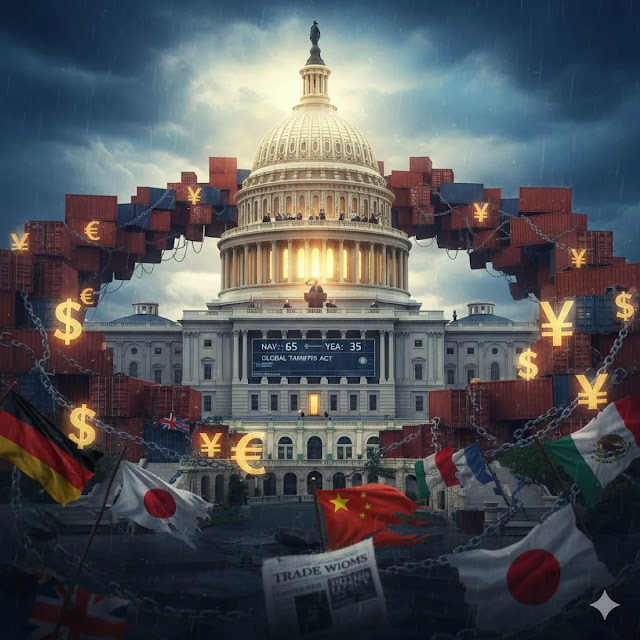
The United States Senate’s decision to nullify President Donald Trump’s sweeping global tariffs marked a significant, albeit politically constrained, moment in the ongoing debate over presidential power versus congressional authority
. The vote, which occurred on October 30, 2025, passed by a narrow margin of 51 to 47, representing the culmination of a strategic legislative campaign aimed at challenging the legality and economic consequences of what was branded as "Liberation Day" tariffs. These tariffs, announced by President Trump in April 2025, established a universal baseline duty of 10 percent on all imported goods from nearly every country in the world, with higher rates applied to nations deemed to have the largest trade deficits with the U.S.. The core of the legislative effort was not merely to oppose a specific tax measure but to contest the very foundation upon which it was built: President Trump’s invocation of the International Emergency Economic Powers Act (IEEPA) of 1977 to declare a national emergency over persistent U.S. trade deficits. This move was seen by many lawmakers as an unprecedented expansion of executive authority, fundamentally altering the balance of power between the branches of government in matters of international commerce and taxation.
The tactical execution of the Senate's opposition was crucial to its success. Rather than attempting a direct confrontation that might have been subject to a filibuster requiring 60 votes, Democrats orchestrated the repeal effort using a decades-old statute, allowing them to bypass standard procedural hurdles
. This maneuver meant the resolutions only needed a simple majority to pass, a threshold they consistently met through a combination of unanimous Democratic support and the defection of several Republican senators. The strategy unfolded in phases, beginning with targeted resolutions aimed at specific allies before escalating to a comprehensive measure against the global tariff regime. First, on October 29, 2025, the Senate passed a resolution to end the tariffs imposed on Canada by a vote of 50-46. Two days later, on October 28, 2025, another resolution successfully repealed the tariffs on Brazil, passing 52-48. These initial victories were not just about removing specific duties; they served as critical political and procedural building blocks, demonstrating a clear pattern of dissent within the Senate and establishing a precedent for challenging the administration's expansive use of emergency powers.
The final and most significant vote came on October 30, 2025, when the Senate passed Senate Joint Resolution 88, introduced by Senator Ron Wyden (D-OR), to terminate the national emergency declaration that justified the broad-based global tariffs
. The passage of S.J.Res. 88 by a 51-47 vote effectively sought to invalidate the legal basis for tariffs affecting more than 100 nations. The resolution was framed as a necessary step to restore congressional authority over trade policy, a power enshrined in Article I of the Constitution. Senator Wyden argued that tariffs are a form of taxation, and such power should not be delegated to the executive branch through broad emergency declarations. This constitutional argument resonated with both Democrats and a small but influential bloc of Republicans who grew increasingly concerned about the economic damage wrought by the unpredictable and sweeping nature of the tariff policy. The vote reflected a deepening unease over a strategy that critics described as chaotic, relying on unpredictable announcements and secretive one-on-one deals that disrupted customs operations and damaged the predictability essential for global trade.
This legislative action was part of a longer history of resistance to the administration's trade policies. An earlier attempt at a similar repeal measure had failed in April 2025 by a 49-49 tie vote, highlighting the razor-thin margins and the pivotal role of individual senators
. The absence of key figures during that vote, including then-Majority Leader Mitch McConnell and Senator Sheldon Whitehouse (D-R.I.), proved decisive. Their presence and subsequent votes in favor of the October resolution were instrumental in securing the necessary majority. The successful repeal also benefited from a broader context of legal challenges. Lower federal courts had already issued rulings declaring the administration's use of IEEPA to impose sweeping tariffs on trade partners to be unlawful, setting the stage for an appeal to the Supreme Court. The Senate's action, therefore, occurred at a critical juncture where the legislative body was confronting both the tangible economic fallout and the questionable legality of the president's actions. Despite the symbolic weight of the vote, the resolution faced a formidable path ahead, as will be discussed later, making its immediate impact on policy uncertain while its long-term significance as a statement of legislative intent remains clear
| Senate Actions on Trump Tariffs (2025) | | :--- | :--- | :--- | :--- | | Date | Resolution/Action | Vote Result | Key Supporters | | Oct 30, 2025 | Passes S.J.Res. 88 to end global tariffs affecting >100 nations
| 51-47 | Democrats + 4 Republicans (Paul, McConnell, Murkowski, Collins) | | Oct 29, 2025 | Passes resolution to end tariffs on Canada | 50-46 | Democrats + 4 Republicans (Collins, Murkowski, McConnell, Paul) | | Oct 28, 2025 | Passes resolution to end tariffs on Brazil | 52-48 | Democrats + 5 Republicans (Collins, Murkowski, McConnell, Paul, Tillis) | | Apr 10, 2025 | Failed vote on a similar resolution to block global tariffs | 49-49 (Tie) | Absence of McConnell and Whitehouse was critical|
Economic Fallout: The Human and Corporate Cost of the Trade War
The legislative push to repeal President Trump's sweeping global tariffs was overwhelmingly driven by a rapidly accumulating body of evidence detailing the severe economic harm inflicted upon American businesses, workers, and consumers
. The economic narrative is not one of abstract market fluctuations but of tangible financial losses, workforce reductions, and rising prices that directly impacted the daily lives of millions. One of the most compelling and frequently cited examples of this damage is the case of John Deere, a cornerstone of American manufacturing and agriculture. The company, a major producer of agricultural and construction equipment, found itself caught in the crossfire of retaliatory tariffs and domestic policy uncertainty. John Deere publicly attributed a staggering $600 million in annual costs directly to tariffs, with $300 million incurred by mid-2025 and another $300 million anticipated by year-end. These costs stemmed primarily from tariffs on steel and aluminum, which are fundamental inputs in the production of tractors and other machinery. This direct hit to the company's bottom line resulted in a 26% year-over-year decline in net income for the quarter ending July 24, 2025, and a further 29% decline compared to the previous year in its most recent quarter report.
The financial strain at John Deere rippled outward into its workforce. In response to declining sales and soaring input costs, the company was forced to implement layoffs, cutting 238 employees across factories in Illinois and Iowa during the summer of 2025
. This human cost underscores the direct link between trade policy and labor market outcomes. The situation was compounded by the fact that even though John Deere sourced only 25% of its components from foreign countries and assembled 75% of its machines domestically, the upstream tariffs on raw materials still created a disproportionate impact on its downstream operations. Furthermore, the trade conflict extended beyond direct tariffs. Retaliatory tariffs imposed by China on U.S. agricultural exports decimated demand for John Deere's customers. The price of soybeans, a key crop, dropped 40% since 2022, while corn prices fell 50%, weakening farmers' ability to invest in expensive new equipment. This illustrates a critical feedback loop: tariffs on imports lead to retaliatory tariffs on exports, which in turn reduce demand for the capital goods produced by domestic manufacturers. The uncertainty generated by the erratic tariff policy was also a major deterrent to long-term investment, creating a "pen-stroke risk" that made it difficult for farmers and businesses to plan for the future.Beyond the case of a single corporation, the macroeconomic data paints a grim picture of widespread disruption across the U.S. economy. The Center for American Progress (CAP) identified a sharp downturn in manufacturing employment, reporting that the sector shed 12,000 jobs in August 2025 alone, with a total of 42,000 manufacturing jobs lost since April of that year
. This trend was corroborated by automakers, who announced nearly 5,000 job cuts in July 2025, partly attributable to the adverse impacts of tariff pressures. The Federal Reserve Bank of St. Louis has documented a long-term decline in manufacturing employment, a trend that the policy uncertainty surrounding the tariffs appears to have exacerbated significantly. This environment of instability fostered a "no-hire economy," characterized by very low hiring rates that severely impacted young workers and those seeking new employment, as businesses became hesitant to commit to long-term investments and workforce expansions.
Perhaps the most direct and visible impact of the tariffs was on the American consumer. Multiple analyses confirmed that tariffs function as taxes, with a significant portion of the cost being passed down the supply chain and absorbed by households. Research from the Federal Reserve Bank of St. Louis found that the first round of Trump-era tariffs added 0.5 percentage points to the core Personal Consumption Expenditures (PCE) inflation rate in 2019
. A separate estimate from the Boston Federal Reserve in 2025 placed the inflationary effect at 0.75 percentage points. Consumer advocates warned that Americans bear the brunt of these costs, with estimates suggesting that between 50% and 70% of the total tariff burden is ultimately paid by consumers in the form of higher prices. Product categories such as furniture, car parts, electronics, and clothing saw noticeable price increases due to the levies. For instance, the list price for new tractors from John Deere has increased by at least 60% over the past eight years, pushing farmers toward the more affordable used equipment market. This surge in prices was particularly acute for lower- and middle-income households, which spend a larger share of their income on tradable goods. The cumulative effect was a squeeze on household budgets, with over three-quarters of Americans reporting that their monthly expenses had risen by more than $100 due to the tariffs. This erosion of purchasing power, combined with the chilling effect on business investment, created a self-inflicted wound on the U.S. economy, prompting calls from lawmakers and business groups alike for a return to more stable and predictable trade policies.
A Schism Within the GOP: Why Four Senators Defied the President
A defining feature of the Senate's successful vote to repeal the global tariffs was the consistent and decisive defection of four senior Republican senators: Mitch McConnell of Kentucky, Rand Paul …of Kentucky, Lisa Murkowski of Alaska, and Susan Collins of Maine.
. These were not junior or obscure legislators; they were powerful figures within their respective committees and constituencies, representing states with significant manufacturing and agricultural interests. Their repeated alignment with Democrats against the president's own party created a stark schism within the GOP, signaling that the economic toll of the administration's protectionist policies had reached a point of political and practical unacceptability, even for staunchly conservative lawmakers. Their collective opposition was not a one-off occurrence but a sustained pattern of resistance, having previously crossed party lines to vote for resolutions repealing the tariffs on Canada and Brazil. This consistency demonstrated a principled stance against the administration's use of emergency powers and a pragmatic assessment of the policy's damaging consequences.
Senator Mitch McConnell, the Senate Minority Leader, provided some of the clearest articulations of the economic rationale for his opposition. He publicly stated that tariffs make "both building and buying in America more expensive," a sentiment echoed by the observed rise in consumer prices and input costs for domestic industries
. His position carried significant weight, as it suggested a top-tier leader of the Republican Party viewed the president's economic strategy as counterproductive to American prosperity. Similarly, Senator Rand Paul, a vocal advocate for limited government and free-market principles, criticized the underlying justification for the tariffs. He dismissed the president's claim that a trade deficit constituted a national emergency as a "fallacy" and "completely meaningless accounting of trade," arguing that the resulting tariffs act as taxes that harm everyday consumer purchases and stifle business growth. Paul's co-sponsorship of the repeal resolution underscored a shared philosophical opposition to the broad application of tariffs as a tool of economic policy.
The motivations behind their defiance were multifaceted, blending constitutional concerns with palpable economic distress felt in their home states. Senator Susan Collins of Maine, a state with a strong industrial and fishing economy, and Senator Lisa Murkowski of Alaska, whose state's economy is heavily reliant on natural resource exports, likely saw firsthand the negative repercussions of retaliatory tariffs and global market disruptions
. While the provided documents do not contain direct quotes from them on this specific issue, their consistent voting record indicates a prioritization of their constituents' economic well-being over unwavering loyalty to the president's agenda. Their actions suggest a recognition that the president's aggressive tactics were alienating trading partners and harming American exporters, a classic dilemma for politicians representing export-oriented states. This internal division within the Republican ranks was a critical factor in the Senate's ability to muster the votes needed for the repeal, transforming what could have been a purely partisan affair into a rare moment of cross-party cooperation driven by shared economic anxieties.
The contrast between these four senators and their Republican colleagues was stark. On the other side of the aisle, Senate Finance Committee Chairman Mike Crapo (R-ID) staunchly defended the administration's approach
. He argued that the president's tariff strategy was yielding tangible results, pointing to new trade deals and the resumption of Chinese purchases of U.S. soybeans as evidence of its effectiveness. Other farm-state Republicans like Roger Marshall (R-KS) and Kevin Cramer (R-ND) expressed cautious optimism about the benefits for farmers from the new China deal, even while acknowledging the logistical and financial challenges remaining from the prior market disruptions. This divergence highlights the deep rifts within the party. While some Republicans remained committed to the president's leverage-through-tension strategy, others concluded that the short-term diplomatic gains were insufficient to offset the long-term economic damage being done to American families, businesses, and the broader economy. Vice President JD Vance's lobbying efforts on Capitol Hill, urging support for the tariffs as essential leverage in international negotiations, further illustrate the high-level defense of the policy from the executive branch. However, the steadfastness of the four Republican senators demonstrated that the legislative branch was becoming increasingly unwilling to serve as a rubber stamp for the administration's controversial trade war tactics.
The Diplomatic Dimension: A New China Deal Amidst Legislative Conflict
While the U.S. Senate engaged in its legislative battle to nullify President Trump's global tariffs, a parallel development in the realm of diplomacy was unfolding, adding a complex layer to the narrative. Coinciding almost perfectly with the Senate's passage of the resolution to end the global tariffs on October 30, 2025, President Trump announced a new trade agreement with China following a meeting with Chinese leader Xi Jinping in South Korea
. This diplomatic breakthrough served as a powerful counter-narrative to the legislative rebuke, framing the administration's tariff policy as a successful negotiating tactic rather than an economically damaging blunder. Under the terms of the deal, China agreed to purchase 25 million metric tons of U.S. soybeans annually for the next three years, starting with 10 million metric tons for the remainder of 2025. This agreement was presented as a significant victory for American farmers, who had suffered immensely when China, previously the largest buyer of U.S. soybeans, had imposed a moratorium on purchases during the height of the trade war. The 2024 U.S. soybean exports to China totaled nearly 27 million metric tons, meaning the new deal restored but did not exceed the pre-trade-war levels of trade.
Supporters of the administration, including farm-state Republican senators like Roger Marshall (R-KS), hailed the deal as "huge news" for agriculture, arguing that it demonstrated the efficacy of the president's leverage-through-tariff strategy
. From this perspective, the tariffs were not an end in themselves but a means to compel China to take concrete steps to address the trade imbalance and protect U.S. interests. The administration also highlighted other concessions from Beijing, including commitments to help curb the flow of fentanyl precursor chemicals into the U.S. and to ease export controls on rare earth minerals, which are critical to U.S. manufacturing and technology sectors. This diplomatic success was used to justify the continuation of tariff threats and to argue that any legislative attempts to limit the president's trade authority would undermine his ability to secure further favorable agreements. Senate Finance Committee Chair Mike Crapo reinforced this view, stating that the president's negotiations "are bearing fruit" and that tariffs should be more targeted to avoid causing unnecessary domestic harm.
However, critics of the administration's policy offered a starkly different interpretation of the China deal. They argued that it was less a genuine trade victory and more a costly admission of defeat, a political spin designed to distract from the severe economic damage caused by the preceding trade war
. According to this viewpoint, the tariffs themselves were responsible for destroying the lucrative soybean market, and the current agreement is merely a taxpayer-funded compensation package to repair the damage. Senator Chuck Schumer (D-NY) dismissed the deal as such, accusing the administration of leaving American families, farmers, and small businesses to bear the brunt of the fallout from its erratic and destructive policies. Even among supporters of the deal, there was acknowledgment of the lingering scars. Farm-state senators admitted that, despite the new agreement, logistical and financial challenges remained for farmers trying to rebuild their businesses after years of market disruption. Furthermore, while welcomed, the reduction in tariffs on China was partial. After the meeting in South Korea, Trump announced a 10-percentage-point reduction on certain fentanyl-related tariffs, lowering the total duty from 57% to 47%, but other tariffs remained in place, with Senator Rand Paul warning they would continue to drive up consumer prices.This simultaneous legislative and diplomatic activity created a confusing and contradictory public message. On one hand, the Senate was voting to terminate the broad emergency declaration that enabled the tariffs, citing chaos and economic harm
. On the other hand, the executive branch was celebrating a negotiated settlement with China that relied on the threat of those same tariffs. This duality encapsulated the core tension of the entire trade policy dispute. It raised fundamental questions about whether the tariffs were a sustainable long-term strategy or simply a disruptive tool of brinkmanship. The China deal, therefore, cannot be viewed in isolation. Its value is measured against the immense collateral damage it was intended to remedy. The legislative repeal effort, in this context, can be seen as a direct response to the perceived failure of the tariff-as-leverage strategy, arguing that the costs of maintaining such a volatile and harmful policy far outweigh the benefits secured through secret negotiations. The entire episode highlighted the profound disconnect between the administration's diplomatic triumphs and the domestic economic reality facing American families and businesses.
Beyond the Vote: Procedural Barriers and the Unlikely Path to Repeal
Despite the Senate's successful vote to nullify the tariffs by a margin of 51 to 47, the resolution's journey from legislative action to enacted law was fraught with insurmountable obstacles, rendering its practical implementation highly improbable
. The primary barrier stood in the Republican-controlled House of Representatives, which institutionalized a procedural roadblock specifically designed to prevent such measures from advancing. In September 2025, House Republican leadership implemented a special rule that extended restrictions on considering resolutions aimed at ending the president's national emergency declarations related to tariffs, effectively blocking any floor vote on the matter until March 31, 2026. This rule created a formal, procedural wall that rendered the Senate's bipartisan approval largely moot. Without a corresponding vote in the House, the resolution could not proceed to the president's desk for signature. This legislative impasse underscored the limitations of checks and balances when one party controls both chambers of Congress and the presidency, allowing the executive and its allies in the House to effectively neutralize a majority opinion in the Senate.
Even if the House rule were somehow circumvented—a scenario widely considered politically impossible—the resolution would still face a second, equally daunting hurdle: an expected presidential veto
. President Trump had consistently defended his tariff strategy as a necessary and effective tool of foreign policy, describing it as essential leverage in international negotiations and a means to put American workers first. Given this public commitment, a veto was considered a certainty if the bill were to reach his desk. To override a presidential veto requires a two-thirds supermajority in both the House and the Senate, a feat that is exceptionally difficult to achieve without overwhelming consensus or a national crisis. Senator Rand Paul himself acknowledged the difficulty of mustering such a majority, noting that he believed a veto-proof coalition would only emerge in the event of an "economic calamity". With the administration claiming successes like the new China deal, the political motivation to mount a full-scale override effort appeared slim.
This convergence of procedural obstruction in the House and the certainty of a veto in the White House transformed the Senate's vote from a potential policy change into a powerful but symbolic statement. The action served multiple purposes beyond the immediate goal of repeal. Firstly, it created a permanent and irrevocable record of disapproval, providing a valuable asset for industry lobbyists and advocacy groups seeking greater policy certainty in the future
. Every roll call vote was a public declaration by senators that the use of sweeping tariffs and broad emergency powers was unacceptable. Secondly, the vote acted as a significant rebuke to the administration's methods, forcing a reckoning with the growing unease over the economic costs of the trade war. As Senator Tim Kaine (D-VA) noted, the symbolic impact of Republican defections could influence the president's behavior, sending a clear signal that such extreme measures would carry a heavy political price. Finally, the legislative effort kept the debate alive, ensuring that the constitutional question of executive overreach in matters of trade and taxation remained a central issue for public and political discourse.The paradox of the situation was that while the resolution was unlikely to succeed, the momentum behind it was real and growing. The narrow margins of the votes—often decided by just a few senators—indicated that the political landscape was shifting
. The consistent defiance of the four key Republican senators showed that the administration's base of support was eroding, particularly as the negative economic consequences became more pronounced and harder to ignore. Therefore, while the immediate legislative effort was stalled, it laid the groundwork for future challenges. Should the economic pain intensify or if the diplomatic outcomes fail to meet expectations, the precedent set by these votes could prove invaluable. The ultimate fate of the tariffs, however, remained firmly in the hands of the executive branch and the procedural rules of the House, leaving the Senate's action as a potent but temporary expression of legislative discontent rather than a definitive policy reversal.
Conclusion: A Recorded Disapproval in a Power Struggle Over Trade Policy
In conclusion, the U.S. Senate's passage of a resolution to nullify President Trump's sweeping global tariffs represents a landmark moment in the contemporary struggle over executive power and economic policy. The 51-47 vote on October 30, 2025, was more than a simple legislative action; it was a calculated and defiant rebuke of what many lawmakers viewed as an unconstitutional expansion of presidential authority under the guise of national emergencies
. By targeting the tariffs that affected more than 100 nations, the Senate challenged the very foundation of a trade strategy that had unleashed a torrent of economic uncertainty, job losses, and rising consumer prices across the nation. The corporate case of John Deere, with its reported $600 million in tariff-related costs and hundreds of layoffs, serves as a stark microcosm of the widespread hardship inflicted upon American businesses and their workers. This tangible economic damage was the primary driver behind the bipartisan movement to halt the policy, creating a powerful narrative that transcended party lines.
A crucial element of this story is the deepening schism within the Republican Party. The consistent and courageous defiance of four of its most senior members—Senators McConnell, Paul, Murkowski, and Collins—was a seismic event
. Their willingness to break ranks with the president demonstrated that the costs of the administration's protectionist tactics had become politically untenable, even for staunch conservatives. Their votes signaled a clear-eyed assessment that the strategy was inflicting more harm on the American economy than it was delivering benefits, a sentiment echoed by numerous economists and business leaders. This internal party friction stands as a testament to the divisive nature of the trade war and highlights the limits of presidential control over a deeply divided political landscape.
Ultimately, the resolution's path to becoming law was blocked by formidable procedural and political barriers. The determined opposition from House Republican leadership, which erected a procedural wall preventing the bill from ever reaching a vote, combined with the near-certainty of a presidential veto, ensured that the Senate's action would remain a powerful symbol rather than an immediate policy change
. This outcome underscores the inherent limitations of the legislative branch when confronted with a unified executive and a compliant majority in the other chamber. Nevertheless, the true significance of the vote lies in its permanence. It created an official, recorded disapproval of the administration's methods, a historical record that will be referenced in debates about trade policy for years to come. The legislative battle was fought and won in the Senate, serving as a crucial check on executive power and a clear warning to policymakers about the perils of protectionism. As the nation awaits the Supreme Court's ruling on the legality of the tariffs themselves, the Senate's action stands as a bold declaration that the American people and their elected representatives are deeply concerned about the direction of the country's economic course.

Comments
Post a Comment