ExxonMobil’s Resilient Earnings Engine 2025

 ExxonMobil's Resilient Earnings Engine: How Record Production and Radical Efficiency Drive Growth in a Low-Price Era

include ExxonMobil’s logo

The Anatomy of an Earnings Beat: Deconstructing Profitability Amidst a Bearish Oil Market

ExxonMobil's ability to deliver robust financial results despite a challenging global energy landscape defined by persistently low oil prices represents not a fleeting anomaly but the culmination of a deliberate and deeply embedded corporate strategy

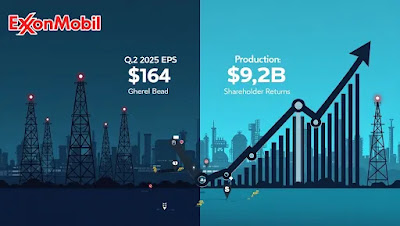
. The company's reported earnings figures underscore this resilience, demonstrating a sophisticated model that decouples profitability from volatile commodity markets. For the full year 2024, ExxonMobil reported earnings of $33.7 billion under U.S. GAAP and $33.5 billion when excluding identified items, alongside a substantial $55.0 billion in cash flow from operations and $34.4 billion in free cash flow. These results, while slightly down from the exceptional levels seen in 2023, marked the third-best financial performance in a decade and stood as a testament to the company's operational prowess  This trend continued into the third quarter of 2025, where the company reported earnings of $7.5 billion (or $1.76 per share) and adjusted earnings of $1.88 per share, which surpassed Wall Street's consensus estimate of $1.81 per share. This achievement occurred even as crude prices weakened, highlighting the effectiveness of the underlying strategies that form the bedrock of ExxonMobil's financial stability.

The central pillar enabling this earnings resilience is a radical and sustained program of structural cost savings, a multi-year initiative that has fundamentally re-engineered the company's operating footprint and created a powerful buffer against external market pressures

. Since 2019, ExxonMobil has achieved cumulative structural cost savings of $14.3 billion by the third quarter of 2025. His aggressive cost discipline is not a temporary measure but a core component of the company's competitive strategy, with management aiming to increase this figure to $18 billion by the end of 2030. These savings have proven indispensable in mitigating the financial impacts of lower industry refining margins and natural gas prices that weighed on earnings in 2024. Specifically, the savings more than offset inflationary pressures and higher depreciation expenses, allowing upstream earnings to remain stable despite headwinds. The impact of these efficiencies extends across all segments; for instance, unit operating expenses were reduced by 12% year-over-year in Q3 2025, while procurement savings reached 8%, directly bolstering margins in a low-price environment  This relentless focus on cost control gives ExxonMobil a distinct advantage over its international peers, allowing it to maintain profitability at lower price points and widen its margin of safety in a cyclical market.

This foundational cost-saving framework is powerfully amplified by a concentrated portfolio strategy that focuses capital and expertise on a select few high-return, low-cost production assets. The company's emphasis on advantaged assets like the Permian Basin and Guyana has driven top-line growth that would otherwise be impossible, given the prevailing price environment

. In 2024, net production reached 4.3 million oil-equivalent barrels per day (koebd), the highest level in over ten years, representing a remarkable 16% increase compared to 203. This volume growth was almost entirely attributable to record output from these two key regions, partially offsetting divestments of non-strategic assets. The company’s commitment to vertical integration across the entire energy value chain—from exploration and production to refining, chemicals, and marketing—further enhances its efficiency and provides another layer of resilience. By controlling more of the value chain, ExxonMobil can optimize costs, manage supply chains more effectively, and capitalize on its own resources within downstream operations. This integrated approach was evident in the performance of its various business segments. While the Energy Products segment saw earnings decline due to weaker industry-wide refining margins, cost savings and advantaged projects helped mitigate the losses. More impressively, the Chemical Products segment saw its earnings rise to $2.6 billion in 2024, driven by improved margins from lower ethane feedstock costs in North America—a direct benefit of its vertically integrated asset base. Similarly, the Specialty Products segment delivered $3.1 billion in earnings, up from the previous year, fueled by record sales of high-value products and structural cost savings  This strategic focus on premium products and operational excellence ensures that profitability is not solely dependent on crude oil prices but is also supported by the company's ability to generate value from complex chemical processes and advanced materials.

 . The combination of radical cost reduction and a hyper-focused, high-performing asset portfolio creates a virtuous cycle: lower costs enhance profitability on existing production, while high-margin growth from advantaged assets generates the surplus cash needed to fund further efficiencies and shareholder returns.

Metric
                                Full-Year 2024
GAAP Earnings
                                     $33.7 billion
Adjusted Earnings
$33.5 billion
Cash Flow from Operations
$55.0 billion
Free Cash Flow
$34.4 billion
Net Production
4.3 million boe/d
Return on Capital Employed (ROCE)
12.7%
Total Shareholder Distributions
$36.0 billion ($16.7B Dividends, $19.3B Buybacks)

In essence, the "earnings beat" is less a reaction to favorable market conditions and more a predictable outcome of a meticulously executed long-term strategy. ExxonMobil has engineered a highly efficient and resilient business model designed to thrive regardless of commodity price fluctuations. Its success lies in the dual pillars of deep, structural cost reductions and a laser-like focus on deploying capital into a handful of the world's most prolific and profitable hydrocarbon basins. This approach not only insulates the company from the volatility of the broader oil market but also allows it to consistently outperform competitors who may lack the same degree of operational discipline or asset concentration.

Two Engines of Growth: The Hyper-Performance of Guyana and the Permian Basin

At the heart of ExxonMobil's record-breaking production and superior financial performance are two distinct yet equally potent engines of growth: the offshore mega-project hub of Guyana and the vast, contiguous acreage of the Permian Basin. These "advantaged assets" represent the concentrated application of the company's capital and technical expertise, yielding disproportionately high returns and serving as the primary drivers of its top-line expansion and cash flow generation

. The company's strategy of focusing on a few high-probability, high-margin plays has allowed it to bypass the inefficiencies of a globally diversified portfolio and instead build a powerful dual engine for sustained growth

. The consistent and accelerating success in both regions validates this approach, creating a virtuous cycle where each new project enhances profitability, which in turn funds the next phase of development, ensuring a durable competitive advantage.

The Stabroek Block off the coast of Guyana has emerged as one of the most successful deepwater exploration and development programs in modern history, consistently delivering on its promise of massive resource potential and exceptional execution

. Following the initial discovery at Liza-1 in 2015, ExxonMobil and its partners have systematically unlocked the block's vast reserves, turning them into a tangible production powerhouse. The quarterly production record set in Q3 2025, surpassing 700,000 oil-equivalent barrels per day (koebd), was a significant milestone, underscoring the basin's immense scale. This achievement was largely propelled by the early startup of the Yellowtail development, which began producing four months ahead of schedule and under budget. Utilizing the ONE GUYANA floating production storage and offloading (FPSO) vessel, Yellowtail added an initial annual average capacity of 250,000 barrels of oil per day, pushing total installed capacity in Guyana past the 900,000 bopd mark. The fact that multiple FPSOs—including Destiny, Unity, Prosperity, and now ONE GUYANA—have been brought online successfully since 2019 demonstrates not only the quality of the reservoirs but also ExxonMobil's unparalleled project execution capabilities  The resource potential of the Stabroek Block is staggering, with estimates exceeding 11 billion barrels of oil equivalent, featuring average reservoir thicknesses over 200 feet and recovery factors ranging from 45–55%. Looking forward, the company has a clear path to doubling its current output, with plans to deploy eight FPSOs to reach a peak capacity of 1.7 million boepd by 2030  His long-term growth trajectory is supported by the final investment decision on the Hammerhead project, expected to add another 150,000 bopd by 2029, and ongoing assessments for natural gas development to meet growing domestic demand. The economic returns are equally impressive; combined profits from the consortium in 2024 surged 64% to $10.4 billion, with ExxonMobil alone generating $4.7 billion in adjusted earnings from its stake, making Guyana one of the most lucrative oil plays globally.

Simultaneously, the Permian Basin has been transformed into a cornerstone of ExxonMobil's growth story, primarily through the transformative acquisition of Pioneer Natural Resources for $60 billion

. This deal significantly expanded the company's presence in the Permian and reinforced its fossil fuel operation. The integration of Pioneer's assets created a large, contiguous acreage position that enables significant operational efficiencies, such as the use of multi-well pads and optimized gathering systems, which reduce development costs and accelerate production growth. The synergy benefits are substantial, with the company now expecting annual synergies to exceed $3 billion, a figure 50% above original estimates. This has translated directly into record production levels. In Q3 2025, ExxonMobil set a new quarterly production record in the Permian of nearly 1.7 million koebd, a level of output that underscores the basin's immense productivity. The company's resource base in the Permian is estimated at approximately 10 billion oil-equivalent barrels, with the potential for further expansion as development continues. A key driver of this success is the deployment of proprietary technologies that enhance recovery rates and improve capital efficiency. For example, the use of lightweight proppant has been shown to improve well recoveries by up to 20%, while advanced subsurface modeling and data analytics optimize drilling and completion cycles, leading to a 25% improvement in cycle times. These innovations ensure that investments in the Permian continue to generate double-digit returns even at low oil prices; for instance, at a $35 per barrel price, the average return on investment still exceeds 10%. With a plan to increase rig counts to approximately 55 by the end of the year and construct infrastructure at 30 sites to support output growth, ExxonMobil aims to push Permian production to over 2 million boe/d by 2030  The combination of scale, technology, and operational excellence makes the Permian Basin a formidable engine of growth, complementing the deepwater success in Guyana to create a balanced and powerful portfolio of advantaged assets.

| Comparative Analysis of ExxonMobil's Advantaged Assets | | | :--- | :--- | :--- | | Metric | Guyana Stabroek Block | Permian Basin | | Recent Quarterly Production | >700,000 boe/d (Q3 2025)

| ~1.7 million boe/d (Q3 2025) | | Key Project Startup | Yellowtail FPSO (April 2025) | Integration of Pioneer assets (May 2024) | | Capacity Add (per new project) | 250,000 bopd (Yellowtail) | Information not available in provided sources | | Long-Term Capacity Target | 1.7 million boepd by 2030 (via 8 FPSOs) | ~2.3 million boe/d by 2030 | | Resource Base | >11 billion boe (Stabroek Block) | ~10 billion boe | | Technological Focus | Floating Production Storage and Offloading (FPSO) optimization | Lightweight proppant, advanced data analytics, automation | | Breakeven Cost Profile | Estimated below $30/bbl | As low as $20/bbl WTI:HH | | Strategic Role | Deepwater, ultra-large-scale production hub | Unconventional, high-density, technologically-driven production|

The synergy between these two regional giants is crucial. Guyana provides a source of extremely high-margin, light crude production with a very low breakeven cost, making each incremental barrel highly accretive to consolidated margins

. The Permian, in contrast, offers immense scale and density, leveraging technology to achieve high returns on a massive capital base. Together, they allow ExxonMobil to diversify its risk geographically while concentrating its efforts on the highest-potential opportunities. This dual-focus strategy has enabled the company to achieve a production profile where more than half of its volumes now come from these advantaged assets, a significant shift from a decade ago

. It is this concentrated, high-performance portfolio that allows ExxonMobil to navigate the complexities of the global energy market, consistently beating earnings expectations and generating the robust cash flows necessary to fund its ambitious growth plans and generous shareholder return programs.

A Fortress Balance Sheet: Financial Discipline Fueling Aggressive Shareholder Returns

ExxonMobil's ability to execute its ambitious growth strategy and reward shareholders is built upon a foundation of profound financial discipline and a remarkably strong balance sheet. Despite increasing capital expenditures to support the ramp-up of its Guyana and Permian operations, the company has maintained leverage levels that are among the lowest in the energy industry, providing it with the flexibility to withstand prolonged periods of low commodity prices without compromising its commitments

. This financial fortitude is not accidental; it is the direct result of disciplined capital allocation, stringent cost controls, and a clear-eyed focus on generating sustainable free cash flow. The company's balance sheet metrics serve as a powerful testament to this prudence, offering a stark contrast to many of its international peers and reinforcing investor confidence in its long-term stability and ability to navigate market volatility.

The health of ExxonMobil's balance sheet is clearly reflected in its debt-to-capital and net-debt-to-capital ratios. As of the third quarter of 2025, these ratios stood at 13.5% and 9.5%, respectively

. This is a remarkably conservative position for a super-major with billions of dollars in annual capital spending. For comparison, at the end of 2024, the net-debt-to-capital ratio was an even healthier 6%, supported by a substantial cash balance of $23.2 billion. Even after funding significant shareholder distributions and increased capital expenditures in 2024, the company ended the year with a drawdown in its cash reserves from $31.5 billion to $23.0 billion and a notable increase in net debt to $18.7 billion. However, this remains a manageable level of indebtedness for a company of its size and cash-generating capability. The company's strong liquidity position, bolstered by over $15 billion in available liquidity at the end of Q3 2025, provides a crucial cushion against unforeseen market shocks or operational challenges. His financial strength is a key reason why ExxonMobil maintains investment-grade credit ratings (Aa2/AA-) and boasts a high interest coverage ratio of 12.5x, signaling to lenders and investors alike that its cash flow reliably covers its obligations with ample room to spare

This robust financial footing directly enables ExxonMobil's aggressive and consistent capital allocation policy, which prioritizes returning a significant portion of its free cash flow to shareholders. The company has masterfully balanced its need for reinvestment in high-return projects with its commitment to rewarding its owners, satisfying both growth-oriented and value-oriented investors

. In 2024 alone, ExxonMobil distributed a total of $36.0 billion to shareholders, comprising $16.7 billion in dividends and $19.3 billion in share repurchases. It is placed among the top five S&P 500 companies in terms of shareholder distributions. The company has extended its annual share-repurchase program to $20 billion through 2026, demonstrating management's confidence that the stock is undervalued relative to its intrinsic cash-generating power. The dividend policy is particularly noteworthy, featuring a peer-leading streak of 43 consecutive years of annual increases, with the fourth-quarter 2025 dividend declared at $1.03 per share, marking the 43rd consecutive year of growth
. This unwavering commitment to dividend growth is a powerful signal of the company's financial health and long-term optimism.

The sustainability of this generous payout is well-supported by the company's strong free cash flow generation. In 2024, free cash flow of $34.4 billion fully covered the $36.0 billion in shareholder distributions, indicating that the company can sustain its return program even if operating cash flow fluctuates

. The dividend payout ratio, calculated based on free cash flow, stands at a healthy 2.1x, suggesting a comfortable cushion. Analysts view the dividend as sustainable as long as oil prices remain above $60/bbl, a threshold that appears achievable given the company's projected cash surplus of $165 billion between 2025 and 2030. Furthermore, ExxonMobil's reinvestment rate—the proportion of cash flow reinvested—is projected to drop to 40% by 2030, freeing up even more cash for shareholder returns without requiring aggressive production growth. His disciplined approach to capital allocation is a cornerstone of the company's strategy. Management has explicitly stated that its priorities are first, investing in advantaged assets to drive long-term earnings and cash flow growth, and second, returning cash to shareholders through sustainable and growing dividends and consistent buybacks.

. This clear hierarchy ensures that every dollar spent is scrutinized for its potential return, whether it goes toward developing a new FPSO in Guyana or buying back shares in the open market. The result is a virtuous cycle: disciplined spending on high-return assets generates strong free cash flow, which is then used to fund shareholder returns, which in turn supports the company's stock price and lowers its cost of capital, making future investments more attractive.

Metric
Value / Status
Debt-to-Capital Ratio
13.5% (as of Q3 2025)
Net-Debt-to-Capital Ratio
9.5% (as of Q3 2025)
Year-End 2024 Net-Debt-to-Capital Ratio
6%
Cash Balance (End of 2024)
$23.2 billion
Available Liquidity (End of Q3 2025)
Over $15 billion
Credit Ratings
Aa2/AA-
Interest Coverage Ratio
12.5x
Annual Share Repurchase Program
$20 billion (extended through 2026)
Total Shareholder Distributions (2024)
$36.0 billion ($16.7B Dividends, $19.3B Buybacks)
Dividend Payout Ratio (FCF Basis)
2.1x (based on Q3 2025 FCF)
Consecutive Years of Dividend Increases
43 (as of Q4 2025)

Ultimately, ExxonMobil's financial strategy is a model of prudence and foresight. By maintaining a fortress-like balance sheet, the company has insulated itself from the worst effects of market downturns and positioned itself to capitalize on opportunities when they arise. Its transparent and aggressive capital allocation policy, centered on rewarding shareholders, has built immense trust and loyalty among its investor base. This financial strength is not merely a defensive posture; it is an offensive weapon, providing the firepower needed to execute its long-term growth vision while continuing to deliver tangible value to its owners.

Navigating Global Headwinds: Supply Glut and Price Forecasts Defining the Operating Environment

ExxonMobil's impressive financial performance and strategic execution must be viewed within the context of a profoundly challenging global energy market. The company is not merely performing well in a good environment; it is proving the efficacy of its resilient business model precisely because it is operating in a deliberately difficult one, characterized by a significant oversupply of crude oil and persistently weak pricing

. Understanding these external headwinds is crucial to appreciating the magnitude of ExxonMobil's achievements. The prevailing market dynamics are driven by a confluence of factors, including robust supply growth from non-OPEC+ producers, a gradual unwinding of production cuts by the OPEC+ alliance, and tepid global demand growth, all of which have created a bearish outlook for oil prices throughout 2025 and into 2026
. This environment serves as a constant stress test for the industry, and ExxonMobil's ability to thrive amidst these pressures underscores the superiority of its cost structure and asset concentration strategy.

The primary driver of the current low-price environment is a significant imbalance between global oil supply and demand. Projections from multiple authoritative sources paint a clear picture of a market flooded with crude. Global liquid fuels production is forecast to surge by 2.7 million barrels per day (mb/d) in 2025 and 1.3 mb/d in 2026, while consumption is expected to grow by a much more modest 1.1 mb/d annually during the same period

. This supply-demand mismatch is projected to lead to a severe global oil surplus, averaging 1.9 mb/d from January to September 2025 and potentially ballooning to nearly 4 mb/d in 2026. This oversupply situation is exacerbated by rising global oil inventories, which reached a four-year high of 7.9 billion barrels in August 2025. A significant portion of this inventory build-up is occurring on "oil on water," with a massive 102 million barrel increase recorded by September 2025—the largest since the Covid-19 pandemic—which indicates vessels are unable to find buyers or sufficient port storage capacity
. This glut of commercial crude is putting immense downward pressure on prices, forcing producers to compete fiercely for market share.

A key contributor to this supply glut is the policy of the Organization of the Petroleum Exporting Countries and its allies (OPEC+). After implementing significant production cuts in 2023 and 2024 to prop up prices, the group has begun to gradually unwind these restrictions

. In 2025, OPEC+ is on track to increase its output by an average of 1.4 mb/d, with a further 1.2 mb/d increase projected for 2026. Several member countries, including Saudi Arabia, the UAE, and Iraq, are actively expanding their capacity, adding hundreds of thousands of barrels per day to the global market. This policy directly counteracts any attempts by the remaining members to keep the market tight and contributes significantly to the bearish sentiment. Compounding this is the rapid growth of non-OPEC+ supply, which is expected to account for the majority of the world's production growth in the coming years. The United States, Brazil, Canada, and especially Guyana are leading this charge, with non-OPEC+ producers forecast to add 1.6 mb/d in 2025 and 1.2 mb/d in 2026. The U.S. alone is on track to see its crude production reach a record high of 13.5 million b/d in both 2025 and 2026, driven by strong momentum in Gulf of America projects

. This surge in U.S. shale production, in particular, adds a highly flexible and responsive element to the global supply curve, capable of quickly responding to price changes and keeping prices suppressed.

The consensus among analysts and forecasting agencies reflects this bleak outlook for oil prices. Multiple projections point to a continued decline from the relatively high levels seen earlier in the year. The U.S. Energy Information Administration (EIA) forecasts Brent crude oil prices will average $69 per barrel in 2025 but fall sharply to $52 per barrel in 2026

. J.P. Morgan Research echoes this bearish sentiment, projecting Brent prices to average $66/bbl in 2025 and $58/bbl in 2026. The World Bank offers a similarly cautious forecast, predicting an average of $64/bbl in 2025 and $60/bbl in 2026. S benchmark crude prices fell below $57 per barrel in mid-October 2025, the lowest level since early 2021, reflecting the market's response to these supply pressures

. This persistent low-price environment is the crucible in which ExxonMobil's strategy is forged. Its ability to generate $34.4 billion in free cash flow in 2024 despite these conditions highlights the effectiveness of its cost-cutting measures and its focus on low-breakeven assets. However, it also means that the company's future cash flow generation is heavily contingent on the duration and severity of these market conditions. If prices remain near these forecasted lows, even ExxonMobil's highly efficient model could face significant pressure on its free cash flow, potentially testing the limits of its shareholder return commitments.


Metric
Forecast for 2025 / 2026
Global Liquid Fuels Production Growth
+2.7 mb/d in 2025, +1.3 mb/d in 2026
Global Liquid Fuels Demand Growth
+1.1 mb/d in 2025, +1.1 mb/d in 2026
Projected Global Surplus
~1.9 mb/d (Jan-Sep 2025), projected to reach nearly 4 mb/d in 2026
Brent Crude Price Forecast (EIA)
Average $69/bbl in 2025, fall to $52/bbl in 2026
Brent Crude Price Forecast (J.P. Morgan)
Average $66/bbl in 2025, $58/bbl in 2026
Brent Crude Price Forecast (World Bank)
Average $64/bbl in 2025, $60/bbl in 2026
U.S. Crude Production Forecast
Average 13.5 million b/d in 2025 and 2026
OPEC+ Production Increase
+1.4 mb/d in 2025, +1.2 mb/d in 2026

In conclusion, the external market environment presents a formidable challenge to the entire oil industry. The combination of a significant supply glut, led by non-OPEC+ producers and a gradual increase in OPEC+ output, coupled with subdued global demand, has created a persistent bearish bias for crude oil prices. ExxonMobil's success in this climate is therefore all the more impressive. It is a clear demonstration that a strategy built on radical cost discipline and a portfolio of advantaged assets is not just a theoretical advantage but a practical necessity for survival and profitability in the modern energy sector.

The Forward-Looking Strategy: Doubling Down on Fossil Fuels While Investing in Decarbonization

ExxonMobil's current success is not merely a product of navigating a difficult past but is also a reflection of a clear and ambitious forward-looking strategy designed to secure long-term growth and relevance in a rapidly evolving energy landscape. The company's corporate plan, outlined in presentations such as the December 2024 Upstream Presentation, reveals a sophisticated vision that balances a continued heavy investment in its core fossil fuel business with targeted, strategic moves into lower-emission solutions

. This dual-pronged approach is pragmatic and opportunity-focused, seeking to maximize the value of its hydrocarbon legacy while simultaneously building a new revenue stream from the burgeoning market for decarbonization technologies and critical minerals

. This strategy is not a pivot away from oil and gas but rather an evolution, positioning ExxonMobil as a key enabler of the energy transition rather than simply a traditional producer of fossil fuels.

The cornerstone of ExxonMobil's growth strategy remains the continued ramp-up of its advantaged assets in Guyana and the Permian Basin. The company has set a clear goal to double its earnings and cash flow potential by 2027 compared to 2019 levels, a target predicated almost entirely on the success of these high-return projects

. Production from these two regions is expected to grow by 1.2 million oil-equivalent barrels per day by 2030, accounting for over 60% of the company's total upstream production. In Guyana, the plan involves bringing online the remaining four planned FPSOs, taking the basin's capacity to 1.7 million barrels of oil equivalent per day by 2030. In the Permian, the objective is to increase production to approximately 2.3 million barrels per day by 2030, driven by the continued deployment of advanced technologies and infrastructure expansion. This focused investment in its most productive assets is expected to generate strong returns, with an anticipated average of around 30% on capital investments, and over 90% of planned upstream capital spending having payback periods under 10 years. This commitment to fossil fuel growth is underpinned by a significant capital expenditure program, with guidance for 2025 set between $27 billion and $29 billion, demonstrating a bullish stance on growth even as some competitors reduce spending. The company expects these investments to generate at least $20 billion in additional earnings and $30 billion in additional cash by 2030, solidifying its position as a leader in the super-major space.

Parallel to this continued investment in hydrocarbons, ExxonMobil is making substantial, albeit still relatively small in absolute terms, investments in lower-emission initiatives. The company's "Low Carbon Solutions" business is a key part of this effort, with plans to invest up to $30 billion between 2025 and 2030 in areas like carbon capture and storage (CCS), hydrogen, biofuels, lithium extraction, and synthetic graphite

. Approximately 65% of this capital is earmarked for projects that aim to reduce emissions for other companies, positioning ExxonMobil as a "decarbonization enabler. One of the most significant moves in this area was the acquisition of Denbury Resources, which gave ExxonMobil access to the largest CO2 pipeline network in the United States, forming the backbone of its CCS ambitions. The company is pursuing the development of the world's only large-scale end-to-end CCS system, targeting the sequestration of millions of metric tons of CO2 annually. Another major focus is on critical minerals essential for the energy transition. ExxonMobil is beginning development of its first lithium production phase in Arkansas, aiming to produce enough lithium to supply approximately 1 million electric vehicles annually by 2030. It has also acquired Superior Graphite's U.S. assets to enter the synthetic graphite anode market for EV batteries, further diversifying its portfolio into the battery supply chain. These investments are strategically chosen to leverage the company's core engineering, industrial, and logistical strengths, allowing it to participate in new markets while mitigating climate-related risks and aligning with the needs of customers in a decarbonizing world.

This forward-looking strategy is encapsulated in the company's long-term goal to achieve net-zero Scope 1 and 2 greenhouse gas emissions from its operated assets by 2050, with interim goals like eliminating routine flaring by 2025 and reaching net-zero for unconventional operations in the Permian by 2030

. The company's overall emissions are also targeted for a reduction of 20% to 30% by 203. While these targets are ambitious, it is crucial to recognize the scale of the company's existing operations. Less than 1% of ExxonMobil's revenue currently comes from renewables or non-oil activities, highlighting that the vast majority of its capital, strategy, and business model remains firmly rooted in hydrocarbons

. The investments in low-carbon solutions are designed to be complementary, enhancing the company's overall resilience and addressing the concerns of increasingly influential environmental, social, and governance (ESG) stakeholders. This balanced approach allows ExxonMobil to continue generating the cash flow needed to fund its core growth projects while simultaneously building a foothold in the industries of the future. It is a strategy designed to hedge against the risks of a faster-than-expected energy transition while maximizing the value of its extensive existing asset base. By combining the pursuit of high-margin fossil fuel production with strategic investments in decarbonization, ExxonMobil is attempting to chart a course that secures its long-term viability in a world that is both demanding more energy today and moving towards a cleaner energy mix tomorrow.

Key Takeaways and Future Outlook: Assessing ExxonMobil's Competitive Moat and Long-Term Risks

In summary, ExxonMobil's ability to post earnings beats and deliver robust shareholder returns in a low-oil-price environment is not a matter of chance but a direct consequence of a deeply entrenched and highly effective corporate strategy. The analysis of its financial performance, operational execution, and forward-looking vision reveals a company that has successfully engineered a powerful competitive moat. This moat is built on three fundamental pillars: a radical and sustained program of structural cost savings that has fundamentally altered its cost structure; a concentrated portfolio focused on a few, exceptionally high-return production assets in Guyana and the Permian Basin; and a disciplined, fortress-like financial management approach that prioritizes shareholder returns without jeopardizing long-term growth. These elements, combined with vertical integration and technological superiority, have created a resilient business model that is uniquely positioned to navigate the volatility of the global energy market.

The key takeaways from this comprehensive examination are clear. First, ExxonMobil's $14.3 billion in cumulative structural cost savings since 2019 is not merely a line item but a core strategic asset that acts as a shock absorber against commodity price swings

. This aggressive cost discipline provides a distinct advantage over its international peers and allows the company to maintain profitability at price points that would cripple less efficient competitors. Second, the hyper-performance of its advantaged assets is the primary engine of growth. The consistent, record-breaking production from the Stabroek Block and the Permian Basin, validated by successful project startups and technological advancements, demonstrates the power of concentrating capital in the world's most prolific hydrocarbon basins  Third, the company's financial strength, evidenced by its low debt-to-capital ratios and strong cash flow generation, provides the flexibility to pursue an aggressive and consistent shareholder return program, including a 43-year streak of dividend increases and a $20 billion annual share-repurchase program. Finally, its forward-looking strategy, which combines continued investment in fossil fuel growth with strategic bets on decarbonization, positions it to address both the immediate energy needs of the world and the long-term challenges of the energy transition

However, a complete assessment requires acknowledging the significant risks and uncertainties that temper this overwhelmingly positive outlook. The most prominent risk is valuation skepticism from the market. Despite its operational excellence, there is a persistent valuation gap between U.S. majors like ExxonMobil and their European counterparts, and some analyses suggest its equity may be overvalued under strict climate policy scenarios

. This indicates that investors remain wary of the long-term secular risks associated with climate change regulation and the potential for a faster-than-expected decline in oil demand, as envisioned in scenarios like the IEA's Net Zero 2050 pathway. Secondly, the company's heavy reliance on the Guyana and Permian hubs, while a source of strength, also represents a single point of failure. Any significant geopolitical issues, operational setbacks, or changes in fiscal terms in either region could disproportionately impact the entire company's fortunes. Furthermore, ExxonMobil faces intense scrutiny from environmental groups and ESG-focused investors, which could lead to stricter regulations or reputational damage. The company's decision to cut jobs in Europe and Canada, partly in response to stringent EU sustainability laws, signals a potential conflict between its operational goals and regional regulatory pressures.

To conclude, ExxonMobil stands as a case study in strategic adaptation and operational excellence. It has successfully transformed itself from a traditional oil company into a highly efficient, resilient, and financially disciplined enterprise. Its ability to thrive in a bearish market environment is a testament to the soundness of its core strategy. For investors and analysts, the future of ExxonMobil hinges on its ability to continue executing this strategy flawlessly while managing the significant long-term risks posed by the global energy transition. The company's future will likely depend on its capacity to translate its operational successes into sustained market confidence and navigate the complex interplay between fossil fuel demand, decarbonization mandates, and shareholder expectations. 

Comments

Popular Posts