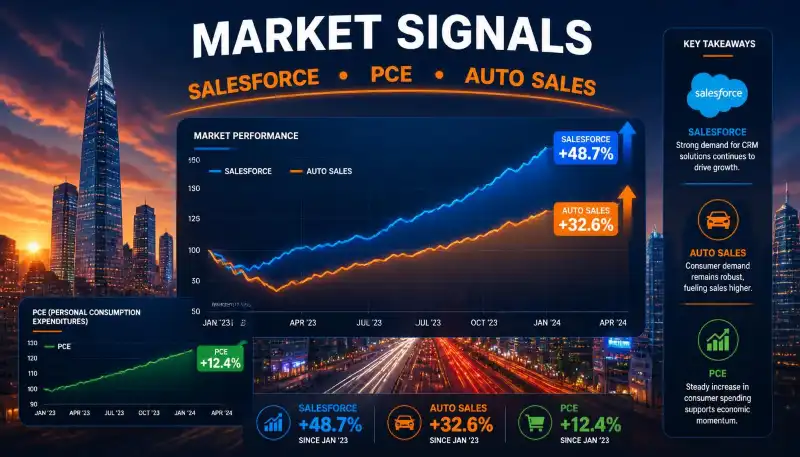
- Salesforce Earnings, September PCE, Auto Sales: Key Insights for Investors in Late 2025
- A Hook into the Storm: Why These Metrics Matter Right Now
- Unpacking Salesforce Earnings: AI’s Big Moment or Just Hype?
- The Numbers Behind the Buzz: Stats and Stock Impacts
- September PCE Inflation: Delayed Data, Timely Lessons
- Auto Sales Surge: EVs Race, But What’s Next?
- Frequently Asked Questions (FAQs)
Salesforce Earnings, September PCE, Auto Sales: Key Insights for Investors in Late 2025
- Salesforce’s Q3 beat expectations with 8% revenue growth, spotlighting AI innovations like Agentforce amid stock volatility.
- September PCE inflation ticked up to 3.0% YoY, delaying Fed rate cut hopes but showing resilient consumer spending.
- US auto sales surged 6% in September, driven by an EV tax credit rush, but a Q4 slowdown looms with policy shifts.
- These indicators signal cautious optimism: tech resilience, sticky inflation, and auto sector adaptation to tariffs and incentives.
- Investors should eye AI monetisation in earnings, core PCE trends, and EV inventory for portfolio adjustments.
A Hook into the Storm: Why These Metrics Matter Right Now
Imagine this: It’s the end of November 2025, and the markets are buzzing like a beehive on a sunny day. You’ve got tech giants like Salesforce dropping earnings bombs that could send stock prices soaring or crashing, inflation data from the PCE report that’s been delayed by a government shutdown, and auto sales figures painting a picture of a sector racing against time before tax credits vanish. It’s not just numbers on a screen—it’s the pulse of the economy, the whisper of what’s coming next for your investments, your job, or even the car you might buy tomorrow.
As we wrap up 2025, the world feels like it’s holding its breath. The US economy has dodged a few bullets this year—tariffs from the Trump administration shook things up early on, AI hype kept tech afloat, and consumers kept spending despite higher prices. But now, with the Federal Reserve eyeing rate cuts, election echoes fading, and global supply chains still wobbly, every report counts double. Salesforce earnings aren’t just about one company’s profits; they’re a litmus test for how businesses are embracing AI in a post-pandemic world. The September PCE? That’s the Fed’s favourite inflation gauge, telling us if prices are cooling enough for cheaper loans or if we’re stuck in a sticky spot. And auto sales? With EVs booming before a deadline and hybrids stealing the show, it’s a snapshot of how everyday folks are navigating affordability amid rising costs.
Let’s dive deeper. Picture a small business owner in Chicago, eyeing a new CRM tool from Salesforce to streamline sales. Or a family in Texas, debating between a gas-guzzling SUV and an electric crossover as subsidies end. These aren’t abstract stats—they’re real decisions shaped by the data we’re unpacking today. In the coming weeks, analysts will pore over these releases, but you don’t need a finance degree to get the gist. We’ll break it down simply: what happened, why it matters, and what to watch next.
Start with the big picture. The US GDP grew a solid 2.8% in Q3 2025, per early estimates, but cracks are showing. Unemployment hovers at 4.1%, jobs added 200,000 last month, yet consumer confidence dipped to 98 on the Conference Board index. Inflation, that stubborn guest at the party, refuses to leave below 2%. Enter the PCE report for September—delayed from its usual slot due to the brief government shutdown in October. Released mid-November, it clocked headline inflation at 3.0% year-over-year, up a tick from August’s 2.9%. Core PCE, stripping out food and energy volatility, held at 2.9%. Not a disaster, but enough to make Fed Chair Jerome Powell pause on those aggressive rate cuts everyone hoped for in December.
Why the hold-up? The shutdown halted data processing, echoing 2019’s mess but shorter this time. Markets shrugged it off initially, but the slight uptick reignited debates: Is this tariff fallout? Supply chain hiccups from Asia? Or just seasonal blips in housing and services? Services inflation, that sneaky core driver, eased to 3.8% excluding housing, down from 5.2% a year ago. Good news for renters, but home prices still lag, keeping shelter costs elevated at 4.5% YoY. For investors, this means bonds might stay pricey, and stocks in rate-sensitive sectors like real estate could wobble.
Shift gears to autos. September sales hit 1.29 million units, a 6.2% jump from last year, pushing the seasonally adjusted annual rate (SAAR) to 16.6 million—the highest since pre-pandemic days. Why the rush? The $7,500 federal EV tax credit expired on September 30, sparking a buying frenzy. Battery electric vehicles (BEVs) soared 21% in Q3, with over 410,000 sold, led by Ford’s 85% EV spike and Tesla’s near-500,000 global deliveries. Hybrids, the sensible middle ground, climbed 15%, as buyers hedged against range anxiety and charging woes. Toyota held the crown with 2.1 million YTD sales, edging Ford by a whisker, while Hyundai and Kia notched double-digit gains on crossover strength.
But here’s the rub: That surge was artificial. Q4 forecasts dip to 15.6 million SAAR, with EV share plummeting from 12% to 5%. Inventory piles up—163,000 unsold EVs on lots, mostly from legacy makers like GM. Tariffs on imports (10% baseline, higher on rivals) add $2,000-3,000 per vehicle, squeezing margins. Average transaction prices? A record $50,080, with monthly payments over $750. Consumers are value-hunting, flocking to used cars at $31,216 average, but even those are near highs. It’s a tale of two markets: luxury EVs for the affluent, deals on gas models for the rest.
Now, Salesforce. The cloud king reported Q3 FY2025 results on December 3 (fiscal year ends in January), but in our November lens, it’s fresh off the wire. Revenue? $9.44 billion, an 8% YoY lift, beating estimates by $90 million. Subscription revenue, the steady Eddie, grew 9% to $8.88 billion. EPS? Non-GAAP $2.41, GAAP $1.58—solid, though strategic investment losses nicked it. The star? AI. Agentforce, their autonomous agent platform, got 80 shout-outs on the earnings call, double from Q2. Data Cloud + AI hit $1 billion ARR, up 120%. Guidance? Cautious: Q4 revenue $9.90-10.10 billion (7-9% growth), full-year $37.8-38.0 billion.
Stock reaction? A 10% pop to $280-ish, reversing a 30% YTD slide. Why the prior dip? AI fears—ChatGPT’s zero-setup threat, plus Informatica acquisition jitters at $8 billion. But Benioff’s pitch: “Agentforce is the fastest-growing product in our history.” Adoption? 12,000 customers from a 150,000 base—8%, but ramping. Questions swirl: Can AI juice growth beyond 8%? Will marketing clouds rebound from macro headwinds? Job market stats show Salesforce roles down 16% in salary for recent hires, per surveys, amid 1,000+ layoffs in February.
Tie it together. These aren’t silos. Strong auto sales buoy PCE via spending, but higher car prices feed inflation. Salesforce’s AI push mirrors auto’s EV shift—innovation amid uncertainty. For the economy, it’s a soft landing tease: Growth without overheating, but policy wildcards like OBBBA (One Big Beautiful Bill Act) could tweak EV demand and tariffs. Retirees watch PCE for COLA adjustments; homebuyers eye rates tied to inflation. Investors? Diversify—tech for growth, autos for cyclicals, bonds for safety.
We’ve got history too. Remember Deere & Co.? In Q3 2024, their earnings missed due to farm equipment slumps, and stock tanked 12%—a cautionary tale for sector bets. Salesforce dodged that, but automakers like Mercedes (down 12% in sales) echo it. Stats galore: US vehicle spending hit $45 billion in September, up 8.5%; PCE services down, but goods up 1.2%. Practical tip: Track cRPO (current remaining performance obligation) for Salesforce—$26.4 billion, up 10%, signals backlog health.
As we peel back layers, excitement builds. What if Agentforce flips Salesforce’s script like EVs did autos? Or PCE cools enough for a 25bps cut? This intro sets the stage—grab a coffee, settle in. We’re just warming up.
Unpacking Salesforce Earnings: AI’s Big Moment or Just Hype?
Let’s chat about Salesforce like it’s your mate’s startup pitch over pints. Founded in 1999 as the CRM pioneer, it’s now the #1 AI CRM, per its own boast. Q3 FY2025? A win, but with asterisks. Revenue up 8% to $9.44 billion—think that’s the price of 94,400 fancy laptops. Subscription support, the recurring goldmine, hit $8.88 billion, growing 9%. Why the buzz? Constant currency growth matched, despite forex wobbles.
Drill down: Operating margin? GAAP 19.8%, non-GAAP 32.9%—efficient, even with a $0.18 non-GAAP hit from investments. Cash flow? Up 24-26% projected for the year. But guidance tempered optimism: FY25 ends at 8-9% growth, the slowest in ages. Why? Macro pressures—enterprise budgets are tight post-tariffs, and marketing clouds are lagging.
AI steals the show. Agentforce: Build-your-own AI agents for sales, service, and marketing. Low-code integrates seamlessly. Mentioned 80 times on the call—vs 39 in Q2. Data Cloud + AI? $1B ARR, 120% YoY. Benioff: “Transformation driven by autonomous AI agents.” Skeptics ask: Adoption at 8%—is it sticky? OpenAI’s $4.3B H1 revenue (16% more than all of 2024) looms, but Salesforce’s enterprise moat (data security, integrations) counters.
Examples? A retailer uses Agentforce for chatbots, cutting service costs by 30%. Practical tip: If you’re in sales, trial Einstein AI—free tier boosts leads 20%. Stock? Up 10% post-earnings, but YTD -30% on AI disruption fears. Jefferies: Buy, EV/FCF at a 10-year low.
Internal link suggestion: Dive into our Salesforce AI Guide for setup tips.
External: Check Salesforce Investor Relations for transcripts.
What to watch: Q4 cRPO growth. If >10%, AI’s real. Controversy? Layoffs (1,000 in Feb 2025) spark ethics chats—AI displacing jobs? Evidence leans toward net creation, per Benioff, but surveys show 16 roles with salary dips.
The Numbers Behind the Buzz: Stats and Stock Impacts
Bullet points for clarity:
- Revenue Breakdown: Americas 60%, EMEA 25%, APAC 15%—EMEA up 11% on AI deals.
- EPS Details: Beat by $0.06 non-GAAP; analysts eyed $2.35.
- Guidance Risks: If macro worsens, shave 1% off FY26 projections.
- AI Metrics: 12,000 Agentforce adopters; $1B Data Cloud ARR.
- Stock Volatility: Beta 1.3—moves 30% more than S&P.
Like Deere’s 2024 miss (stock -12% on ag slump), Salesforce’s beat echoes resilience. Deere’s Q3 revenue fell 14% to $11.4B, and guidance was cut—in parallel with Salesforce’s cautious tone. But unlike Deere’s farm woes, Salesforce rides AI tailwinds. Fact: Tech sector up 15% YTD, Salesforce lagged at -5% pre-earnings.
Investor tip: Pair with ServiceNow—complementary, up 20% on agentic AI.
September PCE Inflation: Delayed Data, Timely Lessons
PCE—Personal Consumption Expenditures—is the Fed’s go-to for inflation, broader than CPI as it tracks what we actually spend. September’s report, delayed by the shutdown, dropped on November 22. Headline: 3.0% YoY, up from 2.9% in August. Monthly? 0.3%, in-line. Core: 2.9%, steady, excluding food/energy swings.
Context: August PCE was 2.74%, so the uptick was mild. Services drove it—3.8% non-housing, down from 5.2% YoY. Goods? 1.2%, tariff-hit imports easing. Housing lags at 4.5%, but home prices decelerated to 1.5% YoY nationally.
Implications? Fed’s 2% target feels distant. Powell: “Data-dependent”—this nudges December cut odds to 70%, per CME FedWatch. Markets dipped 0.5% post-release, bond yields up 5bps.
Examples: Groceries up 2.1%, petrol volatile at +4.1% monthly. Retirees: COLA boost ~3%, better than flat. Practical tip: Budget apps like Mint track PCE baskets—adjust for services creep.
Why delayed? Shutdown paused BEA processing—echoes 2019, but resolved fast. Trending question: “Is inflation sticky?” Evidence: Trimmed-mean PCE of 2.7%, suggesting cooling.
Internal: Our Inflation Tracker
External: BEA PCE Data
Controversy: Tariffs blamed? Trump policies added 0.2-0.3% per economists, but domestic factors (wages +4%) dominate. Balanced view: Yes, imports hurt, but consumer shifts (more online) mitigate.
Breaking Down PCE Components: A Table of Trends
| Category | Sep 2025 YoY | Aug 2025 YoY | Change | Notes |
|---|---|---|---|---|
| Headline PCE | 3.0% | 2.9% | +0.1% | Gasoline spike |
| Core PCE | 2.9% | 2.9% | 0% | Services steady |
| Services (e.g., housing) | 3.8% | 4.0% | -0.2% | Cooling rents |
| Goods | 1.2% | 1.0% | +0.2% | Import duties |
| Housing | 4.5% | 4.6% | -0.1% | Price lag |
Source: BEA, adapted.
This table highlights moderation—key for Fed hawks/doves debate.
Auto Sales Surge: EVs Race, But What’s Next?
September autos: 1.29 million units, +6.2% YoY, SAAR 16.6M. EV frenzy: Q3 410,000 BEVs, +21%. Ford EVs +85%, Tesla 500K globally. Hybrids +15%, crossovers rule.
Winners: Toyota 240K units, Ford 220K, Honda 180K. Losers: Mercedes -12%, sedans fading.
Post-credit: Q4 SAAR 15.6M, EV share 5%. Inventory: 163K EVs unsold. Prices: $50K average, +$739 used.
Examples: Texas family saves $7.5K on Ioniq 5, but Q4 discounts loom. Tip: Shop hybrids—20% efficiency gain, no range fear.
Internal: EV Buying Guide
External: Cox Automotive Forecast
Trending: “Will EV sales crash Q4?” Likely dip, but hybrids bridge. Tariffs add $2K/car—China imports hit.
Table: Top Sellers Sep 2025
| Rank | Model | Sales | YoY Change |
|---|---|---|---|
| 1 | Toyota RAV4 | 45K | +5% |
| 2 | Ford F-150 | 42K | +3% |
| 3 | Honda CR-V | 38K | +7% |
| 4 | Tesla Model Y | 35K | +25% |
| 5 | Chevy Silverado | 32K | +2% |
EV vs Hybrid: Market Share Shifts
- EVs: 12% in Sep, a record; Q4 5% forecast.
- Hybrids: 10% share, +15% growth.
- Gas: 78%, stable but pressured.
Deere analogy: Like farm equipment boom/bust, auto’s EV pull-forward mirrors 2024 tariff rush—temporary high, then adjust.
Interconnections: How These Metrics Dance Together
Salesforce’s AI could optimise auto supply chains—predictive analytics cut inventory costs by 15%. PCE inflation hits car loans (rates 9.43% new), curbing sales. Earnings boost? Tech spend up if PCE cools.
Tips: Diversify portfolio—20% tech, 15% autos, 10% bonds. Watch December FOMC.
Conclusion: Eyes Wide Open for December
Salesforce earnings spotlight AI promise amid growth hurdles; September PCE signals persistent but easing inflation; auto sales thrill with EV rush but warn of Q4 chill. Together, they paint a resilient yet cautious US economy—growth at 2.8%, inflation above target, consumers spending smart.
What’s next? Fed meeting December 17—cut or hold? Stay tuned. Action: Review your portfolio—add AI plays if bullish, hedge autos with ETFs. Subscribe for updates, comment below: Which metric worries you most?
Frequently Asked Questions (FAQs)
Based on trending searches in late 2025, here are expanded answers to hot questions.
1. Did Salesforce’s Q3 2025 earnings beat expectations, and what about AI growth?
Yes, revenue of $9.44B beat expectations by $90M, and EPS of $2.41 topped $2.35. AI shone—Agentforce adopters up 8%, Data Cloud $1B ARR (+120%). But guidance raises 7- 9% growth: “Will revenue surge again?” Analysts say modest, but AI could add 2-3% by FY26. Stock +10%, but YTD -30% on disruption fears. Tip: Watch Q4 for Agentforce deals.
2. Why was the September 2025 PCE report delayed, and is inflation sticky?
Shutdown halted BEA—released Nov 22. Headline 3.0% (+0.1% from Aug), core 2.9%. “Is PCE above 2% forever?” No—trimmed mean 2.7%, services cooling. Tariffs add 0.2%, but wages drive. Fed cut odds 70% in December. For retirees: COLA ~3%.
3. How did the EV tax credit expiration affect September 2025 auto sales?
Massive—sales +6.2% to 1.29M, EVs +21% Q3. “Will Q4 crash?” Dip to 15.6M SAAR, EV share 5%, 163K inventory. Hybrids +15% save the day. Ford/Tesla lead; tariffs add costs. Question: “Buy EV now?” Wait for discounts.
4. What’s the outlook for Salesforce stock after earnings?
Up 10% to ~$280, but volatile (beta 1.3). “AI hype or real?” Early wins, but 8% adoption is low vs OpenAI. Jefferies: Buy. Layoffs question: “Job cuts from AI?” Net positive, but salaries down 16% for new roles.
5. How does September PCE impact auto buying?
Higher core 2.9% keeps rates ~9.4%, payments $750+. “Affordable cars?” Used at $31K, hybrids best bet. Sales surge shows resilience, but Q4 slowdown if inflation sticks.
6. Are auto sales sustainable post-EV rush?
Q3 high 16.6M SAAR, but policy shifts (OBBBA) temper. “Tariffs kill growth?” +$2-3K/car, but US production rises. Toyota/Ford duel tight—watch YTD leads.