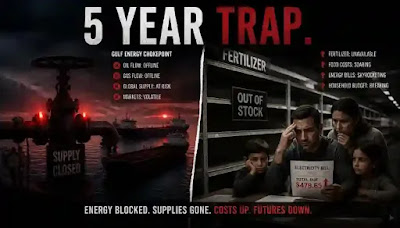
The 5-Year Trap: How a Prolonged Gulf Conflict Will Permanently Rewire Your Cost of Living
If you are still watching the daily stock market fluctuations or waiting for the petrol pumps to change their digital displays, you are missing the entire horizon. What is heading toward us in 2026 isn’t some quick panic that disappears in two weeks. It is a massive structural shift being decided right now behind heavy doors in top-level diplomatic rooms. We are standing at the edge of a conflict that could easily mimic the historical 48-day escalations we’ve seen before. Except this time, the global economy doesn’t have the safety nets to catch the fall.
Let’s get real about what happens when global supply chains are forced to run on empty for more than a month. Most people assume that a military flare-up in the Gulf region is just an issue for commuters and logistics companies. That is a massive understatement. The structural damage doesn’t stop at the transport sector; it actively bleeds into the foundational pillars of global agriculture, heavy manufacturing, and advanced technology.
The Hidden Fertilizer Crisis: Eating into Next Year’s Harvests
No jokes, the biggest blind spot right now is the global food production pipeline. The Gulf region isn’t just an oil exporter; it is the absolute heart of the world’s nitrogen-based fertilizer and urea supply. Nearly 30% of the planet’s seaborne synthetic nutrients originate from these precise trade lanes.
I mean, think about it—modern commercial farming cannot function without a steady, affordable supply of these chemical inputs. When high-level military movements disrupt the factories producing these fertilizers, the impact isn’t felt in weeks; it ruins the entire upcoming agricultural calendar.
[Gulf Natural Gas Interruption]
│
▼
[Global Nitrogen & Urea Production Freezes]
│
▼
[Farmers Scale Back Crop Cultivation & Yields]
│
▼
[3 to 5 Years of Structural Food Scarcity]
Properly look at the numbers. Global urea prices are already sitting at a massive 68% premium due to early-stage shipping friction. If a full-scale confrontation drags on for 48 days or longer, those chemical production plants lose their natural gas feedstocks entirely. Once that fuel supply stops, global vendors won’t just slap a higher price tag on stuff; they will literally run out of inventory. Look at growers across Asia and Europe—their margins are already completely dead. When the price of keeping crops alive doubles in a single day, they can’t just swallow the loss and move on.
They change their behavior permanently. They plant fewer acres, shift to low-yield crops that require less upkeep, or skip nutrient cycles entirely. This means a localized disruption next week directly dictates a severe global crop shortfall next year. Nobody can just flip a switch and magically fix a ruined farming schedule the day a peace pact is signed. Smaller yields trigger a domino effect, creating a massive multi-year deficit that takes at least five seasons to properly balance out.
The Chemical Chokepoint: Industrial Stagnation and Semiconductor Halts
The Chemical Chokepoint: Industrial Stagnation and Semiconductor Halts. Beyond agriculture, the extended crisis is putting serious pressure on advanced industrial manufacturing. The global market is deeply dependent on specific, overlooked industrial gases and petrochemical feedstocks that are produced almost exclusively in the Gulf’s massive refining complexes. We are talking about critical components like commercial helium, specialized polymers, and base chemical precursors that are foundational to modern electronics and heavy industry.
Straight up, your entire digital life depends on these invisible supply lines. Automated microchip fabrication centers in Asia depend entirely on a non-stop flow of these precise gases to keep their operations alive. If shipping vessels get blocked or forced to loop around Africa for more than 40 days, the manufacturing backlog stalls permanently.
Factories in Germany, Japan, and South Korea cannot just source these specific chemical grades from local alternatives—there are none. When industrial production stalls because a base polymer isn’t available, the entire global assembly line grinds to a halt. Car manufacturing, consumer electronics, and medical equipment production face rolling delays. This creates a massive supply vacuum where goods become incredibly scarce, forcing retail values up globally while local job markets freeze due to manufacturing stagnation.
The Five-Year Recovery Illusion: Why the Damage Sticks
Real talk, standard news channels love pushing this soft story about how resilient the markets are. They want everybody to think that as soon as the guns go silent, the financial network snaps back to normal. That is a complete illusion. Major macroeconomic models designed by global institutions like the UN and international trade analysts show a much darker reality.
If a critical trade lane like the Strait of Hormuz gets blocked for a 48-day window, the friction creates heavy scar tissue that hangs around for three to five years minimum.
┌─────────────────────────────────────────────────────────┐
│ Disruption Window: 48 Days of Closed Chokepoints │
└────────────────────────────┬────────────────────────────┘
│
▼
┌─────────────────────────────────────────────────────────┐
│ Structural Scarring: 3 to 5 Years of Market Recovery │
├─────────────────────────────────────────────────────────┤
│ • Depleted Global Buffer Stocks │
│ • Rerouted Global Maritime Shipping Contracts │
│ • Long-Term Capital Expenditure (CapEx) Freezes │
└─────────────────────────────────────────────────────────┘
Why does it take so long? Because of three distinct long-term traps:
- Depleted Buffer Stocks: Every single backup reserve and emergency supply is drained to zero during the first 30 days of a total halt. Rebuilding those global cushions requires years of excess production that simply won’t exist.
- Rerouted Maritime Contracts: Cargo companies don’t just change their maps for seven days. They tie themselves into expensive, multi-year insurance policies to avoid danger zones. Those high costs get locked in for the long haul, keeping baseline shipping rates permanently up.
- Capital Expenditure Freezes: When global fuel markets become this unpredictable, giant companies entirely stop investing in new infrastructure or expansion plans. They just hoard cash blocks instead of scaling.
This massive investment drought ensures that industrial development slows down to a crawl worldwide. The global middle class is being cornered into a long-term economic hangover where your purchasing power doesn’t just dip for a month—it faces a structural, multi-year decline while the world slowly attempts to fix its broken foundations.
Tactical Survival: Protecting Capital in a Scarcity Economy
When the old rules of a fast-recovering market are completely broken, holding onto your net worth requires a massive shift in perspective. Relying on standard, high-growth equity portfolios or speculative tech assets during a prolonged scarcity cycle is an incredibly dangerous gamble. When base industrial production and agricultural outputs are compromised, traditional corporate valuations become completely untethered from reality.
In a structural five-year trap, liquidity and hard tangible stability are the only things that matter. Shifting a major portion of your wealth away from volatile, debt-heavy corporations and placing it into highly liquid, short-term cash reserves or foundational, non-correlated assets is the most logical defensive play. Minimizing any exposure to variable-rate interest debt is an absolute priority, as central banks will be forced to keep interest rates artificially high to combat persistent, structural supply-side inflation.
The days of expecting a quick market bailout are properly gone. Watch the structural indicators—track the global urea trade, look at chemical freight rates, and pay attention to industrial backlogs. The coming half-decade will belong to those who see the scarcity coming and secure their capital before the countdown hits zero.
FAQ – Strategic Insights
1. Why does a Gulf conflict impact my food prices if my country grows its own crops?
Properly think about the inputs. Growing food domestically does not remove the need for chemical imports that keep agricultural land fertile. When regional factories lose their gas supplies, fertilizer rates go through the roof, forcing farmers to plant less, which destroys local harvest volumes and spikes retail bills.
2. How do industrial chemical shortages in the Middle East affect everyday electronics?
These trade zones supply critical helium and base chemicals needed for advanced microchip manufacturing. A massive pause in these shipments creates an instant production freeze in industrial hubs, creating tech scarcity and driving up gadget prices everywhere.
3. Why will it take 3 to 5 years to recover from a conflict that only lasts 48 days?
Because a 48-day total shutdown completely drains global emergency reserves to zero. Furthermore, cargo companies lock into expensive, long-term multi-year freight rerouting contracts, and major corporations freeze industrial investments due to high volatility, causing a prolonged economic hangover.
4. What is the safest way to protect my wealth during a structural scarcity cycle?
The smartest move is to focus entirely on deep liquidity and reducing risk. Move away from high-growth, debt-heavy stocks that rely on cheap manufacturing, eliminate variable-rate debts immediately, and keep a strong chunk of capital in highly liquid reserves to adapt to persistent supply-side inflation.
This is for educational purposes only. We are not financial advisors. Results may vary based on your individual debt situation.