The 4.8x Housing Illusion: A Deep Dive into Market Divergence
Looking at the latest macro data can be a bit like reading a map upside down. On paper, the numbers are telling us that the US housing market is cooling off. The latest metrics show that the median home price has dropped to 4.8 times the median household income, down significantly from the 6x peak we saw in late 2022.
But if you look closer at the actual transaction data, you’ll find a massive gap between what the charts say and what people are actually paying. Properly speaking, this “4.8x” figure is more of a statistical shadow than a reality for the middle class. As a financial analyst, it is my job to look past the headline numbers and see where the actual capital is flowing.
The Statistical Trap: Why ‘Median’ is Misleading
Listen, the biggest issue with using a national median is that it flattens out the most important details. In the current economic climate, we are seeing what we call a “K-shaped” housing market. In rural areas or declining industrial zones where demand has cratered, prices are falling sharply. That downward pressure is what’s dragging the national average towards that 4.8x mark.
However, in core metropolitan hubs—the places where the high-paying jobs and modern infrastructure actually exist—prices have remained stubbornly high. To be fair, you cannot buy a house based on a national average. If the affordable housing inventory is located in a region with zero economic growth or job prospects, it does nothing to help the professional worker in a high-growth city. We are seeing a dangerous divergence where the data says “affordable,” but the actual available inventory in desirable zip codes is anything but.
The Mortgage Rate Wall
Here is the part that often gets buried in the fine print of these economic reports: the total cost of borrowing. A house isn’t just its sticker price; it’s the total cost of the capital used to carry that asset over thirty years.
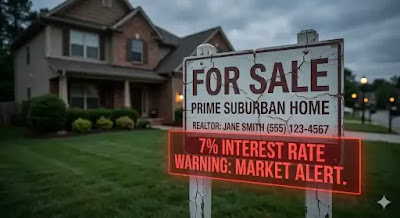
Even though the price-to-income ratio has dipped, interest rates have moved aggressively in the opposite direction. Properly speaking, a 7% mortgage on a $400,000 home is significantly more painful than a 3% mortgage on a $500,000 home. When you run the numbers on the monthly debt service, the “affordability” has actually decreased for the average buyer. The chart shows a healthy correction, but the average family’s bank statement shows a liquidity crisis. We are trading lower purchase prices for much higher long-term interest obligations.
Institutional Encroachment and the Supply Gap
One of the most concerning trends in our current research is the structural shift in ownership patterns. We are seeing a massive influx of institutional capital—pension funds and private equity—into the residential sector. These large-scale firms are not targeting “Luxury” assets; they are aggressively bidding on the “Starter Home” segment.
These firms often come to the table with all-cash offers, completely bypassing the traditional mortgage hurdles that slow down a regular family. This creates an artificial floor for prices. Even if demand from regular families drops due to high rates, these corporations step in to sweep up the remaining inventory, turning potential family equity into permanent rental income for their shareholders. This isn’t just a temporary market cycle; it’s a fundamental shift in how residential wealth is being consolidated.
The Missing Middle and Regulatory Friction
To be fair, we also have to address the chronic supply-side failure. For decades, the “Missing Middle” has been systematically ignored by developers. Due to restrictive zoning laws, high land costs, and expensive building codes, developers are incentivized to build either high-end luxury estates or high-density, low-income rental units.
The 1,500-square-foot family home—the very backbone of middle-class wealth building—is simply not being constructed at the scale required to meet demand. When you have a massive shortage of the specific product the majority of the population wants, the price will remain elevated regardless of what the “median” chart suggests. We are essentially oversupplied in mansions and undersupplied in modest, functional homes.
The Hidden Cost of Insurance and Taxes
Properly speaking, we cannot discuss affordability without mentioning the “hidden” carry costs. In 2026, we are seeing property insurance premiums skyrocket in major markets due to climate risks and rising replacement costs. In some states, insurance costs have doubled in just twenty-four months.
When you add these rising insurance premiums and property tax adjustments to the high interest rates, the “4.8x” price-to-income ratio starts to look completely irrelevant. The total cost of carry—the money leaving your pocket every month—is at an all-time high. A first-time buyer today isn’t just fighting the purchase price; they are fighting an entire ecosystem of rising secondary costs that the national charts simply ignore.
The Verdict for 2026
As we move further into the year, investors and families must remain skeptical of top-level macro data. The 4.8x ratio is a distraction from the structural issues that truly define this market: high interest rates, institutional competition, and a chronic lack of mid-range supply.
Properly speaking, the market isn’t “fixing itself”—it’s becoming more exclusive and more difficult to navigate for anyone who doesn’t have a massive cash reserve. Until we see a significant pivot in interest rate policy or a genuine legislative push to increase mid-market construction, that “correction” on the chart will remain a mathematical illusion. My advice is to ignore the national noise. Focus strictly on localized cash flow, specific neighborhood inventory, and your actual monthly carry capacity. The math has to work for your personal balance sheet, not just on a trend line in a government report.
FAQ Text for Your Blog
Q: Why does the chart say housing is more affordable if my rent is still going up?
To be fair, the chart tracks the “purchase price” of homes across the entire country. It doesn’t track the cost of renting or the cost of living in high-demand cities. While prices might be flat or falling in some areas, the demand for rentals in major cities remains high, keeping rents elevated even if the buying market looks “cheaper” on paper.
Q: Is 2026 a good time to buy a home if the ratio is at 4.8x?
Properly speaking, the ratio alone shouldn’t be your guide. You have to look at the interest rates and your total monthly payment. If your mortgage interest is high, the “lower” price doesn’t actually save you money. You should only buy if you plan to hold the property for at least 7-10 years and the monthly payment is well within your budget.
Q: Will the “Missing Middle” homes ever be built?
Listen, it depends on local government policy. Until zoning laws are changed to allow for more mid-sized homes and duplexes, developers will continue to focus on high-profit luxury projects. We are starting to see some changes in certain states, but it will take years for that new supply to actually hit the market.
Note: This is for educational purposes only. Not financial advice. We are not SEBI-registered.