The Export Parity Trap: Why Record US Production Won’t Yield Cheap Energy
The global energy narrative of 2026 is dominated by a glaring paradox. Data confirms that the United States has reached a historic zenith in oil and gas production, outstripping every other nation in history. For the macro-observer, this should signal a deflationary period for energy costs. Yet, consumers across the US and Europe are witnessing a stubborn floor under energy prices that refuses to budge.
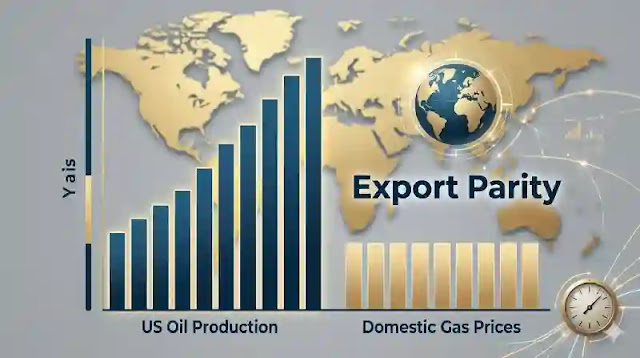
To understand this disconnect, one must look beyond simple supply/demand curves and analyze a structural financial mechanism: Export Parity. This is the invisible hand anchoring domestic prices to a volatile global market, ensuring that domestic abundance no longer translates into a domestic discount.
The Death of the Isolated Energy Market
Historically, the North American energy market functioned as a relatively closed system. If production surged, the excess supply was trapped within domestic borders due to a lack of export infrastructure. This trapped supply naturally forced local prices down to find a buyer.
However, the infrastructure investments of the last decade have fundamentally rewired the system. The US has astronomically expanded its export capacity for both Crude and Liquified Natural Gas (LNG). By building the pipelines and terminals necessary to reach global shores, US producers have effectively broken the domestic cage. We are no longer producing for a local captive market; we are producing for the global highest bidder. If a European utility or an Asian refinery offers a premium over a domestic hub, the molecules will migrate to the export terminal.
Defining Export Parity: The Global Price Floor
In financial terms, Export Parity is the price at which a producer is indifferent between selling locally and selling into the international market. Because the US is now the world’s leading exporter of LNG and a top-tier crude exporter, domestic price discovery is tightly coupled with international benchmarks like Brent or JKM (Japan Korea Marker).
When geopolitical instability flares in the Strait of Hormuz or shipping lanes in the Red Sea are compromised, global risk premiums skyrocket. Even if the US is physically insulated from these physical disruptions—a phenomenon we call the Energy Shield—our pricing mechanisms are not. A producer in the Permian Basin will not sell at a discount to a local refinery when the global market is paying a premium for security of supply. This creates a structural Price Floor that record-breaking production cannot sink.
Supply Security vs. Price Stability: The Energy Shield
There is a critical distinction that modern financial analysis must make: the difference between Supply Security and Price Stability. The 2026 Energy Shield provides the former but rarely guarantees the latter.
- The European & Asian Vulnerability: These regions face an existential supply threat. If maritime routes are severed, the physical volume of energy simply does not arrive.
- The US Relative Advantage: The US faces an economic threat rather than a physical one. The supply is guaranteed because it sits on domestic soil, but the cost of that supply is dictated by global desperation.
This is why we see a significant rotation of capital into US-based energy assets. Investors are not looking for cheap gas; they are betting on the safety of producers who can reach the market without traversing high-risk maritime chokepoints.
The $60 Sweet Spot and the US Shale Efficiency
A pivotal realization for the 2026 market is the refined efficiency of US shale operations. Domestic producers have optimized their balance sheets to thrive at a $60/barrel threshold. At this price point, US shale can act as a swing producer, flooding the market with volume faster than traditional OPEC+ members can react.
However, this glut of American production is a strategic weapon, not a consumer subsidy. It allows the US to capture global market share while traditional producers struggle with logistical or geopolitical constraints. It reinforces the US’s position as the last house standing in a global stagflation environment, but it does not decouple the local price from the global chaos.
The Structural Shift: Tech to Tangibles
For over a decade, the Cost of Compute was the primary focus of capital markets. However, in 2026, we are seeing clear frailty signs in the AI and tech sectors. As energy costs remain structurally high due to export parity, the margins for massive, energy-dependent data centers are being re-evaluated.
We are witnessing a brutal capital rotation. Institutional money is moving away from speculative, unprofitable tech ventures and toward the physical reality of energy infrastructure. The market is finally recognizing that a virtual economy cannot outrun a broken energy map.
Frequently Asked Questions (FAQ)
Q1: If the US is energy independent, why do global tensions still drive up my local energy costs?
While the US is independent in terms of physical volume, it is a primary participant in the global pricing pool. Due to Export Parity, domestic producers sell at the highest price available worldwide. If global prices spike due to geopolitical tension, domestic prices must rise to match that export opportunity cost.
Q2: Is the Energy Shield a government policy?
The Energy Shield is a market-driven reality rather than a formal policy. It describes the structural advantage the US holds by having zero maritime and zero transport risk for its primary energy needs—a security moat that Europe and China currently lack.
Q3: Can we expect $2 gas to return with record production?
It is highly unlikely in the current infrastructure era. As long as the US maintains the capacity to export its surplus to high-demand regions, the domestic market will never again be truly isolated. The US is now the world’s swing producer, and global demand will keep a firm floor under domestic prices.
Q4: How is this energy trend impacting the AI and Tech sectors?
High structural energy costs increase the overhead for data-heavy industries. We are seeing a significant shift in capital as investors move away from tech companies with high energy burn rates and toward secured energy assets that benefit from the current Price Floor.