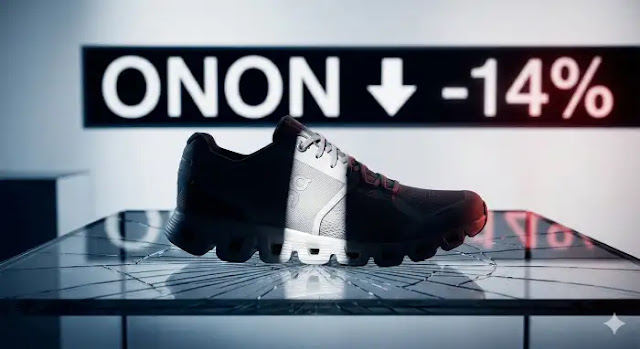
- Swiss Sneaker Giant On Holding Plunges 14% — Is the Running Boom Finally Slowing Down?
- Key Takeaways
- Introduction: When a Hot Brand Hits a Cold Wall
- What Happened to On Holding Stock (ONON)?
- The Forward Guidance That Raised Red Flags
- Why Did Growth Slow?
- The Bigger Picture: What’s Happening in the Footwear Market in 2026?
- A Market Under Pressure
- The Bull Case for ONON
- Why a Cautious Outlook Makes Sense for Investors
- FAQs: What People Are Asking About Holding Stock Right Now
Swiss Sneaker Giant On Holding Plunges 14% — Is the Running Boom Finally Slowing Down?
Key Takeaways
- On Holding (ONON) shares fell nearly 14% after the company issued weaker-than-expected guidance for 2026
- The Swiss sneaker brand warned of slower revenue growth, disappointing Wall Street analysts.
- Despite strong brand momentum, investor sentiment has shifted cautiously in the global footwear sector.
- The wider shoe industry faces headwind,s including rising costs, currency pressures, and soft consumer spending.ng
- Long-term growth potential remains, but short-term volatility is likely for On Running stock.
Introduction: When a Hot Brand Hits a Cold Wall
Imagine you have just discovered a new favourite restaurant. The food is brilliant, the queues are long, and everyone is talking about it. Then, one morning, the owner steps outside and says, “We expect fewer customers next year.” Suddenly, people start to worry. Is something not right? Has the magic run out?
That is more or less what happened to On Holding AG, the Swiss company behind the wildly popular On Running trainers, in early 2025. The company — known for its cloud-shaped soles and sleek Swiss design — saw its share price crash by nearly 14% in a single trading session after it warned investors that growth in 2026 would be slower than previously hoped.
For a brand that had been one of the most exciting stories in global sport and fashion, this was a significant moment. But does one bad day on the stock market mean the company is in real trouble? Or is this simply a bump on a very long road?
What Happened to On Holding Stock (ONON)?
The Forward Guidance That Raised Red Flags
In the world of stock markets, a company’s guidance — its own forecast for future sales and profits — is often more important than its current results. When a company tells investors, “We expect things to slow down,” markets tend to react quickly and often harshly.
That is precisely what happened with the ONON stock. On Holding reported solid recent performance, but its forward-looking statements for 2026 fell short of analysts’ expectations. The company signalled that revenue growth would be more modest than the rapid pace seen in previous years.
The result? A swift market drop. Shares dropped by nearly 14%, wiping out a substantial chunk of market value in just one day.
To put that in perspective — a 14% single-day drop for a major brand is the stock market equivalent of a professional sprinter pulling a hamstring mid-race. It quickly turns heads.
Why Did Growth Slow?
Several factors appear to be weighing on On Holding’s outlook:
- Currency headwinds: The Swiss franc is a strong currency. When On Holding sells trainers in the US or Europe, the revenue converts back to francs at less favourable rates, squeezing profits.
- Slowing consumer spending: According to the International Monetary Fund (IMF), global consumer confidence has been under pressure due to sticky inflation and higher interest rates in key markets like the US and Europe.
- Increased competition: Nike, Adidas, New Balance, and newer brands like Hoka are all fighting fiercely for the same customer — the fitness-conscious, style-aware shopper willing to spend £150 or more on a pair of trainers.
- Post-pandemic normalisation: The explosive growth in running and outdoor fitness gear during 2020–2023 was partly driven by pandemic-era lifestyle changes. That tailwind has eased.
The Bigger Picture: What’s Happening in the Footwear Market in 2026?
A Market Under Pressure
The global footwear market is worth over $400 billion, and premium sports footwear is one of its fastest-growing segments. But 2026 is shaping up to be a more challenging year than many brands had hoped.
The World Bank has flagged that growth in advanced economies is expected to remain subdued, hovering around 1.5%–1.8% in 2026. When household budgets feel squeezed, discretionary items like £180 running shoes are often the first things people delay buying.
Investor sentiment across the shoe industry has shifted as a result. Even brands with strong fundamentals are being viewed more cautiously.
Metric Current Value (March 2026) Analysis
Current Stock Price $42.44 – $42.89 Stabilizing after the 14% crash
Single-Day Drop – 14% Reacting to conservative 2026 guidance
52-Week High $61.29 Trading at a ~30% discount from its peak
2026 Revenue Guidance ~23% Growth, Lower than previous high-double-digit trends
EPS (Earnings Per Share) $0.31 Beats estimates, showing strong profitability
The Verdict: While the 14% plunge was a shock, the underlying business fundamentals remain surprisingly healthy. The company reported a record gross profit margin of 63.9% and outperformed earnings expectations. The current price dip to the $42 range represents a massive recalibration of growth expectations, but for those focused on brand strength and long-term expansion, it might be a significant “buy the dip” zone to watch.
Mini Case Study: Nike’s Similar Moment
On Holding is not the first premium footwear brand to experience a sharp market correction after an extended growth streak.
In 2024, Nike Inc. faced its own period of turbulence. After years of dominance, Nike issued a profit warning, citing weak demand in China, rising inventory levels, and slowing North American sales. Its share price fell sharply, and the company’s CEO was replaced. Yet Nike has remained a global giant, and analysts still consider it a long-term hold.
So what does this teach us? Even the best brands go through difficult chapters. What matters is whether the underlying business — the product, the brand loyalty, the innovation pipeline — remains strong.
For On Holding, those fundamentals still look reasonably solid. The brand has a devoted following, strong ties to elite athletics, and is expanding into new product categories, including apparel and outdoor gear.
On Running Stock Drop: Should Investors Be Worried?
The Bull Case for ONON
Despite the sharp decline, several analysts remain cautiously optimistic about On Holding’s long-term story:
- Brand strength is real. On Running has successfully positioned itself as a premium lifestyle brand, not just a sports shoe. Celebrities and professional athletes alike wear them.
- The business is steadily broadening its geographic footprint. The company is still growing in Asia Pacific and the Middle East — markets where premium sports goods are seeing rising demand.
- On Holding continues to push innovation forward through major investments in research and development, including its proprietary CloudTec sole technology.
Why a Cautious Outlook Makes Sense for Investors
- Slower growth in 2026 may signal a more permanent deceleration, not just a brief pause.
- Valuation concerns: Even after the drop, ONON trades at a premium compared to many peers. If growth disappoints further, there could be more downside.
- Supply chain and cost pressures remain a risk across the entire industry.
What Does This Mean for the Average Investor?
If you already own ONON shares, the key question is: has anything fundamentally changed about the business?
A slower growth rate does not mean a company is failing. It may simply mean the company is maturing — moving from explosive startup-style expansion to more steady, sustainable growth. That is a natural part of any business lifecycle.
If you are considering buying ONON after the dip, consider doing so as part of a diversified portfolio. No single stock — no matter how exciting the brand — should represent too large a portion of your investments.
FAQs: What People Are Asking About Holding Stock Right Now
Q1: Why did On Holding stock drop so sharply?
The stock fell nearly 14% after the company issued weaker-than-expected guidance for 2026, signalling slower revenue growth than analysts had anticipated.
Q2: Is On Holding (ONON) a good stock to buy after the dip?
It depends on your investment horizon. The brand remains strong, but near-term uncertainty exists. Consider doing your own due diligence or consulting a financial adviser before committing to any investment.
Q3: How does On Holding compare with industry giants Nike and Adidas? On Holding is smaller but growing faster (or was, until recently). It occupies a premium niche that neither Nike nor Adidas fully dominates yet.
Q4: What is On Holding’s 2026 revenue guidance?
The company indicated growth would be slower than the high double-digit rates seen in previous years, though exact figures may vary by reporting period.
Q5: Is the footwear market in trouble in 2026?
Not entirely. The market is experiencing a slowdown in some segments, particularly premium casual footwear, due to softer consumer spending and post-pandemic normalisation. However, long-term growth trends — driven by health consciousness and sportswear-as-lifestyle — remain positive.
Q6: What is ONON’s share price history? Holding was listed on the New York Stock Exchange in 2021 at around $24 per share and rose dramatically before facing corrections. Its price fluctuates — check a live financial source like Bloomberg or Yahoo Finance for the most current data.
Conclusion:
Holding’s 14% stock plunge is a sharp reminder that even the most exciting brands are not immune to the realities of markets, economics, and investor expectations.
But this is not a story about a brand in crisis. It is a story about a high-growth company entering a new chapter — one where expectations must be recalibrated, and growth must be earned more carefully.
The Swiss sneaker maker has built something genuinely impressive: a brand that people love, a product that performs, and a story that resonates globally. The road ahead may be a little bumpier than investors hoped. But for those with patience and a long-term mindset, the journey may still be worth taking.
What do you think — is the ONON dip a buying opportunity or a warning sign? Drop your thoughts in the comments below, and share this article with anyone following the footwear market in 2026.
Note: This is for educational purposes only. Not financial advice. We are not SEBI-registered.