- Strong Earnings, Weak Stock: Why Workday Can’t Shake Software Market Worries
- Key Takeaways
- Introduction: Good Results, Bad Reaction — What’s Going On?
- What Did Workday Actually Report?
- The Good News First
- The Guidance That Disappointed
- Why Is the Market So Scared of AI? The Bigger Picture
- SaaS Stocks Under Pressure
- Workday vs ServiceNow: A Tale of Two Reactions
- The CEO Change: A New Chapter or More Uncertainty?
- Mini Case Study: What Happened to Salesforce in a Similar Situation
- Frequently Asked Questions (FAQs)
Strong Earnings, Weak Stock: Why Workday Can’t Shake Software Market Worries
Key Takeaways
- Workday beat Q4 2026 earnings estimates — EPS of $2.47 vs $2.32 expected — yet the stock still fell over 8% in after-hours trading.
- Fiscal 2027 subscription revenue guidance of $9.93–$9.95 billion missed Wall Street expectations, spooking investors.
- Workday shares are down nearly 39% in 2026 alone — the worst start to a year since the company went public in 2012.
- AI disruption fears are hammering SaaS stocks broadly, with investors worried AI agents could replace HR and finance software entirely.
- Founder Aneel Bhusri has returned as CEO, promising a bold AI-first strategy — but Wall Street isn’t convinced yet.
Introduction: Good Results, Bad Reaction — What’s Going On?
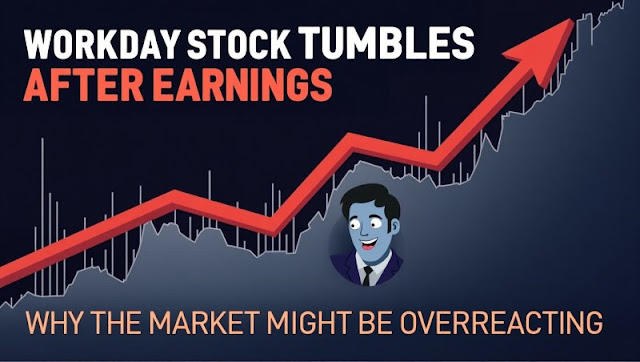
Picture this. A company reports strong profits. Revenue is up. Earnings beat expectations. The CEO is optimistic. And then… the stock falls 8%.
That is exactly what happened to Workday, Inc. (NASDAQ: WDAY) on the evening of 24 February 2026.
If you’ve been following the stock market — or even just the tech news — you might be scratching your head. Workday is one of the biggest names in enterprise software. It helps thousands of companies around the world manage their HR processes, payroll, and finances. It’s not a tiny start-up. It has over 11,500 customers globally. And yet, the market’s response to a perfectly decent earnings report was a sharp and swift sell-off.
So what is going on? Why are investors so rattled? And should you, as someone watching WDAY stock, be worried — or excited?
The answer lies not just in Workday’s numbers, but in a much bigger story unfolding across the entire software industry. It’s a story about artificial intelligence, fear, disruption, and the very real question of whether the software tools companies have paid billions for are about to become… unnecessary.
Here’s the straightforward breakdown.
What Did Workday Actually Report?
The Good News First
To be fair to Workday, the Q4 fiscal 2026 numbers were genuinely solid. Here’s what the company delivered for the quarter ending 31 January 2026:
- Total revenue: $2.532 billion — up 14.5% year-on-year, and just above analyst estimates of $2.52 billion.
- Subscription revenue: $2.360 billion — up 15.7% from the same period last year.
- Adjusted EPS: $2.47 — beating the $2.32 estimate comfortably.
- Non-GAAP operating margin: 30.6% — up from 26.4% a year earlier.
- Full-year operating cash flows: $2.939 billion — up 19.4%.
For context, the full fiscal year 2026 brought in total revenues of $9.552 billion — a 13.1% rise year-on-year. The company also delivered 1.7 billion AI-powered actions across its platform during the year. And its AI product revenue is now running at over $400 million annually.
On paper, that’s a healthy, growing, profitable business. So why the sell-off?
The Guidance That Disappointed
The problem came with the forward-looking numbers — what Workday expects to earn in the coming year. This is what really moves markets.
For Q1 fiscal 2027, Workday guided to subscription revenue of $2.335 billion, with a non-GAAP operating margin of 30.5%. Analysts had expected $2.35 billion in subscription revenue and a 30.9% margin. The gap might sound small, but in the world of high-growth software stocks, even a slight miss sends alarm bells ringing.
For the full fiscal year 2027, Workday expects subscription revenue of $9.925 to $9.950 billion — implying growth of just 12% to 13%. That’s down from higher growth rates in previous years, and below what analysts had hoped for. Total revenue guidance of $10.64 to $10.66 billion also came in below the $10.72 billion analyst estimate.
The message investors took from this: Workday’s growth is slowing. And in a world where AI is changing everything fast, a slowdown is the last thing they want to hear.
Why Is the Market So Scared of AI? The Bigger Picture
SaaS Stocks Under Pressure
Workday’s troubles are not happening in isolation. The entire sector of SaaS — Software as a Service — has been under heavy selling pressure in early 2026. A report from Citrini Research, a bearish research firm, caused significant alarm across the sector, warning that AI agents could make traditional software subscriptions redundant.
The fear is this: for years, companies paid monthly or annual fees to use software like Workday for HR, payroll, finance, and hiring. But what if an AI agent could do all of that work automatically, without needing the expensive software platform at all? What if artificial intelligence makes the middle layer of enterprise software… obsolete?
This is not an irrational fear. We are already seeing AI agents capable of handling repetitive business tasks — scheduling, payroll calculations, reporting, and expense management. Companies like Microsoft, Salesforce, and ServiceNow are all racing to embed AI agents into their products, hoping to stay relevant.
For Workday specifically, the concern is acute. Its core business is HR and finance software. These are, frankly, the types of repetitive, rules-based tasks that AI is particularly good at automating.
Workday vs ServiceNow: A Tale of Two Reactions
It is worth comparing Workday’s performance to ServiceNow, another enterprise software giant. While both companies face AI disruption fears, ServiceNow has handled investor messaging better by framing AI as an opportunity multiplier — leading to relatively stronger share price performance in recent months. Workday, by contrast, has struggled to tell a convincing growth story, which is partly why its stock is down 39% since January 2026 began.
This is a reminder that in the stock market, perception and narrative can matter just as much as raw numbers.
The CEO Change: A New Chapter or More Uncertainty?
On 9 February 2026, Workday announced that its CEO Carl Eschenbach was stepping down after three years in the role. Co-founder Aneel Bhusri — one of the company’s original visionaries — stepped back in as chief executive.
Bhusri is a well-respected figure in the enterprise software world. On the earnings call, he addressed the issue directly: You’ve all heard the narrative that HR and ERP will be replaced or pushed into the background by AI, he told analysts. His response? Workday isn’t a victim of AI — it’s going to be a leader in it.
The company’s strategy revolves around what it calls agentic AI — AI agents built directly into its Workday Illuminate platform that can automate complex tasks like financial reconciliations, payroll changes, and recruitment screening. In Q4 alone, AI-related expansion deals were 50% larger on average than non-AI deals. New AI contract value grew over 100% year-on-year.
Workday also acquired Pipedream — a startup that connects AI agents to a wide range of external services — and announced an AI agent specifically for managing employee shift requests.
The ambition is clear. The question is whether Wall Street will give Bhusri enough time to prove the strategy works.
Mini Case Study: What Happened to Salesforce in a Similar Situation
When Salesforce — the world’s largest CRM software company — first faced AI disruption fears in 2023 and 2024, its stock also sold off sharply on disappointing guidance. Analysts questioned whether the rise of generative AI would undermine Salesforce’s core products.
But Salesforce doubled down on its own AI strategy, launching Einstein AI features and signing major enterprise contracts. By staying close to its customer base and demonstrating real AI value, Salesforce stabilised and eventually recovered. The key was patience, clear communication, and tangible proof of AI-driven revenue.
Workday now faces a very similar test. With $400 million in AI annual revenue and growing, the building blocks are there. But management must now convert those early wins into a credible long-term growth story.
Is WDAY Stock a Buy After the 2026 Earnings Slump?
This is the central question facing investors today.
Here are the facts to consider. Workday’s forward price-to-earnings ratio has collapsed from a historical premium of over 60x to roughly 25x — a dramatic re-rating that reflects genuine doubt about the company’s long-term prospects. Morgan Stanley cut its price target from $280 to $200. Cantor Fitzgerald also cut its target to $200, though it maintains an Overweight (buy) rating.
The bull case: Workday has 11,500 customers, a $28.1 billion subscription revenue backlog, $5.4 billion in cash, and strong cash flows. It is investing heavily in AI, and early signs suggest customers value its AI features — with AI deals running 50% larger than average. The company is not in trouble. It is in transition.
The bear case: Growth is slowing. Guidance missed. The CEO just changed. And the entire software sector faces an existential threat from AI agents that could reduce demand for subscription software. At 25x earnings, WDAY may look cheap historically — but it’s not cheap enough to compensate for the uncertainty.
The IMF’s World Economic Outlook has highlighted that AI could affect up to 60% of jobs in advanced economies, particularly in administrative and professional services — the exact sectors Workday serves. This is the macro backdrop against which every software company must now make its case.
For long-term investors who believe enterprise companies will always need trusted, compliant, secure platforms to run HR and finance — and that Workday is best placed to be that platform in an AI world — the current price could look attractive in three to five years. For short-term traders, the volatility is likely to continue.
Software Market Outlook for 2026: What Comes Next?
The broader software sector is at a crossroads. According to analysis aligned with Federal Reserve and IMF projections on technology investment, enterprise software spending is expected to remain resilient in 2026 — but the composition of that spending is shifting. Companies are moving budgets from traditional SaaS subscriptions towards AI-powered platforms and productivity tools.
Workday, ServiceNow, SAP, and Oracle are all competing for a share of this AI-powered enterprise market. The winners will be those who can demonstrate that their AI features genuinely save customers time and money — not just those who add AI as a marketing label.
Workday’s 1.7 billion AI actions delivered in fiscal 2026 are a tangible number. Its $400 million AI revenue run rate is real. The question is speed — can growth accelerate fast enough to satisfy investors who were expecting more?
Frequently Asked Questions (FAQs)
Why is Workday stock falling today in 2026?
WDAY stock is falling because Workday’s fiscal 2027 revenue guidance came in below analyst expectations, even though Q4 earnings beat estimates. The guidance miss, combined with broader fears that AI could disrupt enterprise software companies, triggered a sharp sell-off.
Is WDAY stock a good buy after the 2026 earnings slump?
It depends on your investment horizon. At roughly 25x forward earnings — well below its historical average — Workday looks cheaper than it has in years. Long-term investors who trust Workday’s AI strategy may find value here. Short-term investors should expect continued volatility.
What is Workday’s fiscal 2027 revenue guidance?
Workday expects fiscal 2027 subscription revenue of $9.925 billion to $9.950 billion — implying growth of 12% to 13%. Total revenue is guided at $10.64 billion to $10.66 billion. Both figures narrowly missed analyst expectations.
How is AI affecting SaaS stocks like Workday in 2026?
Investors worry that AI agents could automate the tasks that enterprise software like Workday currently handles — reducing the need for expensive subscriptions. This fear has caused a broad sell-off in SaaS stocks. Workday, however, argues that AI actually enhances its platform and drives larger deals.
What happened to Workday’s CEO in 2026?
Carl Eschenbach stepped down as CEO in February 2026 after three years. Co-founder Aneel Bhusri replaced him, promising an AI-first strategy to drive Workday’s next phase of growth.
How does Workday compare to ServiceNow on AI?
Both companies are investing heavily in AI. ServiceNow has arguably done a better job of messaging its AI growth story to investors, leading to stronger relative share price performance. Workday is playing catch-up in investor confidence, even if its underlying AI metrics are strong.
Conclusion: Don’t Panic, But Do Pay Attention
Workday’s Q4 2026 results were genuinely solid. The company is growing, profitable, and has real AI traction. But the market is not rewarding solid right now — it is demanding exceptional, and it is punishing anything that hints at a slowdown.
The fears about AI disrupting enterprise software are real and not going away. But history shows that the best-positioned incumbents — the ones with trusted customer relationships, deep integration into business processes, and real data — tend to survive and thrive through technological transitions.
Workday has all of those things. It now needs to prove, quarter by quarter, that Aneel Bhusri’s AI vision is more than a rallying cry.
If you’re an investor watching WDAY, the next two earnings reports will be crucial. Watch subscription revenue growth, AI deal sizes, and operating margin trends. Those three metrics will tell you whether Workday is adapting successfully — or falling behind.
And if you’re new to investing in tech stocks, this is a perfect case study in a truth every investor should know: sometimes, good news is not enough. The market always looks forward. And right now, it is looking at the future of software — and feeling nervous.
Related Reads: How AI Is Transforming Enterprise Software in 2026 | Top SaaS Stocks to Watch This Year | How to Analyse Tech Earnings Like a Professional
Disclaimer: All content published on Marqzy is for educational and informational purposes only and should not be construed as financial advice. We are not SEBI-registered financial advisors. Investments in the stock market, mutual funds, or other financial instruments carry inherent risks. Please seek advice from a qualified financial professional and perform independent due diligence before investing. Marqzy shall not be held liable for any financial loss incurred.