- Why Are AI Stocks Falling Despite Strong Earnings? The 2026 Churn Explained
-
- Key Takeaways
- The Strangest Market Paradox of 2026
- Instead, the share price tanks by 20% the next morning.
- What Exactly is the ‘AI Scare Trade’?
- The Great Rotation: Where is the Money Going?
- Case Study: Palantir (PLTR) — A Victim of its Own Success?
- ❓ Trending FAQs: What Investors Are Asking Right Now
- Conclusion: Read the Sentiment, Not Just the Headlines
Why Are AI Stocks Falling Despite Strong Earnings? The 2026 Churn Explained
Published: February 2026 | Reading Time: 8 minutes | Category: Market Analysis
Key Takeaways
- The Paradox: Major players like Palantir and Salesforce are seeing 20-30% price drops, even after beating earnings expectations by a wide margin.
- The Scare Trade: Investors aren’t worried about AI failing; they’re worried it’s succeeding too fast, potentially making current software business models obsolete.
- Infrastructure Burn: Tech giants are spending over $700 billion on AI hardware in 2026, but the market is questioning when the actual payback begins.
- Valuation Reality Check: High-growth stocks were priced for perfection, leaving zero room for error as institutional sector rotation kicks in.
The Strangest Market Paradox of 2026
Imagine a company that just reported its best quarterly results ever. Revenue is up 70%, profits have tripled, and management is raising its outlook for the rest of the year. Normally, you’d expect the stock to moon.
Instead, the share price tanks by 20% the next morning.
This isn’t a hypothetical scenario; it’s the reality of the US stock market in early 2026. We are witnessing a massive disconnect where strong balance sheets are being met with aggressive sell-offs. This isn’t just a glitch—it’s a fundamental shift in how Wall Street views the future of tech. Analysts are calling it the AI Scare Trade.
If you’re an intermediate investor trying to figure out if this is a buy-the-dip moment or a sign to head for the exits, you’re not alone. Let’s break down what’s really driving this churn and why the old rules of good earnings = green candles aren’t working right now.
What Exactly is the ‘AI Scare Trade’?
To understand the chaos of February 2026, you have to look at Agentic AI.
We’ve moved past simple chatbots. We now have AI agents that can autonomously manage entire workflows—writing code, filing taxes, and handling customer service without human intervention.
This is where the scare comes in. If an AI agent can do what a $50/month software subscription does, why would a company keep paying for that subscription? Investors are dumping shares of SaaS giants like ServiceNow and HubSpot, not because they are failing today, but because they fear these companies might become redundant in three years as per-seat licensing models collapse.
📊Despite the recent recovery, the S&P North American Technology Index still sits nearly 30% below its 2025 peak. This is the sharpest re-rating of software valuations we’ve seen since the 2018 Fed pivot.
The Great Rotation: Where is the Money Going?
The money isn’t necessarily leaving the market—it’s just moving house. We’re seeing a massive rotation out of high-multiple growth stocks into Defensive Sectors:
- Healthcare & Industrials: Businesses with dependable cash generation and real-asset backing — often favoured in volatile markets.
- Consumer Staples: Businesses like Walmart or Costco that remain steady regardless of AI disruption.
Basically, institutional investors are hiding in boring companies until the dust settles on the AI software wars. They are selling their winners (like Palantir) to fund these safer bets, causing what analysts call Extreme Churn.
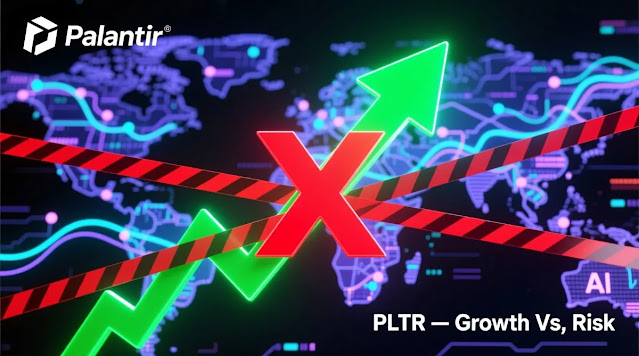
Case Study: Palantir (PLTR) — A Victim of its Own Success?
Palantir is the perfect example of this 2026 dynamic. Their Q4 results were legendary: 70% revenue growth and a 137% explosion in US commercial sales.
So why did it drop 22%?
Valuation. Palantir entered 2026 trading at a price-to-sales ratio that was effectively priced for perfection. When a stock is trading at 300x or 400x earnings, even a perfect report isn’t enough to sustain the momentum. Furthermore, heavy insider selling by executives in early 2026 signaled to the market that even those closest to the company felt the valuation had become stretched.
❓ Trending FAQs: What Investors Are Asking Right Now
Q: Why are AI stocks falling even when earnings are good?
Because markets are forward-looking. Strong earnings reflect the past quarter. The sell-off is driven by fear of the next five years—specifically, that agentic AI will disrupt the software companies that currently dominate enterprise spending.
Q: Is the AI-fuelled tech rally over in 2026?
Not necessarily, but it has changed shape. The rally is shifting away from the Software Layer and moving toward the Infrastructure Layer—chip makers, data center operators, and the energy companies powering them.
Q: Should I buy the dip in AI stocks like Palantir right now?
That depends on your risk appetite. While valuations have cooled, they remain historically high. A staged entry (DCA) over several months is generally safer than going all-in during a period of extreme churn.
Q: What is Agentic AI, and why does it matter?
Agentic AI refers to systems that can autonomously complete multi-step tasks. Unlike a chatbot that just talks, an agent can actually execute. This threatens any business model built on selling human labor or basic software tools for task management.
Q: How does the Fed’s interest rate policy affect this?
The Fed’s decision to pause rate cuts in early 2026 has made high-multiple growth stocks more expensive to hold. Higher rates mean the future value of a company’s earnings is worth less today, leading to lower stock prices.
Q: Which sectors are the safest right now?
Utilities, Healthcare, and Consumer Staples are currently the safe havens as investors rotate out of volatile tech names.
Conclusion: Read the Sentiment, Not Just the Headlines
What we’re seeing in early 2026 isn’t a tech crash; it’s a Tech Re-Rating. The market is trying to figure out who the real winners of the Agentic AI era will be.
For intermediate investors, the takeaway is clear: valuation discipline matters more than ever. Don’t get blinded by blowout earnings if the long-term thesis is being questioned. The AI revolution is very real, but the path to profit is rarely a straight line.
Disclaimer: All content published on Marqzy is for educational and informational purposes only and should not be construed as financial advice. We are not SEBI-registered financial advisors. Investments in the stock market, mutual funds, or other financial instruments carry inherent risks. Please seek advice from a qualified financial professional and perform independent due diligence before investing. Marqzy shall not be held liable for any financial loss incurred