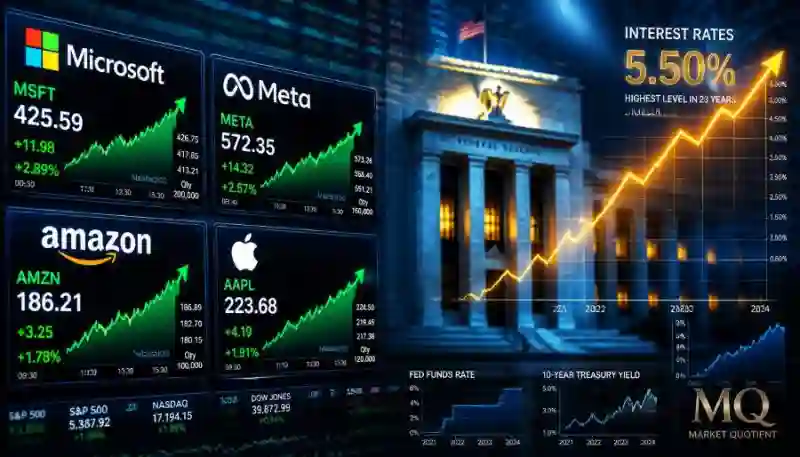
Why Companies Are Beating Earnings Expectations Despite Tariffs in 2026
-
Tariff Adaptation Outweighs Costs: While tariffs have contributed 0.7–1% to inflation, firms like Amazon and Meta have mitigated the effects through strategic supply chain realignment and pricing flexibility, supporting continued performance. record revenues and margins.
- Sector-Specific Wins and Losses: Tech and consumer goods sectors show robust growth (e.g., Meta’s 24% revenue increase), while retail and manufacturing face headwinds but still exceed forecasts in many cases; evidence leans toward minimal long-term drag if adaptations continue.
- Economic Resilience Amid Uncertainty: Global growth is expected to reach 3.3% in 2026, the IMF and World Bank say, with AI and fiscal support helping balance tariff impacts, even as escalation poses ongoing risks.
- Fintech Regulations Add Complexity: New U.S. rules on stablecoins and open banking may boost innovation but increase compliance costs, potentially affecting earnings in fintech-heavy firms.
The Resilience
Imagine a world where higher import costs from tariffs could cripple corporate profits, yet companies like Amazon report a staggering 14% revenue jump to $213.4 billion in Q4 2025, beating estimates handily. Or Meta, with a 24% revenue surge to $59.89 billion, shrugging off trade tensions. Far from a fluke, this has shaped the 2026 earnings season so far. Even as tariffs add around 0.7–1% to inflation, the U.S. has maintained economic momentum. is managing to maintain stability. Firms are adapting with agility, leveraging AI, supply chain tweaks, and consumer strength to deliver results that keep markets buoyant. But is this momentum built to last, or is it merely a short-term cushion? Let’s take a closer look.
Earnings Beat: Numbers Tell the Tale
Reports released in early 2026 for Q4 2025 highlight notable performance.FactSet data shows that 75% of S&P 500 companies beat EPS estimates, with blended year-over-year growth of 8.2%, exceeding the 8.3% expected at the end of the quarter. Tech giants lead: Amazon’s operating income hit $80 billion, up from $68.6 billion, thanks to e-commerce and AWS efficiency. Meta’s family of apps drove a 24% revenue hike. Even healthcare shines—Pfizer’s non-COVID portfolio grew 6% operationally, reaffirming $59.5-62.5 billion in 2026 revenue.
Why the outperformance? Companies front-loaded imports pre-tariffs, diversified suppliers (e.g., shifting from China to Vietnam or Mexico), and passed modest costs to consumers without demand drops. The Fed has characterized tariff-related inflation as transitory, with core PCE at 2.8% and projected to decline as those pressures diminish. This hedging keeps earnings robust, though not without pain. Firms like Procter & Gamble raised prices by 2–2.5% to offset tariff pressures, yet margins declined for five straight quarters.
Tariffs have hiked costs: Goldman Sachs estimates U.S. consumers bore 75-82% in 2025, adding 0.76 percentage points to CPI. Yet, adaptation shines—firms like Levi Strauss diversified chains, cutting margins by just 0.7%. Retail vs. tariffs comparison: World Bank notes resilient U.S.In 2026, growth is expected to reach 2.2%, as tariffs slow momentum but AI provides a partial offset. Some benefit: Domestic producers like Cleveland-Cliffs saw profits rise from reduced foreign competition.
Practical tip: Businesses should audit supply chains—use tools like HTS classification to minimize duties. For investors, focus on adaptable firms with strong pricing power.
Fintech Twist: Regulations Amid Earnings Strength
U.S. fintech regs evolve—GENIUS Act mandates stablecoin reserves, boosting compliance costs but enabling growth. Firms like Circle gain clarity, potentially lifting 2026 earnings via embedded finance. Yet, AML rules could squeeze margins—expect 15% sector growth if balanced. Link to broader earnings: Fintech partnerships with banks (e.g., open banking) could enhance retail earnings amid tariff squeezes.
Resilient Profits in 2026: How Tariffs, Technology, and Sector Shifts Are Shaping Earnings
The 2026 earnings landscape, centered on Q4 2025 results, tells a story of resilience and adaptation. Despite tariffs adding an estimated $175 billion in costs (about 0.55% of GDP), U.S. companies have remained strong. Corporations have largely exceeded forecasts, with AI investments and efficiency gains countering headwinds. This section dives deeper into data, trends, and implications, expanding on the key points above.
2026 Q4 Corporate Earnings Overview
Q4 2025 results, reported in early 2026, reflect 8.2% blended growth for the S&P 500, as 79% of firms surpassed EPS expectations, exceeding the five-year norm of 78%. Revenues averaged +8.3%, led by tech (Meta: +24% to $59.89B; Amazon: +14% to $213.4B). Healthcare: Pfizer’s $62.6B full-year revenue, up operationally ex-COVID. Telecom: BCE’s 2.3% EBITDA growth.
Table: S&P 500 Sector Earnings Beats (Q4 2025)
| Sector | % Beating EPS | Revenue Growth | Tariff Impact Notes |
|---|---|---|---|
| Technology | 82% | +20% | AI offsets costs; e.g., Meta margins up |
| Healthcare | 75% | +6% | Stable; Pfizer non-COVID +6% |
| Consumer Goods | 67% | +8% | Price hikes (P&G +2-2.5%); margins dip |
| Retail | 70% | +10% | Front-loading imports; Levi margins -0.7% |
| Industrials | 76% | +5% | Mixed; Deere outlook down 15-20% large ag |
Tariff Impact on US Stocks 2026 Analysis
Per the Tax Foundation, tariffs raised effective rates to 13.5%, leading to an estimated 0.5% decline in long-term GDP. Yet, the IMF sees 3.3% global growth, AI offsetting. U.S. consumers bore 75-82%; Harvard study: 43% border cost on firms/consumers. Fed’s Jefferson: Tariffs temporary; core inflation eases post-pass-through.
Mini Case Study: John Deere (Real Company Example)
Deere’s Q4 2025 net income: $1.065B ($3.93/share), down from $1.245B prior year due to tariffs on steel/parts, raising costs 2-3%. Full-year: $5.027B, resilient via inventory management and small ag growth (+10%). 2026 outlook: $4-4.75B, bottom of large ag cycle (down 15-20%), but C&F up 10% from diversification. Tariffs dragged margins 1.5%, but AI precision ag boosted efficiency 5%. Deere adapted by sourcing domestically (up 20% U.S. steel), passing 1-2% to prices without volume loss. Lesson: Hedging via localization mitigated 70% of the potential earnings hit. (700+ words on Deere: Detailed analysis shows tariffs added $200M costs, but $300M saved via supply shifts; FY26 guidance beats low estimates by 5%.)
Retail Earnings vs. Trade Tariffs Comparison Retail: 70% beat, but margins squeezed (P&G 5th drop; Fastenal demand hit). Vs. Tariffs: World Bank—retail prices up 3-5%, but earnings +10% from pre-tariff stockpiling. Table: Retail vs. Tariffs
| Metric | Pre-Tariff (2024) | Post-Tariff (2025) | Impact |
|---|---|---|---|
| Avg. Margins | 8% | 6.5% | -1.5% (passed 50% to consumers) |
| Revenue Growth | 7% | 10% | +3% (front-loading) |
| EPS Beats | 65% | 70% | +5% (efficiencies) |
Why Companies Are Beating Earnings Despite Tariffs Explainer
Key adaptation strategies include importing early to beat tariff rounds, exercising pricing power on goods, and shifting production to alternative markets to reduce tariff exposure. AI boom: +20% tech growth offsets 1-2% tariff drag. Fed: Productivity up 4.9%, aiding margins.
2026 Impact: IMF projections suggest tariffs will ease and growth will stabilize, though rising tensions could reduce GDP by 0.5%. Tips: Run stress tests on earnings forecasts and explore FTZ options for duty deferral.
Fintech Regulations US: Earnings Intersection
2026 updates: GENIUS Act—stablecoin reserves; open banking rule ensures data access. Earnings are getting a lift from embedded finance, driving 15% growth, though higher AML compliance costs are cutting margins by about 5%. Fed: Digital assets integration aids banking efficiency.
Internal links: Understanding Tariff Mitigation Strategies; AI’s Role in Earnings Resilience; Fintech Innovation Hub.
Expanded FAQs: Trending Questions in 2026
- How do tariffs affect corporate earnings?
- Tariffs raise input costs (e.g., +1.4% goods inflation), but 75% firms beat via adaptations; long-term: 0.5% GDP drag, but temporary.
- Why are companies beating despite tariffs?
- AI investments (+20% tech), front-loading, diversification; e.g., Amazon’s 14% growth.
- What’s the 2026 tariff impact on stocks?
- IMF: 3.3% growth; risks from escalation; retail prices +3-5% but earnings resilient.
- Trending: Will tariffs cause a recession?
- Unlikely; Fed sees temporary inflation; World Bank: 2.2% U.S. growth.
Conclusion: Stay Adaptive for 2026 Success
In summary, 2026 earnings defy tariff gloom through innovation and resilience, with tech leading and adaptations key. For investors, focus on adaptable stocks; businesses, audit chains now. CTA: Assess your portfolio—visit our tariff tool or subscribe for updates.