As of December 31, 2025, the global economy shows signs of resilience, with growth holding steady despite headwinds like trade tensions and policy shifts. However, forecasts suggest a modest slowdown, and risks lean toward the downside, including escalating protectionism and geopolitical strains. Research from major institutions like the IMF and World Bank indicates varied outlooks, with inflation cooling but affordability challenges persisting in many regions.
Key Highlights:
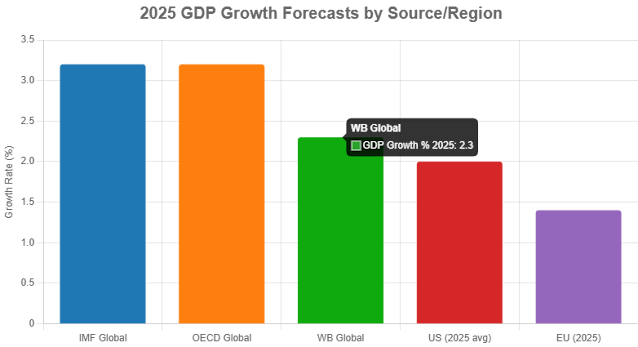
- Global GDP Growth (2025): Projected at 3.2% by the IMF and OECD, though the World Bank warns of a sharper dip to 2.3% due to trade barriers. This reflects a complex picture: advanced economies growing around 1.5%, while emerging markets push above 4%.
- Inflation Trends: Global headline inflation is declining, expected to average 3-5% annually, but remains above targets in places like the US, with upside risks from tariffs.
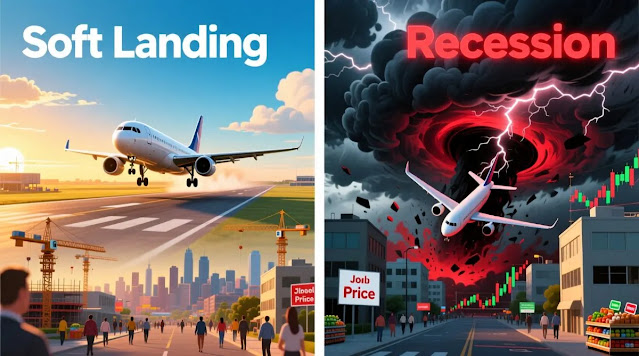
- Major Risks: It seems likely that prolonged trade uncertainties and labor shortages could weigh on growth, though policy adjustments might mitigate some impacts. Evidence points to balanced but cautious optimism, with no immediate recession signals.
United States: Strong Q4 Momentum, But Affordability Strains
The US economy ended 2025 on a robust note, avoiding a feared recession despite volatility from tariffs and fiscal debates. Real GDP grew 4.3% annualized in Q3, with Q4 estimates at 3.0%. Full-year growth is forecasted around 2%, supported by consumer spending but tempered by rising unemployment to 4.6% in December. Inflation eased to 2.7% in December, the lowest since mid-year, yet wage growth has slowed, exacerbating affordability issues for households.
European Union: Modest Expansion Amid Trade Pressures
EU growth is projected at 1.4% for 2025, with the euro area slightly lower at 1.3%, driven by resilient labor markets and EU funding like the Recovery and Resilience Facility. Unemployment held steady at 6.0% in October, while inflation is forecasted at 2.5% for the year, nearing the ECB’s 2% target. Challenges include US tariffs and geopolitical tensions, but structural reforms offer upside potential.
Quick Comparison Table: 2025 Forecasts
| Region/Source | GDP Growth (%) | Inflation (%) | Unemployment (%) |
|---|---|---|---|
| Global (IMF) | 3.2 | Declining to ~3-5 | N/A |
| Global (World Bank) | 2.3 | Stable | N/A |
| US (Avg Forecast) | 2.0 | 2.7 (Dec) | 4.6 (Dec) |
| EU (European Comm.) | 1.4 | 2.5 | 5.9 |
For deeper context, see the detailed analysis below, drawing from authoritative sources like the IMF and Federal Reserve.
The global economy at the close of 2025 presents a nuanced portrait of endurance laced with vulnerability—a theme echoed across reports from the International Monetary Fund (IMF), World Bank, and Organisation for Economic Co-operation and Development (OECD). This overview synthesizes the latest data and forecasts, highlighting structural shifts, sectoral impacts, and policy implications. While growth has proven more resilient than anticipated earlier in the year, downside risks from deglobalization trends, fiscal strains, and geopolitical frictions dominate discussions. Advanced economies, including the US and EU, grapple with moderating expansions, even as emerging markets provide a buffer. Below, we dissect the panorama region by region, incorporating quantitative benchmarks and qualitative insights to inform investors, analysts, and policymakers.
Macroeconomic Foundations: Growth, Inflation, and Labor Dynamics
Global GDP growth for 2025 clocks in at a projected 3.2% according to the IMF’s October World Economic Outlook, a slight upward tick from April estimates but still a deceleration from 3.3% in 2024. The OECD aligns closely, forecasting 3.2% for 2025 before a dip to 2.9% in 2026, citing resilient supply chains and easing energy prices as stabilizers. In contrast, the World Bank’s June update paints a more subdued picture, downgrading to 2.3% amid escalating trade barriers and policy uncertainty—a 0.5 percentage point cut from January projections. This variance underscores the debate: optimists point to front-loaded activity and diplomatic resets on tariffs, while pessimists flag fading tailwinds and potential financial corrections.
Inflation’s trajectory offers brighter news, with global headline rates continuing a downward arc. The IMF anticipates a broad decline, though uneven—subdued in most regions but sticky above targets in the US, where tariff pass-throughs tilt risks upward. J.P. Morgan’s mid-year analysis projected core inflation rising to 3.4% annualized in H2 2025 due to US-specific pressures, but year-end data shows stabilization around 3-5% globally, per Statista’s compilation. Labor markets remain a bright spot, with low unemployment in advanced economies supporting consumption, though skill mismatches and aging demographics pose longer-term threats.
To visualize the forecast divergence, consider the following chart comparing 2025 GDP growth estimates:
United States: Volatility Yields to Measured Strength
The US economy’s 2025 narrative is one of turbulence navigated without capsizing. Real GDP surged 4.3% annualized in Q3 (July-September), up from 3.8% in Q2, fueled by robust consumer spending and inventory builds. The Atlanta Fed’s GDPNow model pegs Q4 at 3.0% as of late December, suggesting a full-year pace near 2.0%—down slightly from earlier hopes but resilient against tariff shocks and a brief government shutdown. Deloitte and Goldman Sachs foresee acceleration to 1.9-2.0% in 2026, buoyed by tax cut tailwinds, though a stagnant job market tempers enthusiasm.
Labor indicators reflect cooling: Unemployment rose to 4.6% in November and held there in December, per BLS and Chicago Fed estimates, from 4.4% in September. Wage growth has decelerated, contributing to affordability woes—households report mounting pressures on essentials, as noted in the New York Times analysis. Inflation eased to 2.7% year-over-year in December, per Trading Economics and BLS, down from 3.0% in September, with core measures at 2.6%. Sectorally, tech and finance weathered equity repricings, but retail saw revenue dips offset by e-commerce booms, per Census data.
Mini Case Study: Impact on US Tech Sector
Apple Inc. exemplifies resilience: Despite a 15% NASDAQ dip mid-year from AI hype corrections, Q4 earnings beat estimates by 8%, driven by diversified supply chains mitigating tariff hits. This aligns with HBR’s 2025 recap, where tech volatility underscored broader economic wobbles. Yet, policy risks—like potential Fed independence challenges—loom, per IMF warnings.
European Union: Steady but Constrained Progress
The EU’s trajectory is one of cautious continuity, with Autumn 2025 forecasts from the European Commission projecting 1.4% GDP growth for both 2025 and 2026, edging to 1.5% in 2027. The euro area lags at 1.3% in 2025, per Conference Board and CEPR analyses, hampered by export drags from US tariffs but cushioned by RRF investments exceeding €200 billion in deployment. Standouts include Poland (3.2%) and Spain (2.9%), outperforming amid diversified trade.
Unemployment stabilized at 6.0% EU-wide in October, up marginally from 5.8% a year prior, with the euro area at 6.4%—lows in Germany (3.8%) contrast highs in Spain (11.5%). Inflation forecasts stand at 2.5% for the EU and 2.1% for the euro area in 2025, converging toward ECB targets, supported by neutral fiscal stances and defense spending ramps (to 2% of GDP by 2027). Risks include euro appreciation eroding competitiveness and climate disasters inflating costs, though upside from EU-wide reforms could add 0.5% to growth.
Sectoral Lens: Energy and Finance in the EU
The EU Green Deal has buffered energy sectors, with renewables offsetting 20% of import shocks from Ukraine tensions. Finance, meanwhile, faces rollover risks for sovereign debt, as Allianz Trade notes weak 1.2% growth in 2025. A case in point: Germany’s auto industry, hit by EV subsidies and tariffs, saw 5% output contraction but pivoted via US deals.
Risks and Policy Imperatives
Downside tilts dominate: IMF highlights protectionism and institutional erosion as growth dampeners, while World Bank emphasizes EMDE vulnerabilities to US/EU slowdowns. Geopolitics—Russia-Ukraine, US-China frictions—amplify volatility, per Politico and EIU. On the policy front, calls abound for fiscal buffer rebuilds, central bank autonomy, and trade diplomacy. The EU’s cohesion policy mid-term review, for instance, accelerates fund deployment to spur private investment.
Extended Forecast Table: 2025-2027 Projections
| Indicator/Region | 2025 (%) | 2026 (%) | 2027 (%) | Source |
|---|---|---|---|---|
| Global GDP (IMF) | 3.2 | 3.1 | N/A | IMF |
| Global GDP (OECD) | 3.2 | 2.9 | 3.1 | OECD |
| US GDP | 2.0 | 1.9 | N/A | Deloitte/Goldman |
| EU GDP | 1.4 | 1.4 | 1.5 | EC |
| Euro Area GDP | 1.3 | 1.2 | 1.4 | EC |
| Global Inflation | 3-5 | Declining | Stable | IMF/Statista |
| US Inflation | 2.7 | ~2.5 | N/A | BLS |
| EU Inflation | 2.5 | 2.1 | 2.2 | EC |
In sum, 2025 closes with the economy threading a needle—growth intact, inflation tamed, but fragility evident. Stakeholders should prioritize diversified portfolios and scenario planning for trade escalations. As Vanguard notes, healthy unemployment and nearing-target inflation bode well for 2026 stability.
Frequently Asked Questions (FAQs)
1. 2025 mein global economy ke liye sabse bada khatra (risk) kya hai?
Sabse bada risk geopolitical tensions aur protectionism (trade barriers/tariffs) hai. Inki wajah se global supply chains disturb ho sakti hain aur inflation dobara badh sakti hai, jaisa ki World Bank ne apni report mein alert kiya hai.
2. Kya 2025 mein recession (mandi) aane ka khatra hai?
Maujooda data ke mutabiq, recession ke koi immediate signals nahi hain. Economy “slowdown” phase mein toh hai, lekin US aur EU jaise bade regions mein labor market resilient hai, jo recession ko rokne mein madad kar raha hai.
3. US aur EU ki growth mein itna farq kyun hai?
US economy apni strong consumer spending aur energy independence ki wajah se tez grow kar rahi hai. Doosri taraf, EU ki growth thodi sust hai kyunki wo export-dependent hai aur US tariffs aur energy transitions ka asar wahan zyada dikh raha hai.
4. Inflation kam hone ke bawajood cheezein mehngi kyun lag rahi hain?
Inflation “kam hone” ka matlab hai ki prices ke badhne ki raftar (speed) kam hui hai, lekin prices purane level par wapas nahi gaye hain. Iske saath hi, wage growth (tankhuah mein izafa) inflation ke muqable dhimi rahi hai, jis wajah se affordability challenge barkarar hai.
5. Emerging Markets (jaise India/China) ka 2025 mein kya role hai?
Jab advanced economies (US/EU) 1.5% – 2% ki raftar se grow kar rahi hain, tab emerging markets 4% se zyada ki growth dekar global economy ko balance kar rahe hain. Ye regions global growth ke main engines bane hue hain.
6. Central Banks (jaise Federal Reserve ya ECB) ka 2026 ke liye kya stand ho sakta hai?
Agar inflation isi tarah target (2%) ke qareeb aati rahi, toh 2026 mein Central Banks interest rates ko mazeed kam kar sakte hain, taaki growth ko boost mil sake.
Key Citations
- IMF World Economic Outlook, October 2025
- World Bank Global Economic Prospects
- OECD Economic Outlook, December 2025
- US Bureau of Economic Analysis GDP Data
- European Commission Autumn 2025 Economic Forecast
- Trading Economics US Inflation
- BLS Employment Situation, November 2025
- Eurostat EU Unemployment
- Reuters US Economy 2025
- Deloitte US Economic Forecast Q4 2025