- The Great Reversal: How Abandoning a Tax Hike Triggered a Crisis of Confidence in the UK
- A Market Shock: Investors React with Pessimism to Fiscal Uncertainty
- The Drivers of the U-Turn: Political Pressure Meets Improved Forecasts
- From Broad Taxes to Stealth Levies: The New Fiscal Strategy Unveiled
- A Government Under Siege: Political Fallout and Eroding Trust
- The Deeper Context: UK Borrowing Costs and Structural Economic Vulnerabilities
- Conclusion: A Nation at a Crossroads Between Manifesto Pledges and Hard Reality
The Great Reversal: How Abandoning a Tax Hike Triggered a Crisis of Confidence in the UK
A Market Shock: Investors React with Pessimism to Fiscal Uncertainty
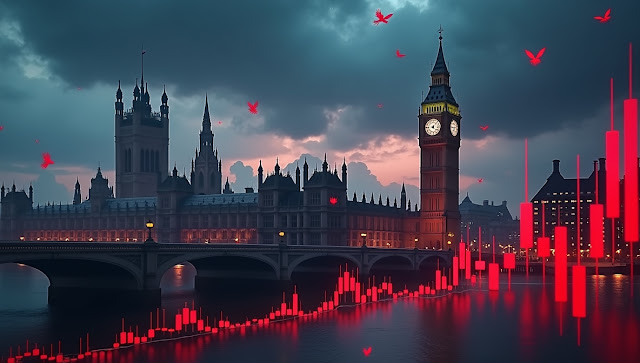
The decision by Chancellor Rachel Reeves to abandon plans for a planned increase in income tax rates sent shockwaves through global financial markets, triggering a swift and significant sell-off in UK government bonds and a sharp depreciation of the pound sterling
.
This negative reaction was not directed at the act of scrapping the tax
hike itself, but rather at the perceived implications of the move—a
signal of improvisation, a retreat from tough fiscal choices, and a
strategy that undermined the government’s credibility.
The markets interpreted the pivot towards a more politically palatable
but fiscally vaguer approach as a sign of weakness, leading to higher
borrowing costs for the UK government and renewed anxiety among
investors about the nation’s economic stability
. The events of late November 2025 painted a stark picture of a government grappling with a difficult reconciliation between political promises and economic necessity, a struggle that exposed deep-seated vulnerabilities in investor confidence.
The most immediate and telling reaction came from the gilt market, which serves as a barometer for the health of the UK’s public finances. Following reports of the policy reversal, bond yields surged dramatically, indicating falling bond prices and rising demand from investors for higher returns to compensate for perceived increased risk
.
The yield on the benchmark 10-year UK government bond jumped by between
7 and 13 basis points, reaching levels not seen since July, when
previous market instability had occurred. One source reported a rise of 12.5 basis points, pushing the yield to nearly 4.6% while another noted a jump to 4.57%. The sell-off extended to longer-dated gilts, with the 30-year yield
climbing by up to 14 basis points and the 20-year yield also increasing
by 12 basis points. These
movements were described by some analysts as the worst day for
long-dated gilts since July 2, 2025, highlighting the severity of the
market’s concern. This
selloff directly translates into higher borrowing costs for the
government, making it more expensive to finance the national debt at a
time when the country is already struggling with high deficit levels.
The British pound also suffered significantly, reflecting widespread investor unease over the government’s fiscal direction
. The currency fell against both the US dollar and the euro, with one report noting a decline of 0.3% against both currencies.
Another analysis showed the pound falling nearly 0.5% against the
dollar to $1.3129 and weakening against the euro following the
announcement. At one point,
GBP/USD hovered just below $1.32, while the GBP/EUR exchange rate fell
to around €1.1321, its lowest level in two and a half years. German Bank analysts noted that the pound’s risk premium had grown to
over 3%, and the widening gap between spot and front-end interest rates
reached its widest since April 2025, further underscoring the flight
from UK assets. While the
pound later recovered slightly after reports clarified that the reversal
was based on improved OBR forecasts, the initial drop signalled a
profound loss of confidence.
The negative sentiment spread to the broader stock market, where the FTSE 100 experienced its worst daily performance since April, erasing nearly all its weekly gains
. The index dropped by 1.1% to 1.6%, with major banking stocks bearing the brunt of the selling pressure. Lloyds, NatWest, and Barclays all saw their shares fall by between 2.8% and 3.5%.
Analysts attributed this downturn to a combination of factors,
including uncertainty over the budget, a sell-off in AI stocks, and
Federal Reserve rate outlook concerns, but the fiscal policy reversal
was a key contributor to the overall negative mood. The market’s reaction demonstrated that prolonged periods of “Budget
nerves” can damage consumer confidence and lead firms to delay critical
investment decisions, amplifying the economic uncertainty.
|
GBP/USD Exchange Rate
|
Fell nearly 0.5% to $1.3129; later down 0.3%
|
14 Nov 2025
|
Signals investor anxiety about the UK fiscal position.
|
|
GBP/EUR Exchange Rate
|
Fell to €1.1321, a 2.5-year low
|
14 Nov 2025
|
Reflects broad-based weakness in the pound against a key European currency.
|
|
10-Year Gilt Yield
|
Rose by 7 to 13 basis points (bps)
|
14 Nov 2025
|
Indicates rising borrowing costs and declining confidence in UK debt.
|
|
30-Year Gilt Yield
|
Rose by up to 14 bps
|
14 Nov 2025
|
Shows heightened concern over long-term fiscal sustainability.
|
|
FTSE 100 Index
|
Fell 1.1% to 1.6%
|
14 Nov 2025
|
The broader market reflects economic uncertainty and negative sentiment.
|
Market analysts offered several interpretations for this sharp downturn. Lee Hardman of MUFG stated that markets viewed the move as prioritising political popularity over financial stability, thereby undermining fiscal credibility
.
Kathleen Brooks of XTB warned that the abandonment of a headline income
tax rise left major spending pledges unfunded and forced the government
to pursue a “death by a thousand cuts” approach of smaller taxes, which
would likely be anti-growth and damage credibility.
Neil Wilson of Saxo Markets highlighted the risk of a “doom loop,”
where rising borrowing costs due to perceived fiscal mismanagement could
force further austerity measures.
The consensus among financial observers was that the government had
missed an opportunity to reassure markets with a clear, albeit tough,
fiscal plan. Instead, the
policy reversal was seen as a “credibility shock,” drawing parallels to
the Truss mini-budget crisis, where a lack of clarity led to severe
market instability. As
Susannah Streeter of Hargreaves Lansdown put it, investors were selling
UK government debt because they believed the government was losing
control of public finances. The core issue was that the market had previously taken reassurance from
signals that Reeves was willing to implement tough fiscal measures,
including possible income tax increases. The shift to a collection of smaller, narrowly targeted taxes was
viewed as less reliable and harder to avoid, signalling a reluctance to
take decisive action
. This created a vacuum of confidence that the market filled with pessimism.
The Drivers of the U-Turn: Political Pressure Meets Improved Forecasts
Chancellor Rachel Reeves’ dramatic reversal on income tax hikes was not a spontaneous decision but the result of a complex interplay between hard fiscal realities and intense political pressures. The official justification provided by the government centred on a significant improvement in the UK’s economic outlook, as revealed by the Office for Budget Responsibility (OBR)
.
However, this fiscal rationale was powerfully reinforced by a
formidable array of political considerations, including the need to
honour a major election manifesto pledge, manage dissent within the
governing party, and respond to strong public sentiment against tax
increases
. Ultimately, the decision to scrap the proposed tax rise represented a strategic choice by the government to prioritise political survival and the maintenance of public trust over what might have been perceived as a necessary but deeply unpopular fiscal consolidation measure.
The primary fiscal driver behind the U-turn was a better-than-expected forecast from the OBR, which revised down the projected size of the UK’s “fiscal black hole”
.
Earlier estimates had pointed to a substantial shortfall in public
finances, prompting consideration of a direct income tax hike. The
revised forecast indicated that this gap was considerably smaller than
previously feared, reducing the immediate pressure on the Chancellor to
raise headline tax rates. Multiple sources confirm that the fiscal gap was narrowed from an
initial estimate of between £30 billion and £35 billion to approximately
£20 billion. This positive
revision provided the crucial fiscal space needed to reconsider the
proposed tax increase. The improvement was attributed to several key
economic factors. First, there was stronger-than-anticipated wage
performance, which translated into higher tax receipts without any
change in the tax rates themselves.
Second, the OBR’s assessment of the economy’s productivity was less
severe than initially expected, meaning the negative impact on public
finances was not as large as feared. This combination of higher revenues and a less damaging economic
outlook allowed the Treasury to conclude that a broad-based tax hike was
no longer the only viable option to meet its fiscal rules.
However, the fiscal justification alone does not fully explain the decision. A powerful set of political forces pushed the government towards scrapping the tax plan. The most significant of these was the Labour Party’s own 2024 general election manifesto, which included a clear and repeated pledge not to raise ‘the basic, higher or additional tax and contribution rates—income tax, National Insurance, and VAT—that apply to workers
.
A proposal to raise the basic rate of income tax by 2p, even if paired
with a cut in National Insurance for lower earners, would have
constituted a breach of this fundamental commitment.
There was immense pressure from across the parliamentary party to keep
this promise. Senior cabinet members, including Health Secretary Wes
Streeting, publicly welcomed the reported U-turn, emphasizing the
importance of honoring election pledges to rebuild trust in politics Internal discussions within the Treasury had even explored redefining
“working people” to those earning under £45,000, a move that would have
still alienated vast swathes of the public, including teachers and NHS
staff, and sparked significant concern over breaching the spirit of the
manifesto.
Public opinion polls confirmed that breaking such a pledge would be politically toxic. A poll conducted ahead of the announcement found that 66% of UK voters believed Rachel Reeves should resign if she raised income tax during the upcoming Budget
.
This overwhelming public backlash made the political cost of proceeding
with the tax hike untenable. Furthermore, the timing of the decision
was critical. It came amid growing internal turmoil within the Labour
government, with reports of a briefing war damaging Prime Minister Sir
Keir Starmer’s leadership credibility and speculation of a post-budget
leadership challenge against him.
Insiders judged the political cost of breaking the manifesto and
risking a rebellion from backbench MPs to be too high, especially given
the prime minister’s weakened standing. The episode deepened concerns among Labour MPs about Starmer’s
leadership strength and electoral viability, creating an environment
where a controversial policy like a tax rise was simply too risky to
implement
. The decision to abandon the tax hike was therefore a calculated move to preserve party unity and protect the fragile authority of the new government. In essence, the improved fiscal forecasts provided the perfect pretext for a politically motivated retreat, allowing the government to avoid a confrontation with voters and its own MPs while appearing to have found a more palatable solution.
From Broad Taxes to Stealth Levies: The New Fiscal Strategy Unveiled
With the headline income tax hike officially scrapped, the Treasury is now tasked with finding alternative ways to close the remaining £20 billion to £30 billion fiscal gap
.
The government’s emerging strategy marks a significant departure from
the original plan of a broad-based tax change. Instead of raising
headline rates, officials are reportedly pursuing a “smorgasbord” of
narrower, more targeted measures designed to generate revenue without
explicitly breaking the manifesto promise not to raise income tax for
“working people”. His new
approach includes the highly scrutinised extension of frozen income tax
thresholds, often termed a “stealth tax,” alongside other levies on
specific sectors and behaviours.
While these measures may appear politically safer, they have drawn
criticism from economists and analysts who warn that this “haphazard
patchwork” of small taxes undermines fiscal credibility, creates
economic distortions, and fails to inspire confidence in the
government’s long-term financial stewardship.
The most prominent alternative being considered is the extension of the freeze on personal income tax thresholds beyond their scheduled end date in 2028
.
This policy, while keeping headline tax rates unchanged, effectively
acts as a tax increase due to “fiscal drag”—the phenomenon where
inflation pushes individuals into higher tax brackets or reduces the
value of their personal allowance. By freezing the thresholds, the government allows inflation to erode
their real value, thereby pulling more people into the tax system and
increasing the number of taxpayers. The Institute for Fiscal Studies (IFS) has estimated that extending the
freeze until 2030 would raise an additional £8.3 billion in revenue for
the Treasury in 2029–30 alone, on top of the £42 billion expected from
existing freezes. The impact
of this “stealth tax” is significant and progressive in nature. By
2029–30, a minimum wage worker would only need to work 18 hours per week
to become liable for income tax, the lowest threshold since the
introduction of the national minimum wage in 1999.
Similarly, the full new state pension is projected to exceed the income
tax personal allowance in 2027–28, meaning 100% of pension recipients
will pay income tax by that year.
Overall, extending the threshold freezes would increase the number of
income tax payers to 42.1 million by 2029–30, a rise of nearly 1 million
from the current policy
Beyond the threshold freeze, the Treasury is exploring a range of other targeted measures to fill the remaining fiscal hole. These include ending tax breaks for salary sacrifice pension schemes, which is estimated to raise around £2 billion, and introducing a new tax on electric vehicles, also projected to bring in £2 billion
.
Other possibilities under discussion include raising taxes on gambling
companies or extending taxes to professional LLP firms, though the
latter idea was reportedly abandoned over concerns about administrative
complexity. This collection of smaller, narrowly drawn tax increases is what officials have described as a “smorgasbord” approach.
The rationale is to find revenue without resorting to a headline rate
change, but critics argue this strategy is fundamentally flawed.
Economist Paul Johnson, former director of the IFS, noted that while
lowering tax thresholds can raise significant funds, it
disproportionately impacts lower-paid workers.
More broadly, economists Kallum Pickering of Peel Hunt and Ruth Gregory
of Capital Economics have expressed concern that abandoning a broad tax
hike in favour of this piecemeal approach undermines fiscal credibility.
They warn that it could generate adverse effects on work, investment, and
savings, as businesses and individuals face a more complex and
unpredictable tax environment.
This shift away from a single, transparent tax reform to a series of smaller, less visible measures has been widely criticised as a failure of fiscal courage. Analysts like Kathleen Brooks of XTB describe it as a “death by a thousand cuts” strategy, where numerous small tax increases leave the government with unfunded commitments and a damaged reputation for fiscal responsibility
.
Mark Dowding of RBC BlueBay Asset Management went so far as to say the
government had “undermined any credibility it has left.
The bond market appears to share this view, with rising yields
suggesting investors doubt the sustainability of a strategy that relies
on taxing the rich alone and instead requires a broadening of the tax
base or spending cuts Andrew Wishart of Berenberg warned that the U-turn would lead to
“smaller and messier fiscal tightening,” increasing the likelihood of
future pre-Budget media chaos as the government scrambles to find more
revenue. The core problem is
that while a broad income tax increase is seen as predictable and
reliable, a “smorgasbord” of smaller taxes is viewed as uncertain,
potentially anti-growth, and a sign that the government is unwilling to
make the hard choices needed to restore long-term economic stability
. This new strategy, therefore, represents a trade-off between short-term political acceptability and long-term fiscal credibility, a gamble that the markets have so far punished severely.
A Government Under Siege: Political Fallout and Eroding Trust
The policy reversal on income tax has triggered a fierce political firestorm, exposing deep fissures within the newly elected Labour government and damaging its nascent reputation for competence and stability. The decision to abandon a key manifesto pledge, however nuanced the implementation, has been met with a mix of relief, criticism, and accusations of poor governance from across the political spectrum. Within the Conservative Party, the U-turn has been seized upon as evidence of Labour’s broken promises and fiscal incompetence, while internal Labour debates have been overshadowed by concerns over leadership and the erosion of public trust
.
The episode has transformed a technical fiscal decision into a major
political crisis, testing the resolve of Chancellor Rachel Reeves and
Prime Minister Keir Starmer and raising serious questions about whether the government can actually follow through on its promises.
The political reaction has been swift and polarised. Conservative leader Kemi Badenoch immediately pounced on the news, claiming credit for forcing Labour to retreat from its tax-raising plans
.
However, she quickly pivoted to criticise the overall budget strategy,
calling it a “Budget built on broken promises” and demanding a guarantee
of no new taxes on work, businesses, homes, or pensions.
Shadow chancellor Mel Stride labelled the market movements a “vote of no
confidence” in the Labour government, describing it as an “economic
disaster”. On the other side
of the aisle, Liberal Democrat Sarah Olney demanded greater
transparency after Reeves gave press briefings suggesting tax hikes were
coming, while Daisy Cooper welcomed the last-minute reprieve for
struggling families. The
Labour Party’s own response has been mixed. Health Secretary Wes
Streeting publicly welcomed the abandonment of the income tax hike,
stressing the importance of keeping manifesto commitments to rebuild
trust in politics. Culture
Secretary Lisa Nandy defended the Chancellor’s actions, stating she is
“completely focused” on the public interest and making the “fairest
possible choices” to grow the economy. Deputy Leader Lucy Powell also emphasised the importance of honouring election pledges ahead of upcoming regional elections.
Despite this support from some senior figures, the episode has intensified scrutiny on the government’s leadership and internal cohesion. The “briefing war” and leaks surrounding the evolving budget plans have been heavily criticised as a display of poor control and have fueled speculation of a leadership challenge against Prime Minister Keir Starmer
.
Allies of Starmer accused Health Secretary Wes Streeting of plotting a
post-budget leadership challenge, which triggered the public leak of
sensitive information and damaged the prime minister’s authority.
Although Starmer later apologised to Streeting, the episode deepened
concerns among Labour MPs about his leadership strength and electoral
viability. Some MPs have
openly criticised the late-stage policy change as evidence of poor
leadership and questioned whether Reeves herself might have to resign
after the budget. This
internal instability has become a key factor in the government’s
decision-making, with insiders judging the political cost of a tax rise
to be too high, given the prime minister’s weakened standing.g
The broader impact on public trust has been significant. Breaking a major election pledge risks severe political consequences, with opponents drawing comparisons to the Liberal Democrats’ tuition fees U-turn in 2010, which caused long-term reputational damage
.
Even though the government avoided raising headline tax rates, the
subsequent pivot to a “stealth tax” via frozen thresholds has been
widely understood as a form of betrayal. This has contributed to a perception of chaos and a lack of conviction within the government.
Critics argue that the government’s focus on pleasing the bond markets
has backfired, creating greater political instability at home and
failing to address the underlying issues of extreme wealth concentration
and inequality The
government’s handling of the situation has been described as lacking
vision, with some commentators viewing Keir Starmer and Rachel Reeves as
“ciphers” taking direction from financial elites rather than exercising
independent leadership.
This erosion of trust threatens the government’s mandate and its ability
to govern effectively, as devolved nations watch Westminster’s
dysfunction with concern, seeing it as justification for pursuing
independence
. The crisis of credibility, therefore, extends far beyond the Chancellor’s office, posing a fundamental threat to the Labour government’s long-term project.
The Deeper Context: UK Borrowing Costs and Structural Economic Vulnerabilities
The market’s harsh reaction to Chancellor Reeves’ policy reversal cannot be understood solely as a response to a single fiscal U-turn. It must be viewed within the broader context of persistently high UK government borrowing costs, which are the highest among G7 nations, and a host of underlying structural economic vulnerabilities
.
The UK’s fiscal position has been precarious for some time, exacerbated
by high government borrowing, a reliance on foreign investment to fund
its debt, and weaknesses in its pension sector.
This backdrop of chronic instability means that any perceived lack of
commitment to fiscal discipline, such as the abandonment of a headline
tax hike, is magnified and triggers a severe crisis of confidence. The
government’s struggles to gain market trust are therefore not just about
this one decision, but about a deeper, systemic issue of restoring
faith in the UK’s long-term economic management after years of missteps
and shocks.
One of the most telling indicators of the UK’s precarious position is its borrowing costs. As of April 15, 2025, the United Kingdom had the highest government bond spread among large economies compared to both German Bunds and U.S. Treasury notes, signalling elevated investor risk perception
.
This means that lenders require a significantly higher return to invest
in UK debt, directly increasing the cost of servicing the national
debt. This high cost is driven by several factors. The UK has a fiscal
deficit of 5.3% of GDP, one of the highest in advanced economies,
exceeded only by the US and France. This deficit is financed partly through high government borrowing, which exceeded £117 billion in a recent year. Compounding this is the fact that over 30% of UK gilts are held by
overseas investors, a figure significantly above the average for
advanced economies, making the UK more exposed to shifts in foreign
sentiment. When domestic
institutions like defined benefit pension schemes reduce their holdings
of gilts—due to crises or regulatory changes—the burden of absorbing
supply falls on more volatile foreign and hedge fund investors, further
destabilising the market.
Inflation has also played a critical role in exacerbating the UK’s fiscal challenges. UK inflation rose to 3.8% in July 2025, higher than in the US and Eurozone, driven by robust wage growth and tight labour markets
.
While high wages are beneficial for workers, they also increase
inflationary pressures, particularly in the service sector, which can
push inflation above target and complicate monetary policy decisions.
The government’s own policies have contributed to this; the October
2024 Autumn Budget featured large real minimum wage increases and higher
employer National Insurance contributions, which created cost pressures
for businesses that were passed on to consumers, contributing to higher
CPI inflation. Hisss
demonstrates a difficult trade-off for policymakers: supporting living
standards through wage growth can conflict with controlling inflation and maintaining low borrowing costs. The persistent weakness
in UK growth data, such as the third-quarter GDP showing growth of only
0.1%, further reinforces expectations of a Bank of England rate cut,
adding downward pressure on the pound and increasing investor concerns
about the economy’s resilience.
The government’s fiscal strategy has also been shaped by self-imposed constraints that some critics argue undermine its effectiveness. Chancellor Reeves has committed to adhering to the Treasury’s “fully-funded rule,” which requires all spending to be paid for without increasing borrowing
.
While intended to project fiscal prudence, critics argue this
self-imposed constraint prevents necessary government investment and
makes the government overly reliant on tax increases rather than using
spending as a tool to stimulate the economy first.
This focus on market deference has been criticised as prioritising the
comfort of bond markets over delivering well-being and full employment
for citizens. The ongoing
debate over these fiscal rules highlights a fundamental tension in the
government’s approach: whether to build credibility through austerity
and market-friendly policies, or by demonstrating leadership through
bold investment that generates real economic growth and public
confidence
. The recent market turmoil suggests that the current path is proving ineffective, leaving the government struggling to convince investors of its long-term economic vision.
Conclusion: A Nation at a Crossroads Between Manifesto Pledges and Hard Reality
In conclusion, the decision by Chancellor Rachel Reeves to abandon her plans for an income tax hike represents a pivotal moment for the new Labour government, revealing a deep and dangerous chasm between its political commitments and the harsh realities of the UK’s public finances. The policy reversal, driven by a combination of improved OBR forecasts and immense political pressure to honour a key manifesto pledge, was intended as a politically safe manoeuvre. Instead, it backfired spectacularly, triggering a severe crisis of confidence in financial markets. The sharp sell-off in gilts, the precipitous fall of the pound, and the decline of the FTSE 100 were not a punishment for scrapping the tax rise, but a clear vote of no confidence in the government’s new, vague, and unconvincing fiscal strategy
.
Investors interpreted the pivot to a “smorgasbord” of narrow, targeted
taxes and “stealth” levies as a sign of improvisation and a lack of
fiscal courage, undermining the very credibility the government sought
to establish
The aftermath of this great reversal has laid bare significant internal divisions within the Labour Party and has severely damaged the public’s trust in the government’s ability to govern competently
.
The political fallout has been swift, with opposition parties seizing
on the perceived broken promises and the government’s leadership facing
unprecedented scrutiny. The
incident has transformed a technical fiscal issue into a major political
crisis, threatening the mandate of Prime Minister Keir Starmer and
casting a shadow over his administration’s entire agendaTheeh government now faces the monumental task of navigating this crisis
of credibility while simultaneously closing a substantial fiscal gap
through measures that are, at best, less transparent and, at worst,
potentially damaging to economic growth.
Ultimately, this episode underscores a fundamental truth about modern economic governance: in an era of globalised capital, fiscal credibility is paramount. The government’s attempt to sidestep a difficult but necessary decision has proven to be a costly miscalculation. Moving forward, the Labour government must decide whether to double down on its current strategy of politically palatable but fiscally ambiguous measures or to return to the table with a more comprehensive and credible plan for long-term fiscal consolidation. The markets and the public alike are watching closely, awaiting clear and decisive action. The path chosen will determine not only the UK’s immediate economic trajectory but also the enduring legacy of this government’s tenure in power.