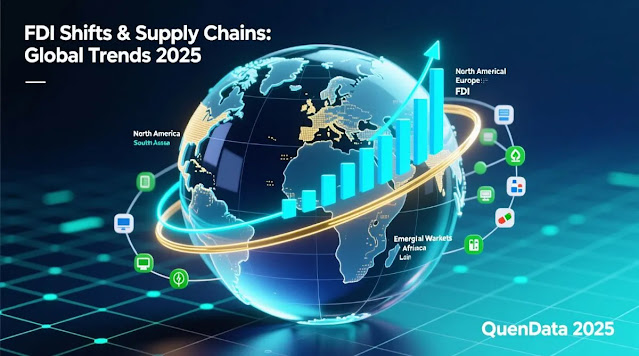
Key Shifts in FDI and Supply Chain Restructuring
Global FDI Decline with Selective Growth:
Research suggests global FDI inflows dipped by about 11% in 2024 when excluding volatile financial hubs, totaling around $1.5 trillion, though sectors like digital infrastructure and green tech saw surges, reflecting a broader pivot toward resilience over pure cost efficiency.
Supply Chain Diversification as a Core Strategy: It seems likely that up to 88% of businesses are planning to reconfigure supply chains in 2025, emphasizing diversification, nearshoring, and localization to mitigate geopolitical risks and disruptions, with a focus on regions like Southeast Asia and Eastern Europe.
Geopolitical and Climate Influences: Evidence leans toward escalating trade tensions, such as U.S. tariffs introduced in 2025, and heightening climate risks driving FDI shifts, potentially reshaping trade corridors and adding costs but enhancing long-term stability.
Rise in Future-Shaping Industries: FDI trends indicate a concentration in AI, semiconductors, EVs, and renewables, accounting for 75% of greenfield announcements from 2022-2025, which could quadruple battery capacity outside China and diversify global tech supply chains.
Regional Winners and Challenges: Developing regions like Southeast Asia saw FDI inflows rise by 10% to $225 billion in 2024, boosted by Chinese investments in greentech, but controversies around labor and environmental impacts highlight the need for balanced policies to ensure equitable benefits.
These shifts underscore a complex landscape where efficiency meets resilience, with opportunities for innovation but risks of fragmentation. For more details, including strategies and examples, see the comprehensive overview below.
Shifts in FDI and Supply Chain Restructuring: Navigating a Changing Global Landscape
Hey there, have you ever wondered why your favorite gadget might suddenly be made in Vietnam instead of China, or why companies are pouring billions into new factories halfway around the world? It’s all tied to shifts in FDI—that’s Foreign Direct Investment for those not in the biz—and the massive restructuring happening in global supply chains. Picture this: just a few years ago, the world was rocked by a pandemic that exposed how fragile our “just-in-time” systems really are. Add in trade wars, climate chaos, and tech booms, and suddenly everyone’s rethinking where they invest and how they source stuff. In this post, we’ll dive into these changes, why they’re happening, and what it means for businesses and economies. I’ll keep it real and conversational, like we’re chatting over coffee, with some real-world examples to make it stick. Let’s get into it.
What Is FDI and Why Does It Matter?
First off, let’s break down FDI. It’s when a company from one country invests in building or buying assets in another—like a U.S. tech giant setting up a factory in India. Unlike just trading goods, FDI involves long-term commitment, creating jobs, tech transfers, and economic ripples.
FDI plays a huge role in supply chains because it shapes where production happens. Think of it as the backbone: strong FDI means robust networks for sourcing materials, manufacturing, and distribution. But lately, shifts in FDI are forcing companies to restructure supply chains for resilience, not just cheap labor. According to recent data, global FDI inflows hit about $1.5 trillion in 2024, but that’s down 11% when you strip out financial hubs like Ireland—showing a cautious world. Yet, in “future-shaping” sectors like AI and renewables, investments are booming, making up 75% of greenfield FDI announcements from 2022 to mid-2025.
Personally, I’ve always found it fascinating how FDI can transform a region. Take my “aha” moment reading about how foreign investments in the 1970s kick-started South Korea’s semiconductor industry—now a global powerhouse. It’s a reminder that these shifts aren’t just numbers; they change lives.
The Big Drivers Fueling Shifts in FDI
So, what’s pushing these changes? It’s a mix of global headaches and opportunities.
Geopolitical Tensions and Trade Wars
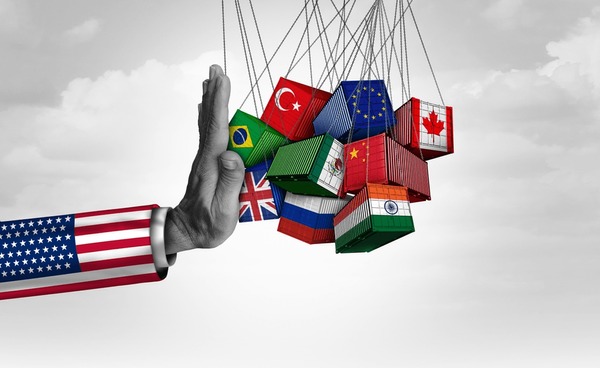
Geopolitics is the elephant in the room. With U.S.-China frictions heating up, companies are diversifying to avoid tariffs and sanctions. In April 2025, the U.S. slapped a 10% baseline tariff on imports from 59 countries, spiking to 50% for some, which could erode manufacturing margins by 20-30%. This is accelerating “friend-shoring,” where investments flow to allied nations.
For instance, the average geopolitical distance of FDI deals dropped 13% since 2017, faster than trade’s decline, as firms like Japanese and European manufacturers pull back from China and pivot to the U.S. and Europe. It’s not all doom—Chinese firms are investing heavily abroad, like $220 billion in greentech projects across 54 countries since 2022, focusing on ASEAN and the Middle East.
Post-COVID Recovery and Resilience Building
COVID-19 was a wake-up call. Supply chains crumbled under lockdowns and shortages, leading to a rethink. Post-pandemic, FDI fell initially due to slowed capex and profits, but now it’s rebounding in resilient setups. Companies are prioritizing diversification to cut over-reliance on any one spot, like China.
A study shows COVID disrupted global value chains, pushing regional supply chains and reducing cross-border exposure. Now, 88% of businesses plan supply chain tweaks in 2025, with 46% diversifying geographically and 37% reducing China dependency.
Climate Change and Sustainability Pressures
Climate risks are no joke—floods, heatwaves, and rising seas threaten hubs. Nineteen of the top 30 global ports face high risk, mostly in Asia-Pacific, potentially disrupting 35% of throughput. This is shifting FDI toward sustainable spots, with green bonds hitting $1.05 trillion in 2024.
Sustainability-linked FDI is rising, like in renewable energy, where announcements doubled to $330 billion annually for low-emissions tech. Companies are embedding climate in decisions, like relocating to low-risk areas.
Technological Advancements and Talent Wars
Tech is a game-changer. AI, robotics, and digital tools are enabling flexible chains. Robotics adoption is surging, with China leading over half of global installations in 2024, boosting productivity up to 50% in autos. But talent shortages—23% of skilled workers want to move abroad—are forcing relocations to hubs like Canada.
Current FDI Trends: A 2024-2025 Snapshot
Strategies for Supply Chain Restructuring: Companies are adapting with smart moves.
Impacts: The Good, the Bad, and the Balanced
How is supply chain restructuring affecting everyday businesses?
Key Citations
- FDI shifts as supply chains move beyond the West
- Foreign direct investment trends in the industries of the future
- World Investment Report 2025: International investment in the digital …
- Supply-chain restructuring: don’t just manage, strategise
- How supply chains need to adapt to a shifting global landscape
- Balancing Cost and Resilience: The New Supply Chain Challenge
- FDI Center featured in Forbes article on global FDI outlook for 2025
- World Investment Report 2025 – UNCTAD
- The effect of COVID-19 on foreign direct investment inflows
- Foreign direct investment and global value chains in the wake of …
- Billion Dollar Factories: Foreign Direct Investment and U.S. …
- Diversifying global supply chains: Opportunities in Southeast Asia
- Impact of Foreign Direct Investment on Export Restructuring and …