- Elon Musk’s xAI Targets $13 Billion Earnings by 2029: The Ultimate Guide to This Ambitious AI Venture
- Introduction
- Why xAI’s Projections Matter
- Opportunities and Risks at a Glance
- Breaking Down xAI’s Financial Projections
- Funding Mechanisms: Debt Sales and Equity Raises
- Massive Investments in Infrastructure
- Implications for the AI Industry and Broader Sectors
- Indian Context: Tapping into a Tech Powerhouse
- Potential Risks and Challenges
- Actionable Guidance for Readers
Elon Musk’s xAI Targets $13 Billion Earnings by 2029: The Ultimate Guide to This Ambitious AI Venture
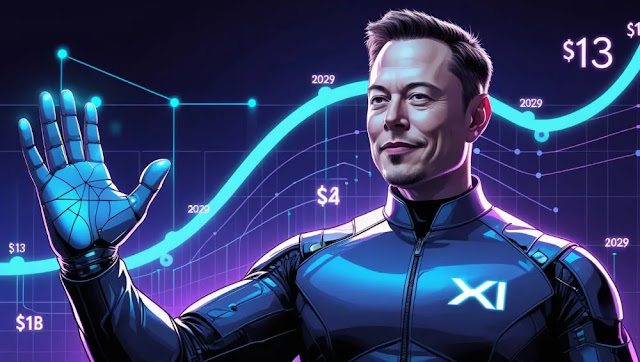
- xAI’s Bold Projections: Research suggests xAI could reach $13.1 billion in EBITDA by 2029, starting from a $341 million loss in Q1 2025, highlighting the high-stakes growth in AI.
- Massive Investments Ahead: The company plans an $18 billion spend on data centres, underscoring the capital-intensive nature of cutting-edge AI development.Funding Strategies: With Morgan Stanley’s backing, xAI has raised $10 billion in debt and equity in 2025, aiming to fuel expansion without diluting ownership excessively.
- Industry Implications: Success could drive breakthroughs in healthcare, climate modelling, and space, but competition from giants like Google and OpenAI poses significant challenges.
- Investor Caution: While promising returns, the current $1 billion monthly burn rate and $13 billion expected losses in 2025 signal risks in this fast-evolving sector.
Introduction
Imagine a world where AI not only chats with you but also unlocks the universe’s deepest secrets. That’s the vision Elon Musk is betting big on with xAI, his latest venture aiming for a staggering $13 billion in annual earnings by 2029. Last updated: September 2025. As costs skyrocket and competition heats up, this projection isn’t just numbers—it’s a bold gamble that could reshape technology. In this post, we’ll dive into the details, from financials to real-world impacts, helping you understand if this is the next big thing or a high-risk play.
Why xAI’s Projections Matter
xAI, founded by Elon Musk in 2023, focuses on understanding the universe through advanced AI. Its flagship product, Grok, competes with models like ChatGPT. The recent disclosures via Morgan Stanley reveal a path to profitability that’s aggressive yet grounded in massive scaling. For investors and enthusiasts, this transparency—rare for a private firm—signals confidence amid AI’s boom.
Key financial highlights include a shift from losses to multi-billion earnings, backed by strategic funding. But with a $1 billion monthly burn, it’s a reminder that AI success demands deep pockets.
Opportunities and Risks at a Glance
Opportunities abound: xAI’s growth could spur innovations in various sectors, creating jobs and tools for everyday use. Risks, however, include technological hurdles and regulatory scrutiny. It seems likely that xAI’s unique focus on scientific discovery will help it stand out, but economic factors could sway outcomes.
For more on AI funding trends, check our internal guides: How AI Startups Raise Billions and Elon Musk’s Tech Empire Overview. Externally, see Bloomberg’s AI reports or Reuters for market insights.
Elon Musk’s xAI is making headlines with its audacious financial projections, positioning itself as a formidable player in the artificial intelligence landscape. This comprehensive analysis explores the intricacies of xAI’s strategy, from its revenue forecasts and investment plans to the broader implications for industries, investors, and global economies. Drawing on recent reports from June and July 2025, we’ll unpack the numbers, challenges, and potential transformative effects, while providing practical insights for readers across demographics.
Breaking Down xAI’s Financial Projections
xAI’s financial roadmap, as detailed in Morgan Stanley documents shared with investors, paints a picture of rapid ascent in a capital-hungry industry. Launched in 2023, the company has quickly ramped up operations, leveraging Musk’s ecosystem, including integrations with X (formerly Twitter).
Revenue and Earnings Trajectory
The projections indicate a steep growth curve:
| Year | Gross Revenue | EBITDA |
|---|---|---|
| 2025 (Q1 actual) | $52 million | -$341 million |
| 2025 (full year projected) | $1 billion | Not specified (but overall losses expected at $13 billion) |
| 2027 | Not specified | $2.7 billion |
| 2029 | $14 billion | $13.1 billion |
This table illustrates the transition from early-stage losses to profitability. Starting with modest Q1 2025 revenue of $52 million, xAI anticipates hitting $1 billion by year-end, scaling to $14 billion by 2029. EBITDA, a key profitability metric, is expected to flip from negative to $2.7 billion in 2027 and soar to $13.1 billion by 2029. These figures reflect optimism in AI adoption, particularly through products like Grok, which could generate recurring revenue via subscriptions and enterprise integrations.
However, the path isn’t smooth. Independent estimates from Sacra in July 2025 peg xAI’s annualized revenue at $3.2 billion, combining xAI and X operations, suggesting the projections might be achievable if synergies hold. Contrasting reports mention alternative figures, such as $500 million in 2025 rising to $19 billion by 2029, but the Morgan Stanley-backed numbers appear more conservative and credible.
Cash Flow and Burn Rate Insights
Cash management is critical in AI, where upfront costs dominate. xAI’s burn rate stands at approximately $1 billion per month as of June 2025, leading to projected losses of $13 billion for the full year. This stems from heavy investments in talent, compute power, and infrastructure. Despite this, the company aims for profitability by 2027, outpacing rivals like OpenAI, which targets 2029.
To illustrate, consider the cash flow dynamics: Initial outflows for R&D and data centres are offset by scaling revenues from AI services. If xAI mirrors Tesla’s trajectory—where Musk turned early losses into profits through innovation—it could validate these projections.
Funding Mechanisms: Debt Sales and Equity Raises
xAI’s approach to financing emphasises debt to preserve equity control, a strategy Musk has used successfully elsewhere.
The $5 Billion Debt Sale and Beyond
In June 2025, Morgan Stanley marketed a $5 billion debt package, including bonds and loans, to support xAI’s operations and X platform. By July, this expanded to $10 billion total, split evenly between debt and equity. Investors committing $50 million or more gained access to detailed financials, enhancing transparency.
A debt sale works like this: xAI borrows funds, repaying with interest over time. This avoids diluting ownership, unlike equity rounds. Morgan Stanley’s involvement lends credibility, as seen in the successful close with additional banks like those in a last-minute twist.
[Flowchart Description: Investor commits funds -> Morgan Stanley allocates -> xAI receives capital -> Invests in data centres and AI R&D -> Generates revenue -> Repays debt with interest.]
Additionally, a $300 million share sale in June targeted a $113 billion valuation, further bolstering liquidity.
Comparisons to Industry Peers
xAI’s funding mirrors the AI arms race. OpenAI’s $6.6 billion round in 2024 valued it at $157 billion, while Anthropic secured $4 billion from Amazon. xAI’s $10 billion raise in 2025 positions it competitively, but its $200 billion valuation target in July talks signals even greater ambition.
Massive Investments in Infrastructure
At the heart of xAI’s strategy is a $18 billion commitment to data centres, following $2.6 billion already spent. This includes the Colossus supercomputer, scaling to 1 million GPUs for unparalleled compute power.
Data Centre Expansion Plans
xAI is eyeing global sites, including potential in Saudi Arabia for energy-efficient operations. A $12 billion debt sought in July specifically funds Colossus 2, with chips online soon. These investments are essential for training advanced models, but they amplify risks if delays occur.
For context, Nvidia’s dominance in GPUs means xAI’s costs could fluctuate with chip prices. A table of AI infrastructure costs:
| Company | Investment Focus | Estimated Spend (2025-2029) |
|---|---|---|
| xAI | Data centres & GPUs | $18 billion |
| OpenAI | Compute partnerships | $10-15 billion (est.) |
| In-house TPUs | $20+ billion (annual capex) |
This highlights xAI’s aggressive stance.
Implications for the AI Industry and Broader Sectors
If xAI hits its targets, it could redefine AI standards, drawing more capital and talent. Its emphasis on scientific discovery—beyond consumer chatbots—promises breakthroughs.
Sector-Specific Impacts
- Healthcare: Faster drug development via AI simulations, akin to how AlphaFold revolutionised protein folding.
- Climate Change: Enhanced modelling for predictions, aiding global efforts.
- Space Exploration: Advanced planning for missions, synergising with SpaceX.
[Icons Description: Healthcare (stethoscope with AI chip), Environment (globe with green tech), Space (rocket with neural network).]
For professionals, this means new tools; for students, career paths in AI.
However, competition is fierce. Google, Microsoft, and OpenAI dominate with established ecosystems. xAI must differentiate through unique applications or partnerships, like potential ties with Tesla for autonomous driving data.
Regulatory hurdles are mounting. Governments are scrutinising AI for ethics, bias, and job displacement. Economic factors, such as interest rates, could dampen investor sentiment.
Investor Perspectives: Opportunities vs. Risks
The $13.1 billion EBITDA projection by 2029 suggests hefty returns, but the $18 billion capex and current losses underscore volatility. Musk’s public persona, including disputes, might sway confidence, though its impact is uncertain.
A balanced view: While xAI’s trajectory outpaces some peers in profitability timing, external shocks like market downturns pose threats.
Indian Context: Tapping into a Tech Powerhouse
India’s vibrant tech scene stands to gain from xAI’s rise. With over 3,000 AI startups, the country is a hotbed for innovation. Companies like Niramai (AI for early cancer detection) and Haptik (conversational AI) exemplify this.
xAI’s advancements could inspire collaborations, attracting Indian talent—home to millions of engineers. For instance, a Bengaluru researcher like Priya might contribute to xAI projects, fostering global exchanges.
Indian businesses could adopt xAI tech for supply chain optimisation or customer service chatbots, boosting efficiency. If xAI establishes an Indian presence, it could leverage local data centres for cost-effective scaling.
Potential table of Indian AI opportunities:
| Sector | Indian Example | Potential xAI Synergy |
|---|---|---|
| Healthcare | Niramai | Joint drug discovery tools |
| Finance | Paytm AI features | Enhanced fraud detection |
| Logistics | Delhivery | AI-optimised routing |
This could create thousands of jobs, aligning with India’s digital economy push.
Potential Risks and Challenges
Achieving these goals involves navigating multiple hurdles:
- Technological Risks: AI development is complex; failures in model training could delay milestones.
- Competitive Landscape: Standing out requires innovation, perhaps via open-source elements or novel applications.
- Regulatory Environment: Global AI laws, like EU’s AI Act, could impose restrictions.
- Capital Expenditure: The $18 billion data centre plan risks over-leveraging if revenues lag.
- Market Conditions: Rising rates or recessions might curb funding.
Musk’s track record—with Tesla and SpaceX—offers reassurance, but AI’s unpredictability adds layers.
Additional table on risks:
| Risk Type | Description | Mitigation Strategy |
|---|---|---|
| Technological | Delays in AI breakthroughs | Invest in R&D talent |
| Competitive | Market saturation | Focus on unique scientific AI |
| Regulatory | New laws | Engage policymakers early |
| Financial | High burn rate | Secure diverse funding |
| Economic | Volatility | Diversify revenue streams |
Despite these, xAI’s momentum suggests resilience.
Actionable Guidance for Readers
Engage with this development proactively:
For Students
- Enrol in AI courses on platforms like Coursera or Udemy for machine learning basics.
- Track xAI updates via their website or X feeds.
- Join hackathons to build AI projects, gaining practical experience.
For Professionals
- Assess how AI transforms your field—e.g., logistics pros might explore AI for predictive analytics.
- Attend conferences like NeurIPS for networking.
- Consider AI investments, but diversify; research via sites like Seeking Alpha.
For Everyone
- Subscribe to newsletters like The Batch from DeepLearning.AI.
- Join discussions on Reddit’s r/MachineLearning or X about AI ethics.
These steps can position you to benefit from AI’s evolution.
Conclusion: A Bold Bet on AI’s Future
xAI’s projection of over $13 billion in annual earnings by 2029 represents a visionary push in AI, backed by substantial investments and strategic financing. While challenges like competition and regulation persist, the potential for global impact—in tech, healthcare, and beyond—is immense, including for India’s thriving ecosystem.
As Musk converges leadership, investment, and technology, this journey offers a compelling case study. Whether you’re investing, learning, or simply curious, stay engaged—subscribe to our blog for more AI insights and share your thoughts in the comments below.
Key Citations:
- Reuters: Musk’s xAI expects annual earnings over $13 billion by 2029
- Bloomberg: Elon Musk’s xAI Is Burning Through $1 Billion a Month
- Seeking Alpha: Elon Musk’s xAI expected to generate $13B in annual earnings by 2029
- Reuters: Musk’s xAI raises $5 billion each in fresh debt and equity
- AInvest: Elon Musk’s xAI Secures $10B at $200B Valuation